Gland packing and mechanical seals both stop liquid escaping where a pump shaft leaves the casing. Gland packing squeezes soft braided rings around the shaft and must drip slightly to stay cool. A mechanical seal presses a spinning face against a fixed face and runs on a microscopic film, with no visible leakage. Packing is cheaper; seals leak less and use less power.
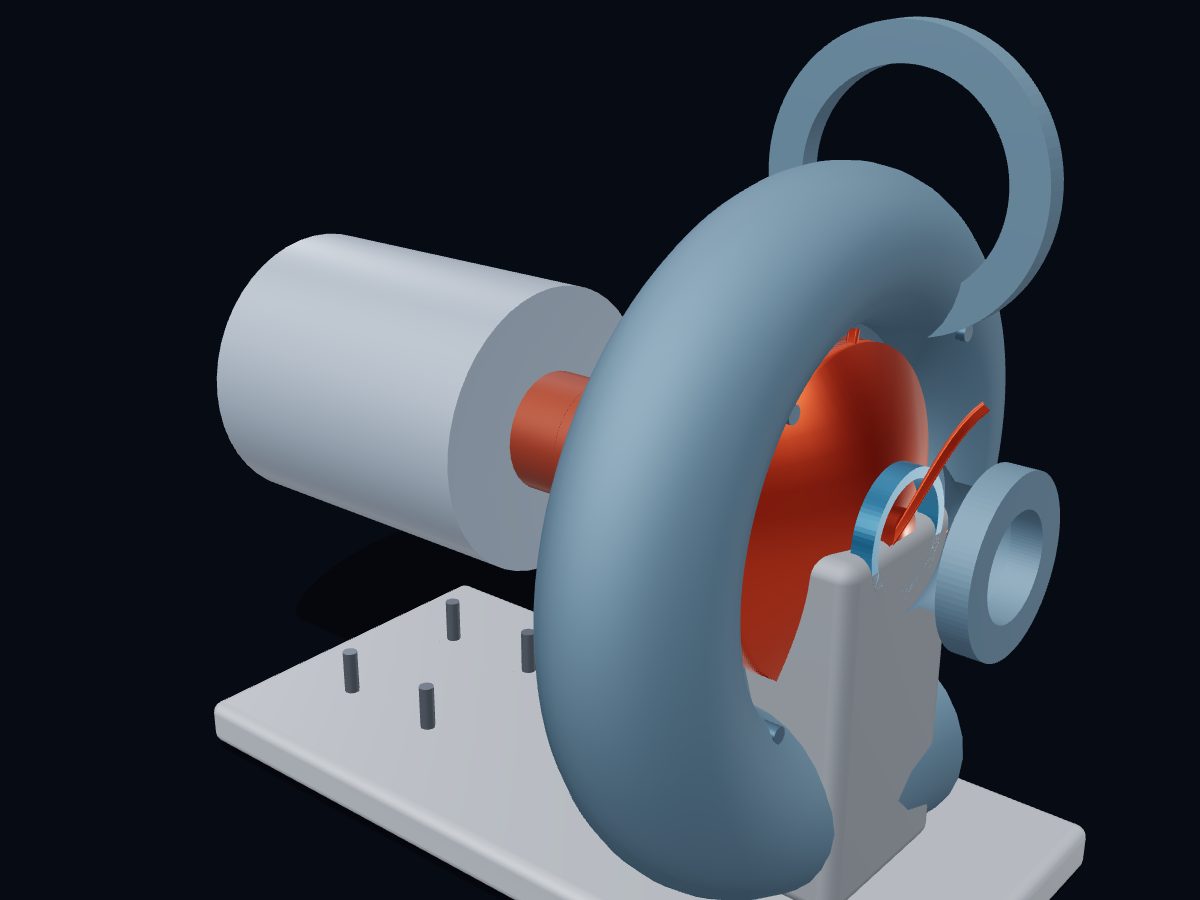
Every centrifugal pump has this problem: a turning shaft has to pass through a casing full of liquid under pressure. You can see the shaft, impeller and seal area of a pump in the Engine-X centrifugal pump 3D model. Which seal sits there decides how much the pump drips, how much power it wastes and how often a fitter has to touch it.
How does gland packing work?
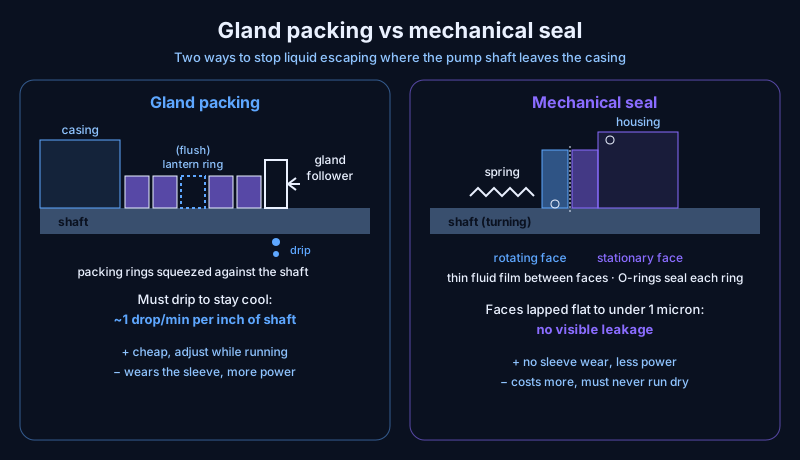
Gland packing works by squeezing rings of soft, braided packing into a space around the shaft called the stuffing box. A gland follower, pulled in by two nuts, compresses the rings so they press against the shaft.
- Several packing rings sit in the stuffing box around the shaft or its sleeve.
- A lantern ring in the middle can feed clean flush water to the packing.
- The gland follower is tightened until leakage drops to a steady drip.
- The drip lubricates and cools the packing where it rubs on the shaft.
That drip is deliberate. AESSEAL gives a target of about 1 drop per minute per inch (25 mm) of shaft diameter, so about 2 drops a minute on a 50 mm shaft, roughly 450 litres a month. Tighten too much and the packing can burn at start-up and wear the sleeve; too loose and it leaks heavily. Gore suggests logging the drip rate and stuffing box temperature when new packing goes in, and replacing it when the temperature difference rises 25% above that baseline or the drip can no longer be controlled.
How does a mechanical seal work?
A mechanical seal works by pressing two very flat rings together: one fixed to the shaft and turning with it, the other fixed in the housing. EagleBurgmann lists five basic parts: a rotating ring, a stationary ring, a spring, and two secondary seals (usually O-rings) that seal each ring to the shaft or the casing.
- Seal faces: lapped flat to less than 1 micron, in carbon, ceramic or carbide, according to the Fluid Sealing Association.
- Fluid film: the pumped liquid forms a very thin film between the faces that lubricates them.
- Spring: keeps the faces closed at start-up and as they wear.
- Secondary seals: at least one must be able to move, to allow for misalignment, thermal growth and shaft end-play.
The film is the clever part. Leakage rises with the cube of the film thickness, so the gap is kept at a working minimum. Too thick and the seal leaks and lets particles in; too thin and the faces overheat. That is why a mechanical seal must never run dry, and why air must be vented from the seal chamber of vertical pumps.
Mechanical seal vs gland packing: which is better?
Neither is better for every pump; each wins on different things:
| Gland packing | Mechanical seal | |
|---|---|---|
| How it seals | Soft rings squeezed around the shaft | Two lapped faces on a thin fluid film |
| Leakage | Designed to drip (about 1 drop/min per inch of shaft) | No visible leakage when fitted correctly |
| Shaft wear | Wears the shaft or sleeve | No sleeve wear |
| Power | Higher friction; AESSEAL says about 6× a balanced seal | Lower |
| Adjustment | Can be tightened while running | None; replaced when worn |
| Cost | Low to buy | Higher to buy |
| Failure | Gradual, more drip | Can be sudden if faces crack or run dry |
AESSEAL makes mechanical seals, so its savings figures are a seller's numbers, but the mechanics behind them are standard. It also points out where packing still makes sense: maintenance crews know it, it can be adjusted with the pump running, and it is used on fire pumps where a sudden seal failure is unacceptable. The drip also lands near the bearings, and AESSEAL cites a study that 0.002% water in oil can nearly halve rated bearing life.
How do you know when to replace packing or a seal?
You replace packing when the drip can no longer be controlled by the gland, the packing extrudes or turns hard, or the stuffing box runs hot, says the Fluid Sealing Association. A mechanical seal is replaced when it starts to leak visibly, since it has no adjustment. For a pump that also cavitates or vibrates, fix that first: shaft movement kills both kinds of seal, as explained in pump cavitation and NPSH and the bearing types guide.
The engineering takeaway
Gland packing seals by squeezing and must drip to survive; a mechanical seal seals with two flat faces and a film too thin to see. Packing is cheap, familiar and adjustable while running, but wastes liquid, power and sleeves. A mechanical seal costs more and hates running dry, but leaks almost nothing. To see where the seal sits on a pump shaft, open the 3D centrifugal pump in the Engine-X atlas.