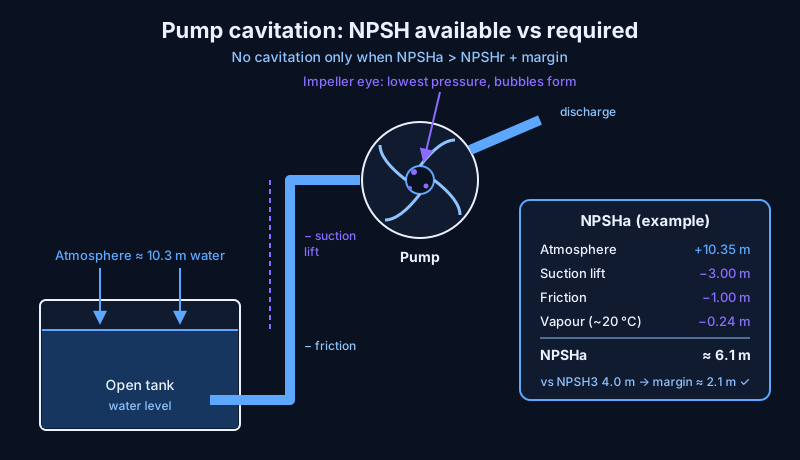
Pump cavitation is the formation of vapour bubbles inside a pump when the pressure at the impeller inlet falls below the liquid's vapour pressure, followed by the bubbles collapsing as pressure rises again. Whether a centrifugal pump cavitates depends on one comparison: the suction head the system supplies (NPSHa) against the suction head the pump needs (NPSHr).
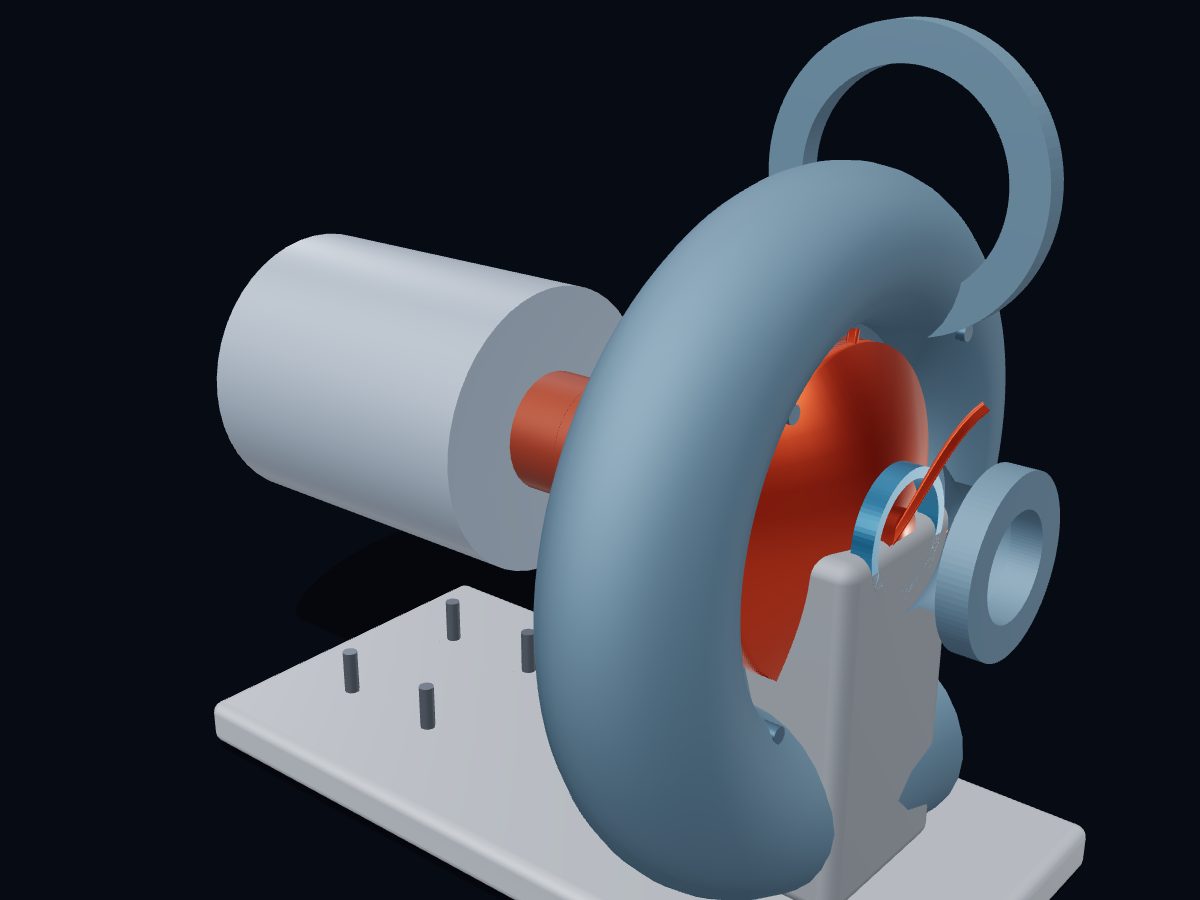
The warning signs are hard to miss. Atlas Copco describes a noise like rocks being pumped, heavy vibration and falling performance. If you want to see where the impeller eye and volute sit before reading on, the Engine-X centrifugal pump guide shows the parts in 3D.
Why does a centrifugal pump cavitate?
A centrifugal pump cavitates because the lowest pressure in the whole system sits right at the impeller eye, where the liquid enters the vanes. Liquid speeds up as it enters the impeller, and faster liquid has lower static pressure.
If that pressure drops below the liquid's vapour pressure at its temperature, the liquid boils — even if it is only cold water.
The damage happens a moment later. The impeller then raises the pressure, and the vapour bubbles collapse almost instantly. Each collapse sends a small, sharp pressure shock into the nearby metal. Repeated millions of times, those jets cause pitting, cracking and chipping of the impeller, and the vibration that comes with them wears seals and bearings early, as Atlas Copco notes.
What is NPSH available (NPSHa)?
NPSH available (NPSHa) is the total head at the pump suction, in absolute terms, above the vapour pressure of the liquid. NPSH stands for net positive suction head. NPSHa is a property of the system — the tank, the pipes and the liquid — not of the pump. Pumps & Systems breaks it into five terms:
- Pressure head on the liquid surface. For an open tank this is atmospheric pressure. At sea level, 14.7 psi equals about 34 ft, or roughly 10.3 m of water.
- Static head. Added when the liquid level is above the pump centreline (flooded suction), subtracted when the pump sits above the liquid (suction lift).
- Friction losses. Subtracted. Longer pipes, smaller diameters, more bends and valves, and higher flow all increase them.
- Velocity head at the suction port. Added, but usually small.
- Vapour pressure head of the liquid at its pumping temperature. Subtracted. Hotter liquid has a higher vapour pressure, so the same system gives less NPSHa.
What is NPSH required (NPSHr) and NPSH3?
NPSH required (NPSHr) is the minimum suction head a pump needs to run at a given flow and speed, set by the manufacturer from test data. In practice, pump curves usually plot NPSH3: the NPSHa at which the pump's head drops by 3% because of cavitation.
According to the Hydraulic Institute, this definition dates from 1932, when a 3% drop was the smallest change that could be measured reliably.
The key point engineers miss is that NPSH3 is not a cavitation-free point. At NPSH3 the pump is already cavitating enough to lose 3% of its head, and bubbles start forming at higher suction pressures than that. The Hydraulic Institute adds that today's faster, higher-energy pumps often need a bigger margin above NPSH3 to reach an acceptable life.
How do you calculate NPSH available? A worked example
NPSH available is calculated by adding up the five terms for the actual installation. Take a pump drawing cold water (about 20 °C) from an open tank at sea level:
| Term | Value |
|---|---|
| Atmospheric pressure head | +10.35 m |
| Suction lift (pump 3 m above water level) | −3.00 m |
| Friction loss in suction pipe and fittings | −1.00 m |
| Vapour pressure head of water at ~20 °C (0.34 psia) | −0.24 m |
| Velocity head (ignored here) | ≈ 0 |
| NPSHa | ≈ 6.1 m |
If the pump curve shows NPSH3 = 4.0 m at the duty flow, the margin is about 2.1 m. Pumps & Systems gives a common rule of thumb: a margin of at least 3.3 ft (about 1 m) or 10% of NPSHa, whichever is greater. Here that means at least 1 m, so this installation passes.
Now move the same pump 3 m higher, to a 6 m suction lift. NPSHa falls to about 3.1 m — below the 4.0 m NPSH3 — and the pump will cavitate badly. Nothing about the pump changed; only the system did.
How do you stop a pump from cavitating?
You stop a pump from cavitating by raising NPSHa, lowering NPSHr, or both:
- Lower the pump or raise the liquid level to cut suction lift, or give it a flooded suction.
- Make the suction pipe larger and shorter, with fewer bends and fully open valves. A partly closed suction valve is a classic cause.
- Clean suction strainers and filters, since a clogged strainer adds friction loss.
- Cool the liquid or pressurise the tank when pumping hot liquids.
- Reduce speed or flow, as Atlas Copco suggests, and run the pump near its best efficiency point (BEP). The Hydraulic Institute notes that running outside the preferred operating region increases the NPSH margin a pump needs.
The engineering takeaway
Cavitation is a system problem that shows up as pump damage. The impeller only fails where the suction side is starved, so the fix is usually in the piping, the liquid level or the temperature, not in replacing the pump. Before blaming a noisy pump, add up NPSHa and compare it with the NPSH3 on the curve — with a margin. For the bigger picture of when a different pump type suits better, see centrifugal vs positive displacement pumps, and for another machine that lives on its intake conditions, read how a ship's turbocharger feeds a two-stroke engine.