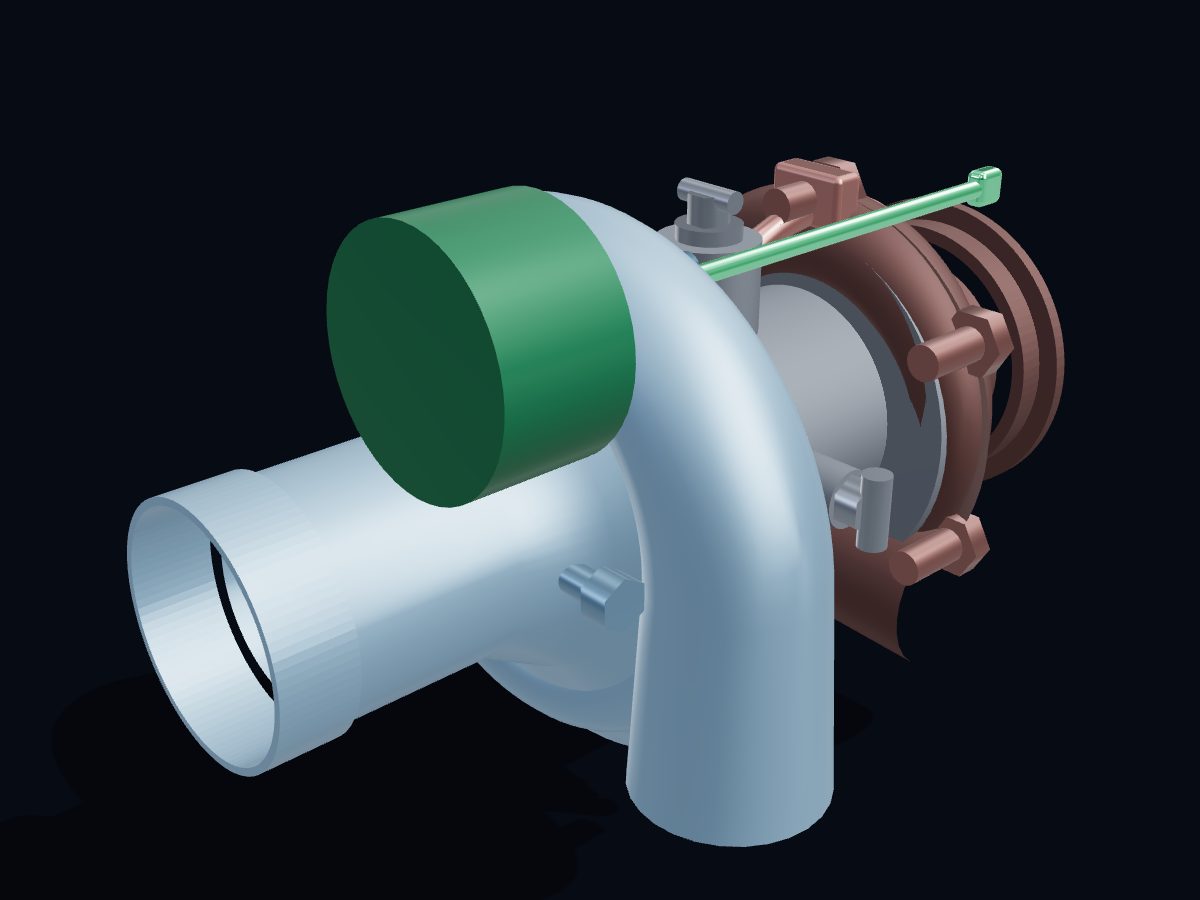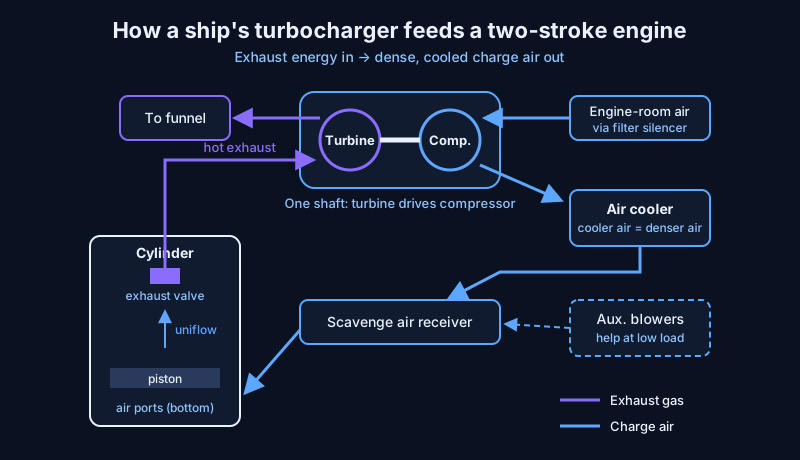
A ship's turbocharger is an exhaust-driven air pump: exhaust from the main engine spins a turbine, which drives a compressor on the same shaft to force dense air back into the engine. On a large two-stroke marine diesel, this air also pushes burnt gas out of each cylinder and refills it for the next stroke.
Turbochargers on modern container ships, tankers and bulk carriers are serious machines. Accelleron's A100-L and A200-L series, for example, is built for low-speed two-stroke engines from 3,000 kW to 28,000 kW, with turbocharger efficiency of up to 75%. If you want to see the basic parts first, the Engine-X turbocharger guide shows them in 3D.
How does a ship turbocharger work?
A ship turbocharger works by recovering energy that would otherwise leave through the funnel. The exhaust gas leaving the cylinders is still hot and under pressure, so the turbocharger uses it in three steps:
- Turbine side. Exhaust from the engine's exhaust receiver flows through the turbine and spins it at high speed, then leaves for the funnel.
- Shaft. The turbine wheel and the compressor wheel sit on one rotor shaft, so the turbine's power goes straight to the compressor.
- Compressor side. The compressor (crew usually call it the blower) draws in engine-room air through a filter silencer and compresses it.
The compressed air then goes to the scavenge air receiver, a large manifold running along the engine that feeds every cylinder. The more fuel the engine burns, the more exhaust energy there is, so the turbocharger speeds up and delivers more air — the system follows the engine load by itself.
What is scavenging in a two-stroke marine engine?
Scavenging in a two-stroke marine engine is the process of pushing exhaust gas out of the cylinder and replacing it with fresh charge air. A two-stroke engine has no separate exhaust and intake strokes, so it relies completely on the turbocharger's air pressure to do this exchange near the bottom of each piston stroke.
Modern large engines use uniflow scavenging, as Maritime Page explains: air enters through ports around the bottom of the cylinder liner, and exhaust leaves through a single exhaust valve in the cylinder cover. The air sweeps upward in one direction, carrying burnt gas, unburnt fuel and carbon out through the valve. Older cross-flow and loop designs had both sets of ports in the liner and struggled to clear carbon, so uniflow replaced them.
This is why the turbocharger matters more on a two-stroke than on a car engine. Without enough scavenge air pressure, burnt gas stays in the cylinder, combustion gets worse, and exhaust temperatures climb.
Why does a ship's engine cool the charge air?
The ship's engine cools the charge air because compression heats it up, and hot air is less dense. A scavenge air cooler is a heat exchanger between the turbocharger and the scavenge receiver, cooled by fresh water. Cooler air packs more oxygen into the same cylinder volume, so more fuel can be burnt cleanly in each stroke.
Maritime Page notes that the cooling water pressure should be watched to protect the cooler tubes from thermal damage. From a dry dock point of view, the cooler is a heat exchanger like any other: its tube bundle is cleaned, inspected and pressure-tested when the ship comes in.
Why do marine engines need auxiliary blowers?
Marine engines need auxiliary blowers because a turbocharger only gives as much air as the exhaust can pay for. At starting, manoeuvring and low load, the exhaust is too weak, so electric auxiliary blowers push extra air into the scavenge receiver.
According to Maritime Page, the blowers typically cut in at about 0.35 bar scavenge pressure and stop at about 0.45 bar, when the turbocharger can hold pressure alone. Non-return flaps stop the air flowing backwards through the stopped blowers.
| Engine condition | Who supplies scavenge air |
|---|---|
| Starting and manoeuvring | Auxiliary blowers + turbocharger |
| Low load | Auxiliary blowers help the turbocharger |
| Normal sea load | Turbocharger alone |
How do crews keep a marine turbocharger clean?
Crews keep a marine turbocharger clean by washing it while the engine runs, because both sides foul in service. The turbine side collects soot and carbon from combustion, and the compressor side collects oil mist and dirt from engine-room air.
A fouled turbocharger gives less scavenge air, which raises exhaust temperatures and fuel consumption and, in bad cases, can lead to surging.
Accelleron's cleaning guidance gives typical intervals:
| What is cleaned | Method | Typical interval |
|---|---|---|
| Two-stroke turbine | Dry cleaning — granules blown in with compressed air, at normal load | Every 25–50 hours |
| Compressor (blower) | Wet cleaning — water sprayed in at 25–85% load | Every 25–100 hours |
Dry cleaning works by impact: the hard granules knock deposits off the turbine nozzle ring and blades. Because no cold water hits the hot turbine, there is no thermal shock, so the engine does not need to slow down. Marine Insight notes that when a turbine is wet-washed, engine speed is first reduced until the exhaust inlet temperature is below about 420 °C, and the turbine is dried afterwards.
The air filter also needs attention. Accelleron recommends checking the filter silencer when the pressure loss across it passes 30 mbar, measured with a simple U-tube manometer — a cheap check that protects the whole compressor stage. Exhaust leaks should also be fixed quickly, because exhaust particles pulled into the compressor build up layers on the wheel and diffuser.
The engineering takeaway
A marine turbocharger is a closed energy loop: exhaust heat drives the turbine, the turbine drives the compressor, and the compressor's cooled air scavenges and fills the cylinders so the engine can burn the next charge of fuel. The same idea runs through other waste-heat machines too, like the sCO2 bottoming cycle Engine-X covered earlier. For a ship, the practical lesson is simple — keep the loop clean and leak-free, and the turbocharger keeps paying for itself in fuel. Want to compare it with other ways of boosting an engine? See turbocharger vs supercharger.