A Denver startup called American Supercritical has come out of stealth with $8 million in pre-seed funding and a simple pitch: bolt a factory-built "power block" onto the exhaust of a simple-cycle gas turbine and make up to 50% more electricity without burning any extra fuel.
Instead of the usual steam equipment, the block uses carbon dioxide as its working fluid.
Those are the company's own claims, and I could not find published operating data from a commercial installation yet. But the mechanism behind them is real engineering, and it is worth understanding.
Where does a gas turbine waste heat?
A gas turbine wastes heat in its hot exhaust. A simple-cycle gas turbine sucks in air, compresses it, burns fuel and expands the hot gas through a turbine. After the turbine, the exhaust still leaves at several hundred degrees Celsius.
In a combined-cycle plant, that heat is captured by a heat recovery steam generator (HRSG), which boils water to drive a second, steam turbine. Simple-cycle units skip all that, so the heat goes up the stack. The company says about 140 GW of such turbines operate in the US.
What is supercritical CO₂?
Supercritical CO₂ is CO₂ held above its critical point, where it is neither a clean liquid nor a gas. Every fluid has a critical point. For CO₂ it is roughly 31 °C and 7.4 MPa (about 74 bar). Above both, CO₂ is no longer cleanly a liquid or a gas.
It is a dense, compressible fluid that flows like a gas but is far denser than any gas.
That density is the trick. Steam at low pressure is very thin, so steam turbines and condensers must be huge. Dense CO₂ packs a lot of energy into a small volume, so the turbine, heat exchangers and piping shrink. American Supercritical says its block needs about one-tenth the space of a comparable steam system.
How does an sCO₂ power loop work?
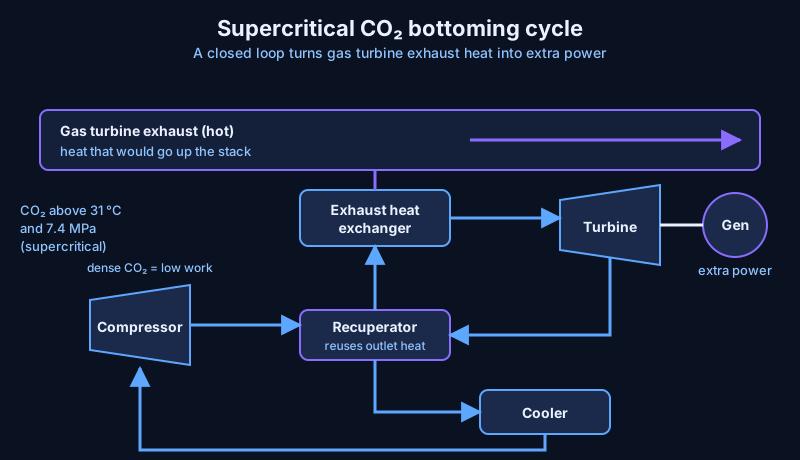
An sCO₂ power loop is a closed Brayton cycle, the same thermodynamic idea as the gas turbine itself, but the CO₂ never leaves the loop:
- Compress. A compressor raises the cooled CO₂ to very high pressure. Because the fluid is dense, close to liquid-like, this takes much less work than compressing a thin gas. Less compression work means more net power at the shaft.
- Pre-heat (recuperator). The compressed CO₂ picks up heat from the turbine's own outlet stream through a heat exchanger. This recycles heat that would otherwise be thrown away.
- Heat from the exhaust. The CO₂ then passes through a heat exchanger in the gas turbine exhaust and rises to the top temperature of the loop.
- Expand. The hot, high-pressure CO₂ spins a turbine connected to a generator.
- Cool. After giving heat to the recuperator, the CO₂ goes through a cooler and returns to the compressor inlet, close to the critical point, and the cycle repeats.
Because the loop only borrows heat from the exhaust stream through a heat exchanger, the gas turbine itself is not changed. The company says no turbine modifications or extra permitting are needed.
Has sCO₂ power worked at pilot scale?
Yes. The best public evidence is not from the startup. The STEP Demo, a 10 MWe pilot led by GTI Energy at Southwest Research Institute in San Antonio, ran a simple sCO₂ cycle in 2024. Its turbine reached 27,000 rpm at 500 °C and about 250 bar and delivered around 4 MWe to the grid.
The next phase was planned to move to a more efficient recompression cycle at 715 °C. That shows the turbomachinery is real; it does not prove the startup's 50% number.
The engineering takeaway
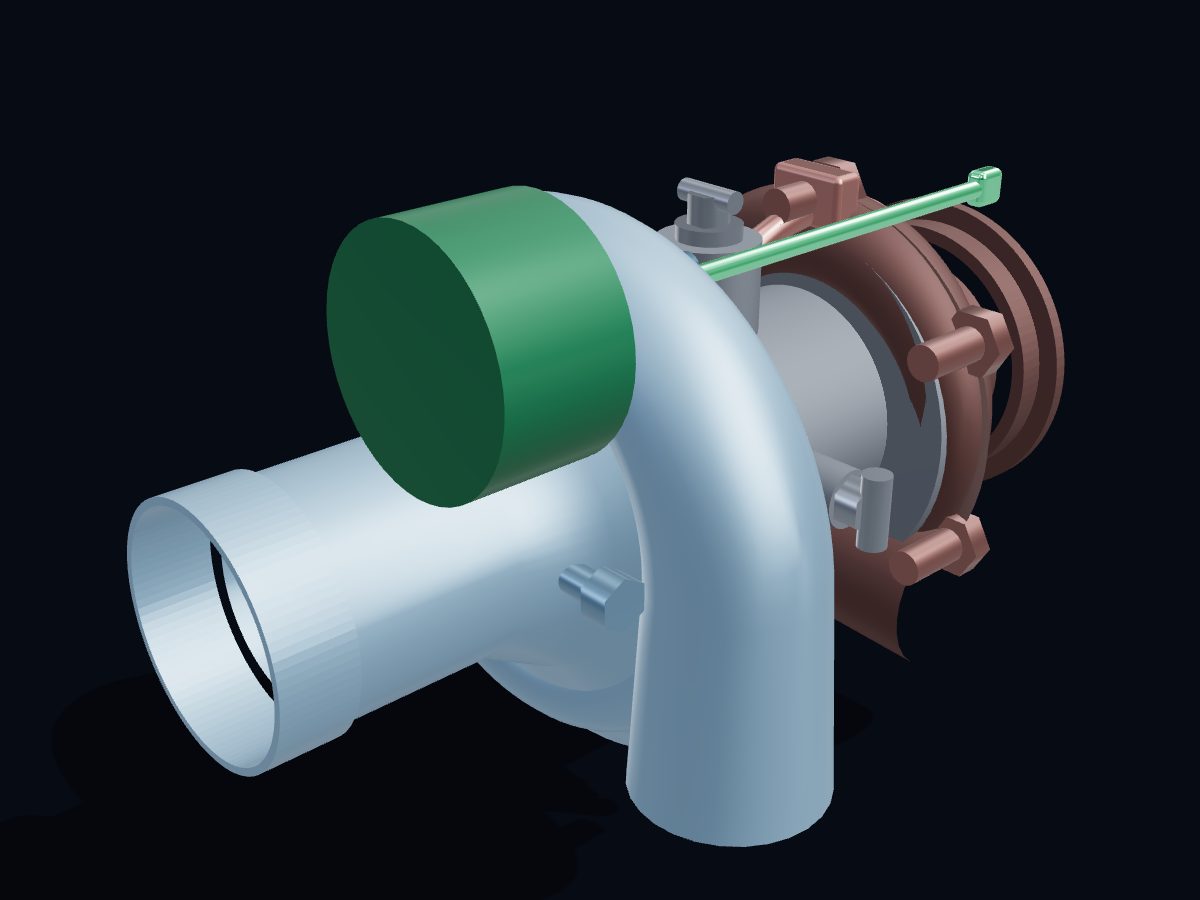
From the dry-dock side, my instinct is to ask about the unglamorous parts: seals on a shaft running tens of thousands of rpm, corrosion at 250 bar, and heat exchangers that must survive thermal cycling. Dense, high-pressure fluids are unforgiving when something leaks. The thermodynamics favours CO₂ clearly. Whether it wins depends on how the hardware lasts in the field, and that is where the first real operating data will matter. The everyday machine that already turns exhaust energy into useful work is the turbocharger; see its turbine and compressor sharing one shaft in the turbocharger 3D guide.
 Turbocharger
 Centrifugal Pump
 V-Belt Pulley Drive
 Helical Gear Reducer
 Marine Diesel Engine
 Plate Heat Exchanger
 Reciprocating Air Compressor
 Planetary Gearbox