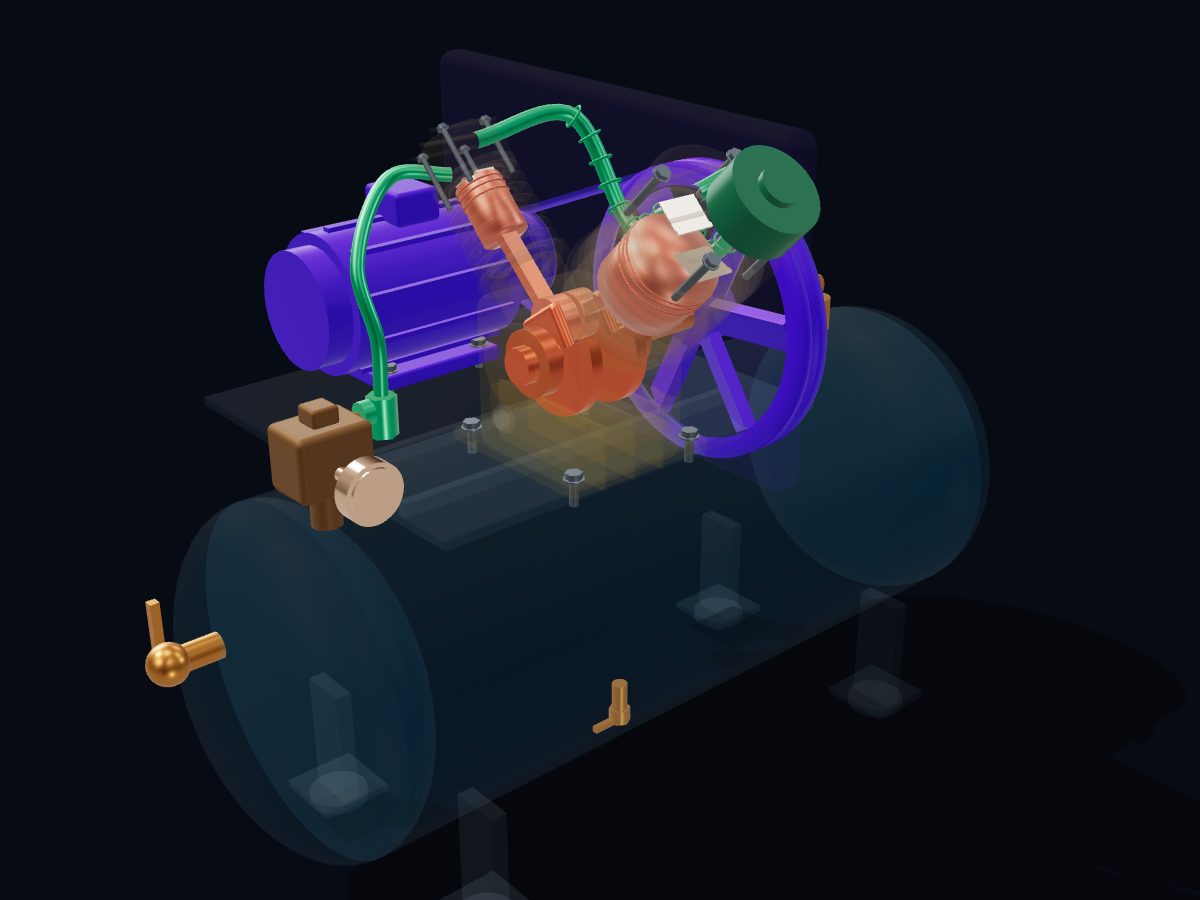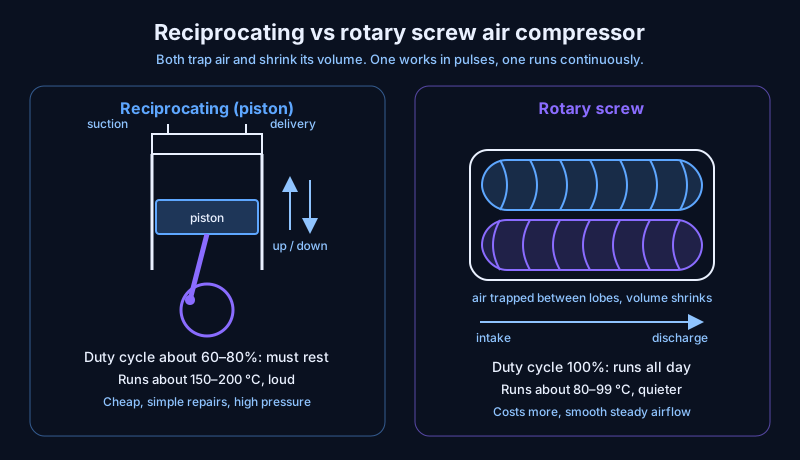
A reciprocating (piston) air compressor and a rotary screw air compressor both push air into a tank, but they suit different jobs. A piston compressor is cheaper, simple to repair and reaches 12 bar easily, but it is rated for only 60–80% duty. A rotary screw runs all day at 100% duty, cooler and quieter.
Almost every workshop, garage and ship-repair yard runs on compressed air: impact guns, grinders, sandblasting, paint guns and pneumatic valves. Choosing the wrong compressor shows up fast as hot, wet air, a motor that never stops, or a machine so loud it has to live outside. You can see every part of a two-stage piston machine moving in the new Engine-X reciprocating air compressor 3D model, and the air compressor guide covers the valve timing and interstage pressure maths.
How does a reciprocating air compressor work?
A reciprocating air compressor squeezes air with a piston moving up and down in a cylinder, driven by a crankshaft, the same way an engine works in reverse. A reed valve is a thin spring-steel flap that opens only when the pressure on one side is higher than the other.
- On the downstroke, the piston draws air in through the suction reed valve.
- On the upstroke, both valves stay shut and the air is squeezed into a smaller and smaller space.
- When the cylinder pressure beats the pressure in the tank line, the delivery valve opens and the air is pushed out.
- In a two-stage machine, a big first cylinder compresses to about 2.6 bar, an intercooler cools the air, and a small second cylinder takes it to about 12 bar (175 psi), as in the Engine-X model.
The piston delivers air in pulses, so a receiver tank evens out the flow and lets the motor stop when the tank is full.
How does a rotary screw air compressor work?
A rotary screw air compressor squeezes air between two long rotors with interlocking helical lobes that turn against each other inside a close-fitting casing. Air trapped between the lobes at the intake end is carried along the rotors, and the space it sits in shrinks steadily until it reaches the discharge port.
Because the rotors turn continuously instead of starting and stopping, the airflow is smooth. In oil-injected screw compressors, oil is sprayed into the rotors to seal the gaps and carry heat away, and then separated out again; ELGi quotes below 3 ppm oil left in the air after its three-stage separation.
What is the difference in duty cycle?
The duty cycle is the share of time a compressor can run before it must stop to cool, and it is the biggest practical difference between the two types. A rotary screw is built for 100% duty and can run around the clock. A piston compressor builds heat at every ring and valve and must rest.
| Reciprocating (piston) | Rotary screw | |
|---|---|---|
| Compression | Piston in a cylinder, in pulses | Two meshing rotors, continuous |
| Duty cycle | About 60% (splash-lubricated) to 80% (pressure-lubricated) | 100% |
| Running temperature | About 150–200 °C | About 80–99 °C |
| Noise | Loud, vibrates; often kept in a separate room | Quieter; you can talk next to many units |
| Oil in the air | Higher, no separator | Below 3 ppm with separation (oil-injected) |
| Wear parts | Rings, reed valves, belt, crankcase oil | Oil filter, separator, airend rebuild after long service |
| Best for | Intermittent use, small shops, high pressure | All-day demand, factories, process plants |
Duty cycle and temperature figures are from VehicleServicePros and ELGi; Nigen gives a similar picture, noting that piston units overheat quickly if pushed to continuous running.
How do you size a piston compressor for the duty cycle?
To size a piston compressor, divide the air you actually need by its duty cycle, because it can only deliver air for part of each hour. VehicleServicePros works through a shop that needs 15 SCFM:
- A heavy-duty piston compressor (80% duty) must deliver at least 15 ÷ 0.80 = 18.75 SCFM.
- A splash-lubricated piston compressor (60% duty) needs about 15 ÷ 0.60 = 25 SCFM.
- A 16 SCFM screw compressor covers the same demand running at about 94% of its capacity.
This is why a "cheap" piston compressor can end up bigger than expected: it has to be oversized to rest between runs. If the demand is close to continuous, such as body-shop painting or a production line, a screw compressor is the simpler answer.
When is a reciprocating compressor still the right choice?
A reciprocating compressor is still the right choice when air is needed in bursts or at high pressure, and budget matters:
- Intermittent work. A small workshop that runs an impact gun or grinder now and then lets the piston machine rest naturally.
- High pressure. Multi-stage piston compressors reach high pressures, which is why Nigen lists pipeline pressure testing among their uses (the method is in our hydrostatic pressure testing guide).
- Simple repairs. Rings, reed valves and belts are cheap and can be changed in the shop, while a screw airend rebuild needs a specialist.
Both machines are positive displacement: they trap a fixed volume and shrink it, unlike a centrifugal machine that speeds the fluid up. The same split for liquids is explained in centrifugal vs positive displacement pump.
The engineering takeaway
Choose by how long the air runs, not just by how much. A reciprocating compressor is cheap, rugged and good at high pressure, but it must rest, runs hot and is loud, so size it for its 60–80% duty cycle. A rotary screw costs more but runs 100% duty, cooler and quieter. To see how the valves, pistons and intercooler of a two-stage machine work, open the 3D air compressor in the Engine-X atlas.