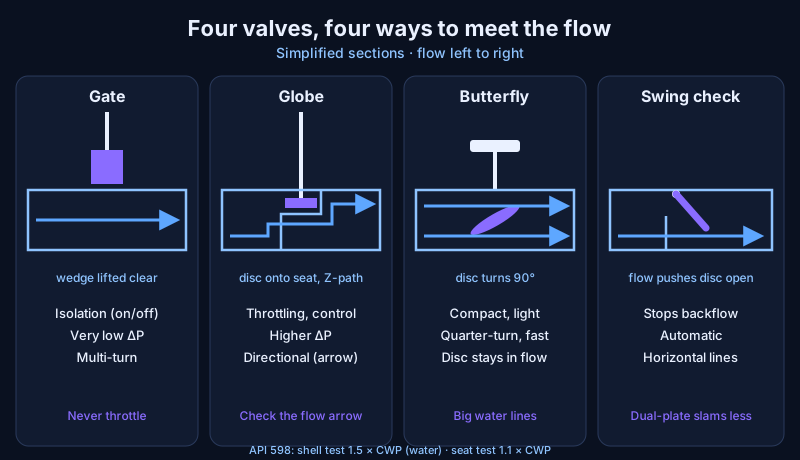
Gate, globe, butterfly and check valves differ in how their closing element meets the flow: a gate valve lifts a wedge completely out of the pipe, a globe valve lowers a disc onto a seat across the flow, a butterfly valve turns a disc a quarter turn, and a check valve opens and closes by itself with the flow.
That one difference decides whether a valve is best for isolation, throttling, compact large-bore service or stopping backflow.
Valves are some of the most common parts I inspect and handle in marine and pipeline work, and most valve trouble comes from using the right valve in the wrong job — a gate valve left half-open to "control" flow, or a check valve fitted where it cannot close properly.
How does a gate valve work, and when should you use it?
A gate valve works by raising or lowering a flat or wedge-shaped gate across the pipe using a threaded stem. Fully open, the gate is lifted completely out of the flow path, so the bore is almost unobstructed and the pressure drop is very low. MachineMFG describes gate valves as giving strong, tight shut-off and allowing flow in both directions.
Gate valves are built for on/off isolation, not control. MachineMFG notes they are not designed for throttling and that partial opening causes wear: with the gate half-down, fast flow is squeezed under its edge and erodes the wedge and seats, so the valve stops sealing. Gate valves are also slow — many turns of the handwheel — and need space above the valve for the stem and gate to travel.
Use for: isolating pumps, tanks and pipe sections in water, oil, steam and cooling-water systems, where the valve stays fully open or fully closed and is operated rarely.
How does a globe valve work, and why is it used for throttling?
A globe valve works by moving a disc or plug straight down onto a seat that sits across the flow path. Fabrico explains that the opening changes smoothly with stem travel, which is why globe valves are the standard choice for throttling, bypass lines and the insides of most control valves.
The trade-off is pressure drop. In the standard Z-body pattern, the flow makes two sharp turns to pass through the seat, so even fully open a globe valve restricts flow far more than a gate valve. Fabrico rates the pressure drop as high for a Z-body, moderate for a Y-pattern (seat at about 45°, one turn) and very low for a gate valve. An angle globe valve removes one turn by having inlet and outlet at 90°.
Globe valves are directional. Fabrico notes the usual arrangement is flow under the seat, marked by an arrow on the body; fitted backwards, the valve becomes hard to operate under pressure. Checking the arrow is one of the simplest — and most often missed — installation checks.
How does a butterfly valve work?
A butterfly valve works by rotating a disc mounted on a shaft through 90°. Turned edge-on to the flow, it is open; turned square to the flow, it is closed. MachineMFG lists its advantages: quick quarter-turn operation, a compact and light body, lower cost especially in large diameters, and the ability to throttle in partial positions.
The disc never leaves the pipe, so it always adds some pressure drop, and MachineMFG notes that very fast closing can cause pressure surges. Butterfly valves also wear when the fluid carries grit or solids, and their shut-off may not be as tight as a gate valve's.
Use for: large water and sea-water lines, cooling water, HVAC, fire-fighting and wastewater — anywhere a big valve must be light, compact and quick to operate.
How does a check valve work?
A check valve works automatically: forward flow pushes it open, and when flow stops or reverses it closes to block backflow. Project Materials explains that it needs no power or operator, which is why one sits on the discharge of almost every pump to protect it from reverse flow.
The common types are:
- Swing check — a disc hinged at the top swings open with the flow and falls shut by gravity. It must be installed in horizontal or slightly sloping lines, not in vertical-up flow, because gravity cannot return the disc there.
- Lift check — a ball or piston lifts straight off a seat, with a body similar to a globe valve, and drops back by gravity or a spring.
- Dual-plate (wafer) check — two spring-loaded half-discs hinge from a central pin. It is compact, light, fits between flanges, works in any orientation, and Project Materials notes it causes far less water hammer than a conventional swing check.
Check valve slam happens when the disc is still open as the flow reverses, so it shuts hard and sends a pressure surge down the line. Project Materials lists the usual causes: pulsating flow, oversized valves that close late because the flow is too slow to hold them properly, and valves fitted too far from the pump discharge.
Which valve should you choose?
| Valve | Closing element | Main job | Pressure drop (open) | Throttling | Operation |
|---|---|---|---|---|---|
| Gate | Wedge lifted out of the flow | Isolation | Very low | No | Slow, multi-turn |
| Globe | Disc onto a seat across the flow | Throttling, control | High (Z-body) | Yes — best | Multi-turn |
| Butterfly | Disc turned 90° | Large-bore on/off and rough control | Low–moderate | Yes | Fast, quarter-turn |
| Check | Disc/plates moved by the flow | Stop backflow | Low–moderate | No | Automatic |
How are valves pressure-tested?
Valves are pressure-tested at the factory, and after overhaul, to prove both the body and the seat. The common standard is API 598, summarised by Project Materials:
| Test | Medium | Pressure | Pass condition |
|---|---|---|---|
| Shell (body) | Water | 1.5 × cold working pressure | No visible leak through body or bonnet |
| High-pressure seat | Water | 1.1 × cold working pressure | Within allowed seat leakage |
| Low-pressure seat | Air or gas | 0.4–0.7 bar | Within allowed bubble rate |
Minimum hold times grow with size: 2 minutes up to 2", 5 minutes for 2½"–6", 15 minutes for 8"–12" and 30 minutes for 14"–24". Soft-seated valves must show no visible seat leakage; metal-seated valves are allowed a small, size-dependent amount. The same logic — water, a pressure margin and a timed hold — runs through the hydrostatic test of the whole piping system.
The engineering takeaway
Pick the valve by its job: isolate with a gate, control with a globe, save space and weight in big lines with a butterfly, and protect pumps with a check valve fitted the right way up. Then respect the details that cause most failures — never throttle a gate valve, follow the flow arrow on a globe valve, keep swing checks out of vertical-up lines, choose a body material that suits the fluid (see SS304 vs SS316 for sea water), and test before service. Valves feeding a centrifugal pump matter twice: a partly closed suction valve is a classic cause of cavitation.
 Turbocharger
 Centrifugal Pump
 V-Belt Pulley Drive
 Helical Gear Reducer
 Marine Diesel Engine
 Plate Heat Exchanger
 Reciprocating Air Compressor
 Planetary Gearbox