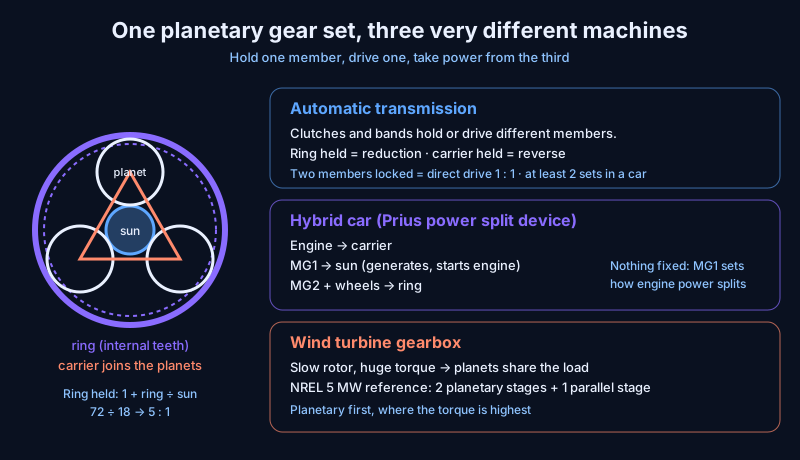
Planetary gears are used in automatic transmissions, hybrid cars, wind turbine gearboxes, starter motors, robot and servo gearheads and industrial reducers. They suit any machine that needs high torque in a compact, in-line package, or several ratios from one gear set, because holding a different member (sun, carrier or ring) changes the ratio and even the direction.
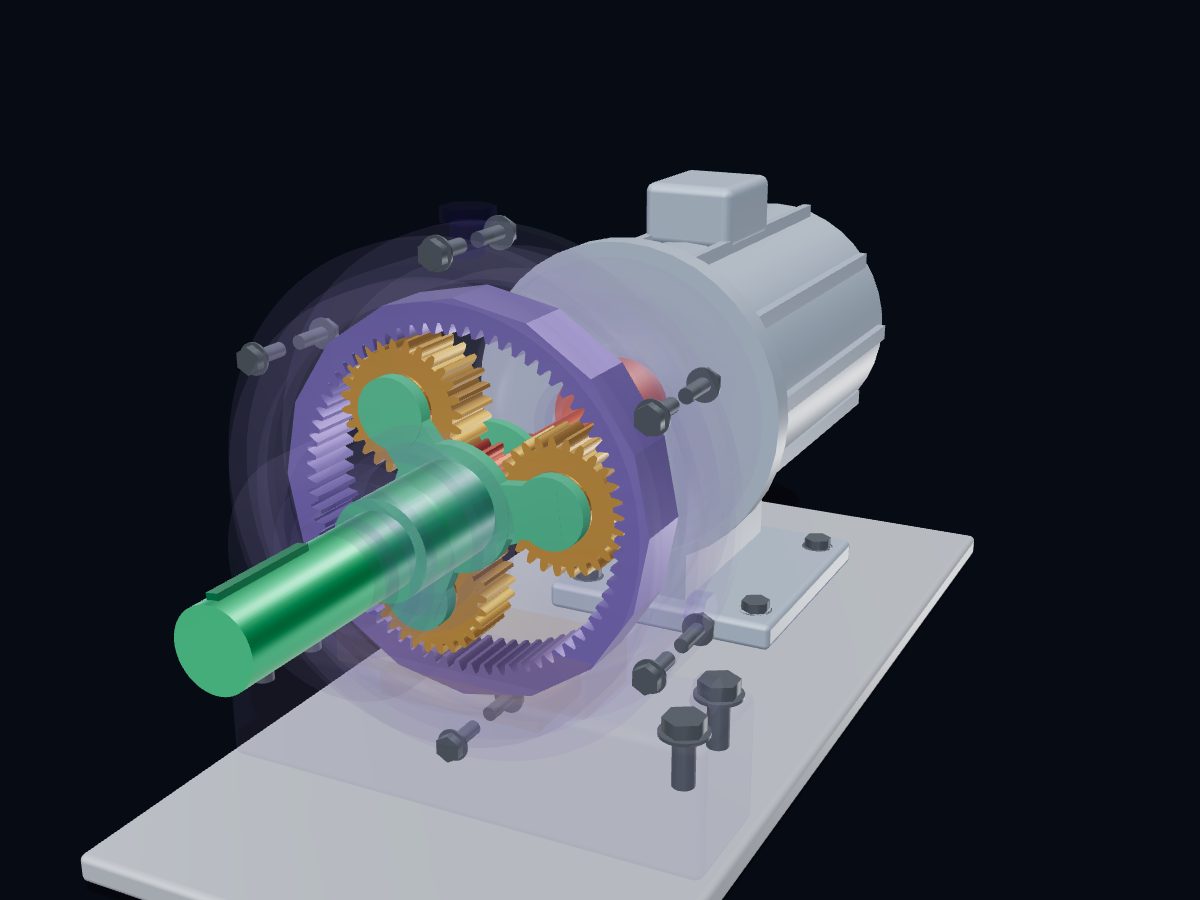
The same four parts appear in all of them: a sun gear in the middle, planet gears around it on a carrier, and a ring gear with teeth on the inside. You can watch them roll in the new Engine-X planetary gearbox 3D model, and the planetary gearbox guide works through the ratio maths. Here is how three very different machines use the same idea.
How does a planetary gear set give different ratios?
A planetary gear set gives different ratios because any of its three members can be the input, the output or the one held still. The planets themselves are idlers: they spin on their pins and pass power between the others.
As Gears Magazine puts it, one member must be held (or two locked together) before the set can transmit power at all.
The rules are simple:
- Ring held, sun drives, carrier output: a speed reduction. With an 18-tooth sun and a 72-tooth ring, as in the Engine-X model, the ratio is 1 + 72 ÷ 18 = 5 : 1.
- Carrier held: the output turns backwards. "If a carrier is held, reverse will result," Gears Magazine notes.
- Carrier drives: an overdrive, the output turns faster than the input.
- Any two members locked together: the whole set turns as one, direct drive at 1 : 1.
kfz-tech.de gives a worked example with a 21-tooth sun, 21-tooth planets and a 63-tooth ring: 4 : 1 with the ring held (first gear), 3 : 1 in reverse with the carrier held, and 1 : 1 with everything locked.
How do automatic transmissions use planetary gears?
An automatic transmission uses planetary gear sets with clutches and bands that hold or drive different members, so it can change ratio under load without a gear lever. A clutch couples a member to the input or locks it to the case; a band is a steel strap that wraps around a drum and clamps it still with hydraulic pressure.
Each gear position is just a different combination of applied clutches and bands. Because one set gives only a few useful ratios, cars stack two or more: kfz-tech.de calls two planetary sets the minimum for a car automatic and cites the 1953 Chrysler PowerFlite. Common compound layouts such as the Simpson set (two rings and two carriers sharing one sun) and the Ravigneaux set (two suns sharing one ring) squeeze more ratios out of fewer parts. kfz-tech.de adds that a car transmission typically uses three to six planets per set, more where the torque is higher.
How does a hybrid car use a planetary gear?
The Toyota Prius uses a single planetary gear set, called the power split device, to share engine power between the wheels and a generator. Transmission Digest describes the connections:
| Planetary member | Connected to | Job |
|---|---|---|
| Carrier | Petrol engine (through a damper) | Input from the engine |
| Sun gear | Motor-generator MG1 | Makes electricity, or cranks the engine to start it |
| Ring gear | MG2 and the final drive to the wheels | Drives the car |
Nothing in this set is permanently held. Instead, MG1 on the sun works like an adjustable reaction member: by changing how hard MG1 generates, the control system changes how the engine's power divides between the ring (the wheels) and electricity. To start the engine, Transmission Digest notes, MG1 simply turns the sun and cranks the engine through the carrier.
Why do wind turbines use planetary gearboxes?
Wind turbines use planetary gearboxes because the rotor turns slowly with enormous torque, and a planetary stage shares that torque between several planets in a compact, in-line housing. The gearbox raises the speed so a smaller, faster generator can be used.
NREL's 5 MW reference gearbox for offshore wind turbines uses three stages: two planetary stages followed by one parallel-shaft stage, with the stage ratios chosen to keep the gearbox as light as possible. The smaller 750 kW gearbox from NREL's Gearbox Reliability Collaborative starts with one low-speed planetary stage with three planets and a floating sun. The pattern is the same in both: the planetary stage sits where the torque is highest, and parallel gears do the faster stages, the same helical gears explained in helical vs worm gear reducer.
Why are planetary gearboxes so compact?
A planetary gearbox is compact because the load is shared between several planets at once, so each tooth mesh carries only part of the torque. With three planets, each sun-to-planet mesh carries roughly a third of the load, and input and output sit on the same axis.
That is why the same layout turns up in small places too: kfz-tech.de mentions car starter motors, and robot joints and servo gearheads use it for the same reason. For a comparison with other gear types, see spur, helical, bevel or worm and the parallel-shaft gear reducer guide.
The engineering takeaway
A planetary gear set is three members and one rule: hold one, drive one, take power from the third. Automatic transmissions switch which member is held to change gear; the Prius holds nothing and uses a generator to split power; wind turbines put planetary stages where the torque is greatest. To see the sun, planets and carrier turning at 5 : 1, open the 3D planetary gearbox in the Engine-X atlas.