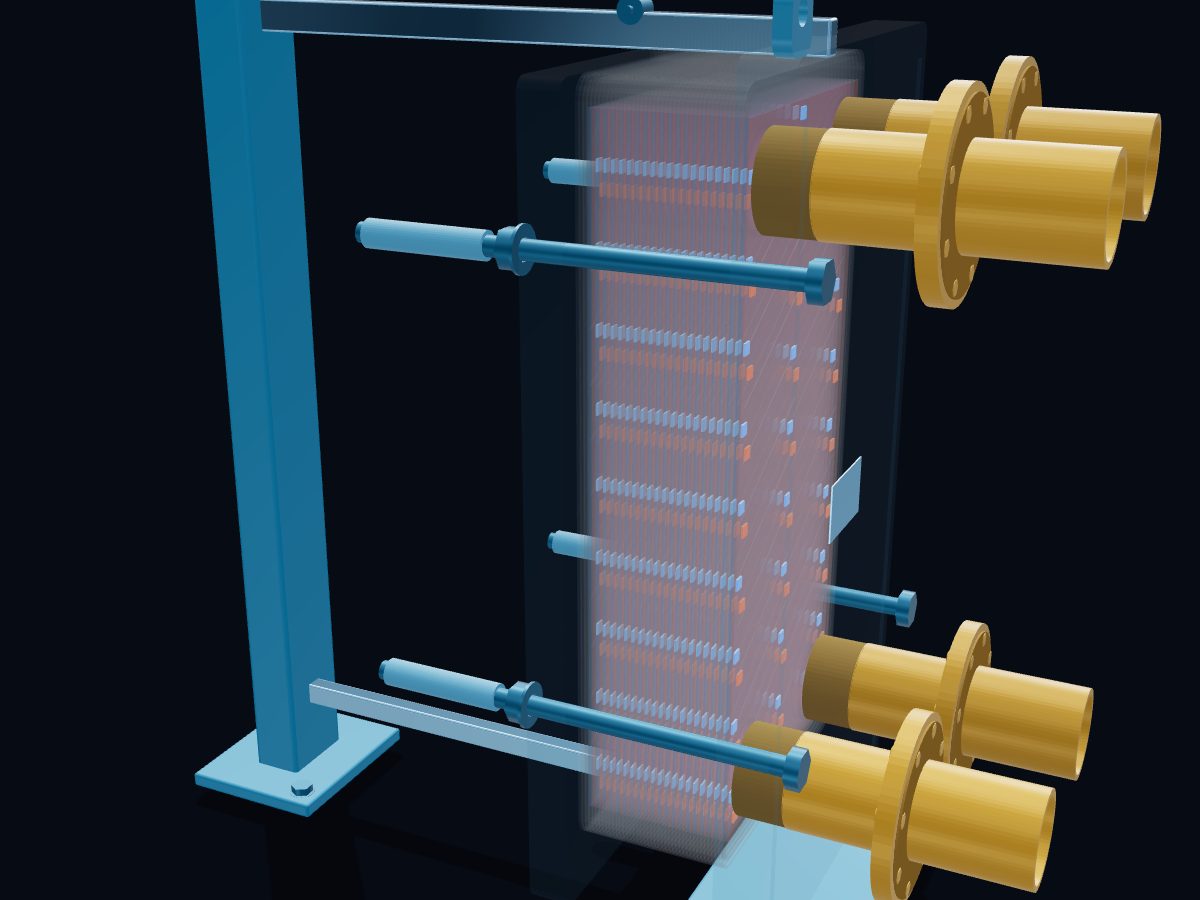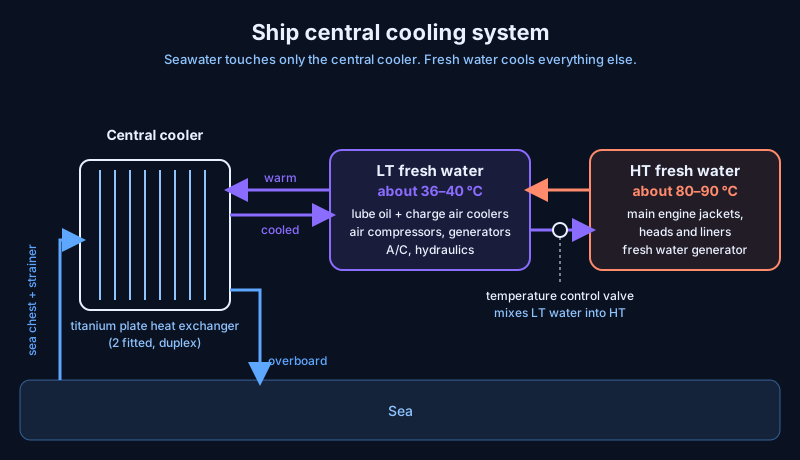
A ship's central cooling system cools the whole engine room with clean fresh water, and lets seawater touch only one machine: the central cooler, a plate heat exchanger with titanium plates. The fresh water runs in two closed circuits, a low-temperature (LT) circuit at about 36–40 °C and a high-temperature (HT) circuit at about 80–90 °C.
Older ships pumped seawater straight through every cooler on board, and the price was corroded pipes, fouled coolers and constant repairs. Most modern ships moved to central cooling, and the plate heat exchanger is the reason it works in a small space. You can open up the same kind of unit, plate by plate, in the Engine-X plate heat exchanger 3D model, and the plate heat exchanger guide explains the flow and the heat-transfer maths.
How does a ship's central cooling system work?
A ship's central cooling system works as three loops passing heat outward, one into the next, until it reaches the sea. According to Merchant Navy Decoded and Marine Insight, the three circuits are:
- HT fresh water circuit. Cools the main engine's cylinder jackets, heads and liners. The engine outlet is held at about 80–90 °C. Some of this heat goes to the fresh water generator, which makes drinking water from seawater.
- LT fresh water circuit. Cools the auxiliaries: lube oil and fuel oil coolers, air compressors, auxiliary engines, air-conditioning compressors, hydraulic oil coolers and the charge air cooler. It runs at about 36–40 °C and also takes the heat out of the HT circuit.
- Seawater circuit. Seawater comes in through the sea chest and a strainer, passes once through the central cooler, takes the heat of the LT circuit and is discharged overboard.
The HT circuit has no cooler of its own to the sea. Temperature control valves mix in cooler LT water to hold the engine outlet steady, so the main engine always sees the same jacket temperature whether the ship is in the Arctic or the Arabian Gulf.
Why is the central cooler a plate heat exchanger?
The central cooler is a plate heat exchanger because it moves a large amount of heat in a compact frame, can be opened for cleaning, and its plates can be pressed from titanium.
A plate heat exchanger is a stack of thin corrugated metal plates with gaskets that make alternate channels for the two liquids, so heat crosses every plate without the liquids mixing.
Alfa Laval describes the seawater path as sea chest → coarse strainer → titanium central coolers → overboard. Titanium is chosen because seawater attacks most other metals; Marine Insight and Merchant Navy Decoded both note that central coolers are generally plate type with titanium plates. A bypass valve on the fresh water side sends only part of the flow through the cooler, which is how the LT temperature is held constant.
| Circuit | Typical temperature | What it cools |
|---|---|---|
| HT fresh water | 80–90 °C (engine outlet) | Main engine jackets, cylinder heads, liners; fresh water generator heat |
| LT fresh water | 36–40 °C | Lube oil, fuel oil and charge air coolers, air compressors, auxiliary engines, A/C, hydraulics |
| Seawater | Sea temperature | Only the central cooler, then overboard |
Temperatures are from Merchant Navy Decoded and Marine Insight and vary with the engine maker's settings.
What are the advantages of central cooling over seawater cooling?
The main advantage of central cooling is that seawater, the liquid that corrodes and fouls everything, is kept in one short loop and one heat exchanger. Marine Insight and Merchant Navy Decoded list these gains:
- Less corrosion and fouling. The rest of the pipes, valves and coolers carry treated fresh water, so cheaper materials can be used for them.
- Stable temperatures. Machinery runs at the same temperature in any sea, which reduces wear; a warm jacket also avoids cold corrosion of cylinder liners.
- Better heat transfer. Fresh water can run at higher speeds than seawater, so coolers and pipes can be smaller.
- Suited to unmanned engine rooms. Fewer seawater leaks and blockages means fewer alarms at night.
The disadvantages are a higher installation cost, more pumps and valves, regular water treatment, and the fact that a central cooler problem affects every machine downstream.
How is the central cooler kept working?
The central cooler is kept working by watching temperatures and pressure drop, and by opening and cleaning the plates when they foul. Central coolers are normally installed in duplex, two units side by side, so one can be isolated and opened while the other carries the load.
Merchant Navy Decoded gives the usual signs: a rising HT or LT temperature means the cooler needs cleaning, and a high differential pressure across it means the plates are fouled. The fresh water side is tested for pH, chloride, nitrite and conductivity, because chloride in the fresh water points to a seawater leak through a plate or gasket. Seawater piping on the cooler side carries the same isolating valves covered in our post on gate, globe, butterfly and check valves, and the seawater is moved by the same kind of machine explained in the centrifugal pump guide.
To open a gasketed plate heat exchanger, the tightening bolts are slackened in diagonal pairs, the pressure plate is rolled back along the carrying bar, and each plate is slid along and cleaned. It closes again to the tightening dimension stamped on its nameplate. You can try the same exploded view in the 3D plate heat exchanger.
The engineering takeaway
Central cooling puts one titanium plate heat exchanger between the sea and the whole engine room. Seawater makes a single pass through it; the LT circuit at about 36–40 °C cools the auxiliaries, and the HT circuit at about 80–90 °C cools the main engine by mixing in LT water. Keep the central cooler clean, keep a duplex unit ready, and watch chloride in the fresh water for the first sign of a plate leak.