Engine‑X machine guide
How does a plate heat exchanger work?
By Parth Parmar, mechanical design engineer · Updated
A plate heat exchanger passes heat from one liquid to another through a stack of thin corrugated metal plates. Gaskets turn the gaps between the plates into channels, and the hot and cold liquids flow through alternate channels, usually in opposite directions, so heat crosses every plate without the two liquids ever mixing.
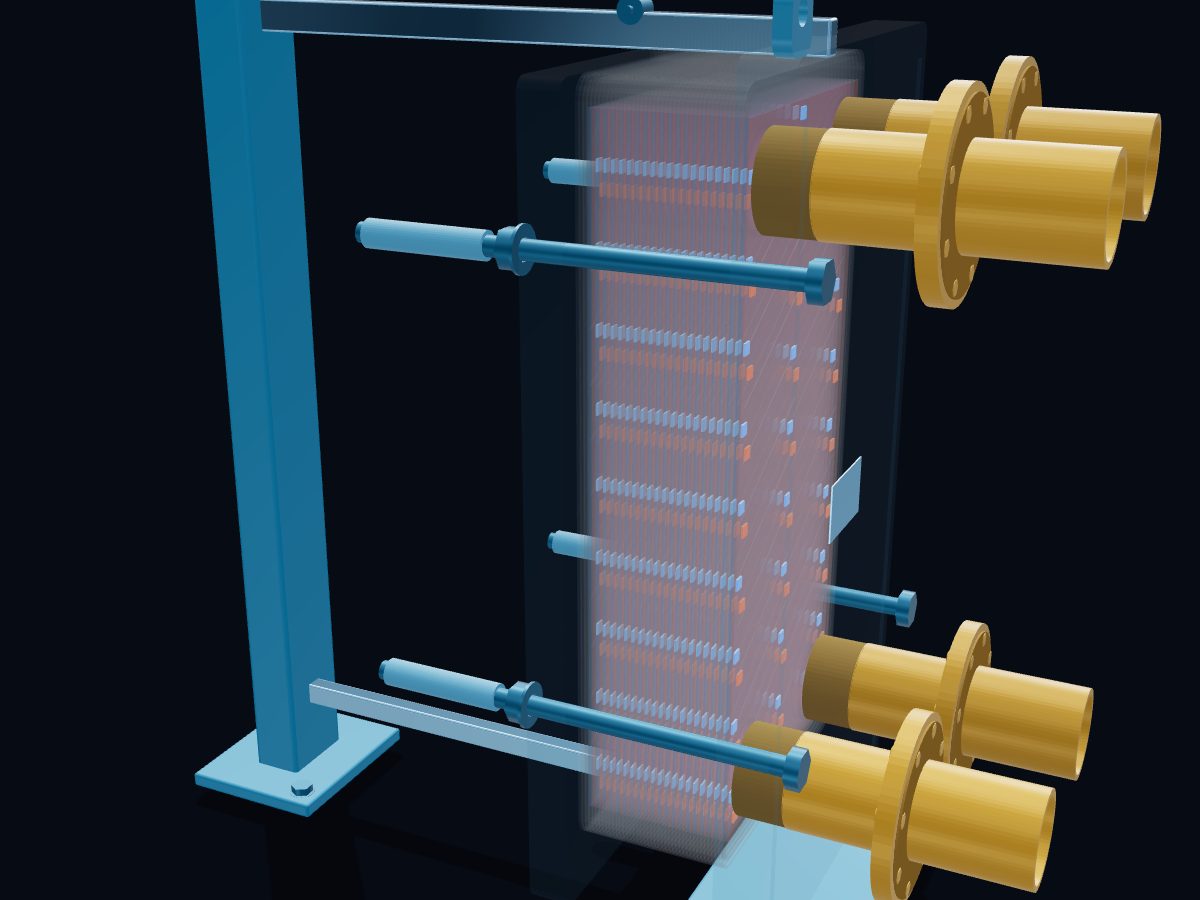
See it work: turn on X‑ray to watch red and blue water run in opposite directions through alternate channels, then explode the plate pack in 3D, free in your browser.
Open the 3D plate heat exchanger →Or download the free 3D model (GLB, STL, AR).
Key facts
| Type in the 3D model | Gasketed plate-and-frame, single pass, countercurrent, all four connections on the frame plate |
|---|---|
| Plate pack | 41 pressed stainless steel plates making 40 channels: 20 hot, 20 cold |
| Channel gap | 4.0 mm free channel (an M10-M-class plate; the M10-B plate has 2.6 mm) |
| Connections | DN100 / NPS 4 flanges |
| Frame size | About 470 mm wide and 1.1 m tall (M10 class: W 470 mm, H 1084 mm) |
| Design pressure | Set by the frame: 6 to 16 bar for most M10 frames, up to about 27 bar for the heaviest |
| Plate materials | Stainless steel 316/316L is common; titanium and nickel alloys for corrosive liquids |
| Gasket materials | NBR, EPDM, FKM and others, chosen for the liquid and temperature |
| Example duty | Hot water 80 → 50 °C, cold water 20 → 60 °C: LMTD about 24.7 K |
How it works, step by step
- Hot water enters the top connection on the frame plate and runs along the tunnel formed by the lined-up port holes.
- In every second gap the gasket leaves the hot ports open, so hot water spreads across that plate and runs down it. In the other gaps, ring gaskets seal those ports off.
- Cold water enters at the bottom and fills the gaps in between, running upwards: countercurrent flow.
- Heat passes through each thin plate from the hot side to the cold side. The herringbone corrugations keep both streams turbulent.
- Each stream gathers in its outlet port tunnel and leaves: the hot water at the bottom, the cold water at the top.
- Tightening bolts keep the pack squeezed between the frame plate and the pressure plate, so every gasket seals.
Main parts of a plate heat exchanger
- Heat transfer plates — thin pressed sheets with herringbone corrugations and a port hole in each corner.
- Gaskets — elastomer seals on each plate that form the channel and decide which two ports feed it.
- Frame plate — the fixed end, carrying all four pipe connections.
- Pressure plate — the movable end, pulled in by the bolts and rolled back to open the pack.
- Carrying bar, guiding bar and support column — hang the plates and keep them in line.
- Tightening bolts — squeeze the pack to its tightening dimension.
- Connections — four flanged nozzles: hot in and out, cold in and out.
How do you calculate the LMTD of a plate heat exchanger?
For countercurrent flow, take ΔT₁ = hot inlet − cold outlet and ΔT₂ = hot outlet − cold inlet. The log-mean temperature difference is (ΔT₁ − ΔT₂) ÷ ln(ΔT₁ ÷ ΔT₂). The heat duty is Q = m × cp × ΔT for either stream, and the plate area needed is Q ÷ (U × LMTD).
| ΔT₁ | 80 − 60 = 20 K |
|---|---|
| ΔT₂ | 50 − 20 = 30 K |
| LMTD | (20 − 30) ÷ ln(20 ÷ 30) ≈ 24.7 K |
| Heat duty | 2 kg/s × 4.18 kJ/kg·K × 30 K ≈ 251 kW (hot water) |
| Cold flow needed | 251 ÷ (4.18 × 40) ≈ 1.5 kg/s |
The overall coefficient U depends on the plate pattern, the liquids and the allowed pressure drop, so it comes from the manufacturer’s plate data. Note the cold outlet (60 °C) ends hotter than the hot outlet (50 °C): a temperature cross, which countercurrent plate units can reach (Alfa Laval).
Plate vs shell and tube heat exchanger: which is better?
A plate heat exchanger is usually smaller and more efficient for the same duty, because thin corrugated plates and turbulent flow move heat well and countercurrent flow allows a very close temperature approach. It is easy to open, clean and enlarge by adding plates. Its gaskets set its limits, so shell and tube units take over at higher pressures and temperatures.
- Plate: compact, close approach, temperature cross possible, capacity changed by adding or removing plates.
- Plate limits: gasket material sets the maximum temperature; frame design sets the pressure (6 to about 27 bar for the M10 range).
- Shell and tube: rugged, takes high pressures and temperatures and dirty or two-phase flows, but is bigger for the same duty.
Why is my plate heat exchanger leaking?
Most leaks to the outside come from a gasket that is loose, damaged or out of its groove, a pack that is not tightened enough, or a bent or misaligned plate. A leak between the two liquids means a plate has been holed, usually by corrosion, or the pipes were connected wrongly. Check the tightening dimension before anything else.
- Leak to the outside: reposition or replace the gasket, retighten evenly, or replace the damaged plate.
- Leak at a connection: a displaced flange gasket or a damaged nozzle lining.
- Cross leak (liquids mixing): holed plate or wrong piping; the plate must be replaced.
- Rising pressure drop or falling heat transfer: fouling or debris; clean or backflush.
How do you open and clean a plate heat exchanger?
Drain the unit, measure and record the tightening dimension at every bolt, mark the plate order with a diagonal line across the pack, then loosen the bolts in diagonal pairs a little at a time and roll the pressure plate back. Clean plates with soft brushes or in place with a cleaning solution, never with steel wool.
- Do not use hydrochloric acid on stainless steel plates.
- Close the pack again in diagonal pairs, keeping the pressure plate parallel, back to the recorded dimension; never below the minimum.
- Glued gaskets can be peeled off after softening with gentle heat; clip-on gaskets snap into slots in the plate.
Common questions
What is countercurrent flow in a heat exchanger?
The hot and cold liquids flow in opposite directions. The coldest cold liquid meets the coolest hot liquid and the hottest meets the hottest, so there is a temperature difference all the way along and more heat is recovered.
Why are the plates corrugated?
The herringbone pattern makes both streams turbulent, which transfers more heat and helps keep the plates clean. Neighbouring plates are turned so their corrugations cross and support each other against the pressure.
Can you add plates to a plate heat exchanger?
Yes. Capacity can be raised or lowered by adding or removing plates, as long as the frame and bars are long enough. The tightening dimension then changes, so check it with the manufacturer.
What is the tightening dimension?
The distance between the frame plate and the pressure plate when the pack is correctly squeezed. It is on the nameplate; tightening below the minimum can crush the plates.
What are double-wall plates?
Two plates welded together around the ports. If one cracks, the leaking liquid escapes to the outside instead of mixing with the other liquid, which matters for things like drinking water or food.
Sources
References for the facts on this page, and further reading:
- Alfa Laval — M10 gasketed plate heat exchanger: product leaflet and technical data
- Alfa Laval — How gasketed plate heat exchangers work
- Alfa Laval — Gasketed plate heat exchangers: plate types and channels
- API Schmidt-Bretten — Plate and frame heat exchanger installation, operation and maintenance manual
- ChemEnggCalc — LMTD calculator for heat exchangers (counterflow formula)
Related reading on the blog
Shell and tube vs plate heat exchanger: how each works and when to use it · How a cooling tower works · Mild steel, SS304, SS316 or cast iron? A practical material selection guide
More machine guides
How does a turbocharger work? · How does a centrifugal pump work? · How does a V-belt pulley drive work? · How does a gear reducer work? · How does a marine diesel engine work? · Centrifugal vs positive displacement pump: what's the difference? · How does a reciprocating air compressor work? · How does a planetary gearbox work?
Need an interactive 3D page like this for your own machine? See Work with Engine‑X.