Engine‑X machine guide
How does a reciprocating air compressor work?
By Parth Parmar, mechanical design engineer · Updated
A reciprocating air compressor squeezes air with a piston in a cylinder. On the downstroke the piston draws air in through a suction valve; on the upstroke it compresses the air until the delivery valve opens and pushes it into a storage tank. Two-stage machines compress in two cylinders and cool the air in between.
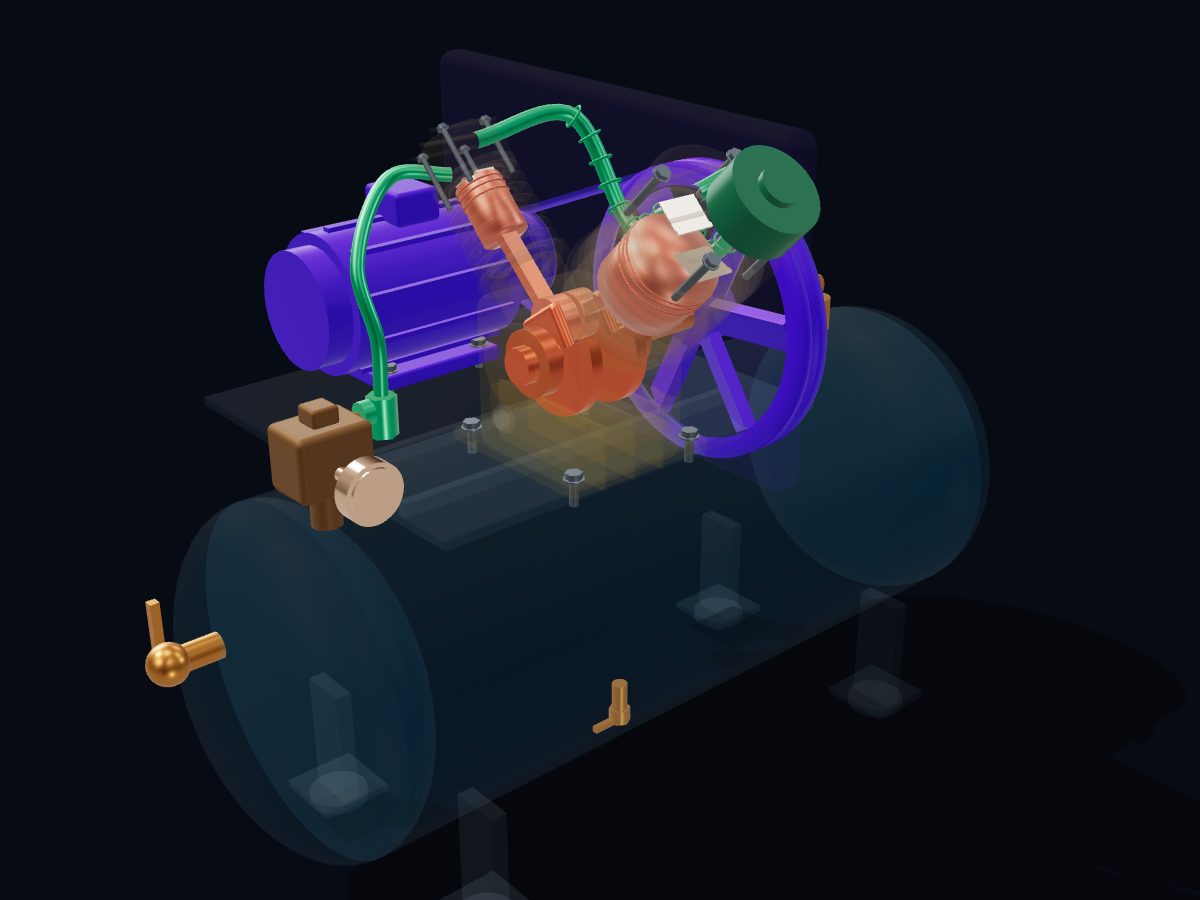
See it run: watch the pistons, connecting rods and reed valves work, then explode, cut open and X‑ray the compressor in 3D, free in your browser.
Open the 3D air compressor →Or download the free 3D model (GLB, STL, AR).
Key facts
| Type in the 3D model | Two-stage, two-cylinder V-twin, air-cooled, belt-driven, on a horizontal tank |
|---|---|
| Maximum pressure | 12 bar (175 psi), typical for two-stage; single-stage units stop at about 9 bar (135 psi) |
| Cylinders | LP Ø100 mm and HP Ø53 mm, 70 mm stroke, 90° V |
| Interstage pressure | About 2.6 bar gauge (ideal √(P₁ × P₃) = 3.64 bar absolute) |
| Pressure ratio per stage | About 3.6 : 1 in each cylinder |
| Speed | Motor 2880 rpm → 3.2 : 1 V-belt → pump about 900 rpm |
| Swept volume (LP cylinder) | About 495 L/min (17.5 cfm); the air actually delivered is less |
| Motor | 3.7 kW (5 hp), two-pole, 50 Hz |
| Valves | Reed (flapper) suction and delivery valves in each head |
| Cooling | Finned cylinders, a fan-spoked flywheel and a finned copper intercooler |
How it works, step by step
- The motor turns the flywheel pulley through a V-belt; the crankshaft turns at about 900 rpm.
- The big low-pressure (LP) piston moves down. Once the air left in the clearance space re-expands, the suction reed opens and outside air flows in through the filter.
- The LP piston moves up, the suction reed snaps shut, and the air is squeezed to about 2.6 bar. Near the top, the delivery reed opens and pushes it into the intercooler.
- The finned intercooler, sitting in the flywheel fan blast, cools the first-stage air.
- The small high-pressure (HP) piston, a quarter turn behind, draws in the cooled air and compresses it again to up to 12 bar (175 psi).
- The air runs down the discharge tube, through the check valve and into the tank, where water settles out.
- When the tank reaches cut-out pressure the pressure switch stops the motor and the unloader vents the line; it restarts when pressure falls to cut-in.
Main parts of a reciprocating air compressor
- Crankshaft, connecting rods and pistons — turn the motor’s rotation into the pistons’ strokes; both rods share one crankpin.
- LP and HP cylinders — finned barrels: a big first stage and a small second stage.
- Valve plates and reed valves — thin spring-steel flaps that open and shut on pressure alone, two per head.
- Cylinder heads and air filter — keep the inlet and outlet chambers apart; the filter cleans the incoming air.
- Intercooler — finned copper tube that cools the air between the stages.
- Flywheel fan pulley, belt and motor — drive the pump and blow cooling air over it.
- Air receiver tank — stores the air, smooths pulses and collects water.
- Pressure switch, unloader, check valve, safety valve, gauge and drain — control, protect and look after the system.
Single-stage vs two-stage air compressor: what’s the difference?
A single-stage compressor squeezes the air once, in one go, and usually stops at about 135 psi (9 bar). A two-stage compressor squeezes it twice: a big cylinder first, then, after an intercooler, a smaller one, reaching about 175 psi (12 bar). Cooling between the stages means less heat and less work at high pressure.
| Compression | Single-stage: once · Two-stage: twice, with intercooling |
|---|---|
| Typical maximum | Single-stage: about 135 psi (9 bar) · Two-stage: about 175 psi (12 bar) |
| Cylinders | Single-stage: one or more of the same size · Two-stage: a large LP and a small HP |
| Best for | Single-stage: light, short jobs · Two-stage: workshops and continuous duty |
Ingersoll Rand gives these two pressures for its single- and two-stage reciprocating ranges, and rates its two-stage 2340 pumps for 100% continuous duty.
How do you calculate the interstage pressure of a two-stage compressor?
Take the square root of inlet pressure × final pressure, both in absolute bar. That split gives both stages the same pressure ratio, which needs the least total work when the intercooler brings the air back to inlet temperature. With equal strokes, the HP bore is the LP bore divided by the square root of that ratio.
| Inlet P₁ | 1.013 bar abs (atmosphere) |
|---|---|
| Final P₃ | 12.07 bar g + 1.013 = 13.08 bar abs |
| Interstage P₂ | √(1.013 × 13.08) = 3.64 bar abs ≈ 2.6 bar g |
| Ratio per stage | 3.64 ÷ 1.013 ≈ 3.6 : 1 |
| HP bore | 100 mm ÷ √3.6 ≈ 53 mm |
In real machines intercooling is never perfect and valves lose some pressure, so designers shift the split a little (Firgelli Auto).
Why does an air compressor tank need draining?
Compressing air also concentrates the water vapour in it. As the hot air cools in the tank, that water condenses and collects at the bottom, together with a little oil. Left there, it rusts the tank from the inside and gets carried into the air lines, so the drain valve should be opened regularly to let it out.
- Drain: open the drain valve at the lowest point with some pressure in the tank, until only air comes out.
- Check: the safety valve, pressure switch and check valve should all work; never plug a safety valve.
- Filter: a clogged intake filter cuts output; a missing one lets dust wear the cylinder.
Common questions
What does the intercooler do on a two-stage compressor?
It cools the air between the low-pressure and high-pressure cylinders. Cooler air takes less work to compress, so the second stage runs cooler and the machine wastes less energy as heat.
What is the unloader valve on an air compressor?
A small valve, often built into the pressure switch, that vents the air trapped between the pump and the check valve when the motor stops. Without it the motor would have to restart against full pressure.
Why does an air compressor have a check valve?
It lets air into the tank but not back out, so the tank stays full when the pump stops and the unloader can vent only the short line from the pump.
What are reed valves in a compressor?
Thin spring-steel flaps in the valve plate. The suction reed opens when cylinder pressure falls below inlet pressure; the delivery reed opens when cylinder pressure rises above the pressure beyond it. No cam is needed.
What does the safety valve on an air compressor do?
It is a spring-loaded valve on the tank that opens if pressure ever goes above its setting, for example if the pressure switch fails, so the tank cannot be over-pressurised.
Sources
References for the facts on this page, and further reading:
- Ingersoll Rand — Single-stage vs two-stage reciprocating air compressors
- Ingersoll Rand — Two-stage electric driven reciprocating compressors, 2–5 hp (model 2340)
- Firgelli Auto — Compound air compressor: two-stage compression with intercooling
- Tameson — Air compressor valves: types, function and maintenance
- Quincy Compressor — Unloader valve: its purpose
- Bharat Skills (DGT, Govt. of India) — Reciprocating air compressor: parts, working and maintenance
Related reading on the blog
Gate, globe, butterfly or check valve? How each works and when to use it · Why V-belts slip, squeal and fail · Ball, roller or journal bearing? How bearing types work
More machine guides
How does a turbocharger work? · How does a centrifugal pump work? · How does a V-belt pulley drive work? · How does a gear reducer work? · Centrifugal vs positive displacement pump: what's the difference? · Belt vs chain vs gear drive: which is better? · How does a marine diesel engine work? · How does a plate heat exchanger work? · How does a planetary gearbox work?
Need an interactive 3D page like this for your own machine? See Work with Engine‑X.