V-belts slip, squeal and fail mainly for three reasons: wrong tension, misaligned pulleys and worn pulley grooves. A V-belt drive works only while the belt stays wedged tightly in its grooves, so anything that loosens that wedge — or overloads it — shortens belt life, wastes power and loads the bearings.
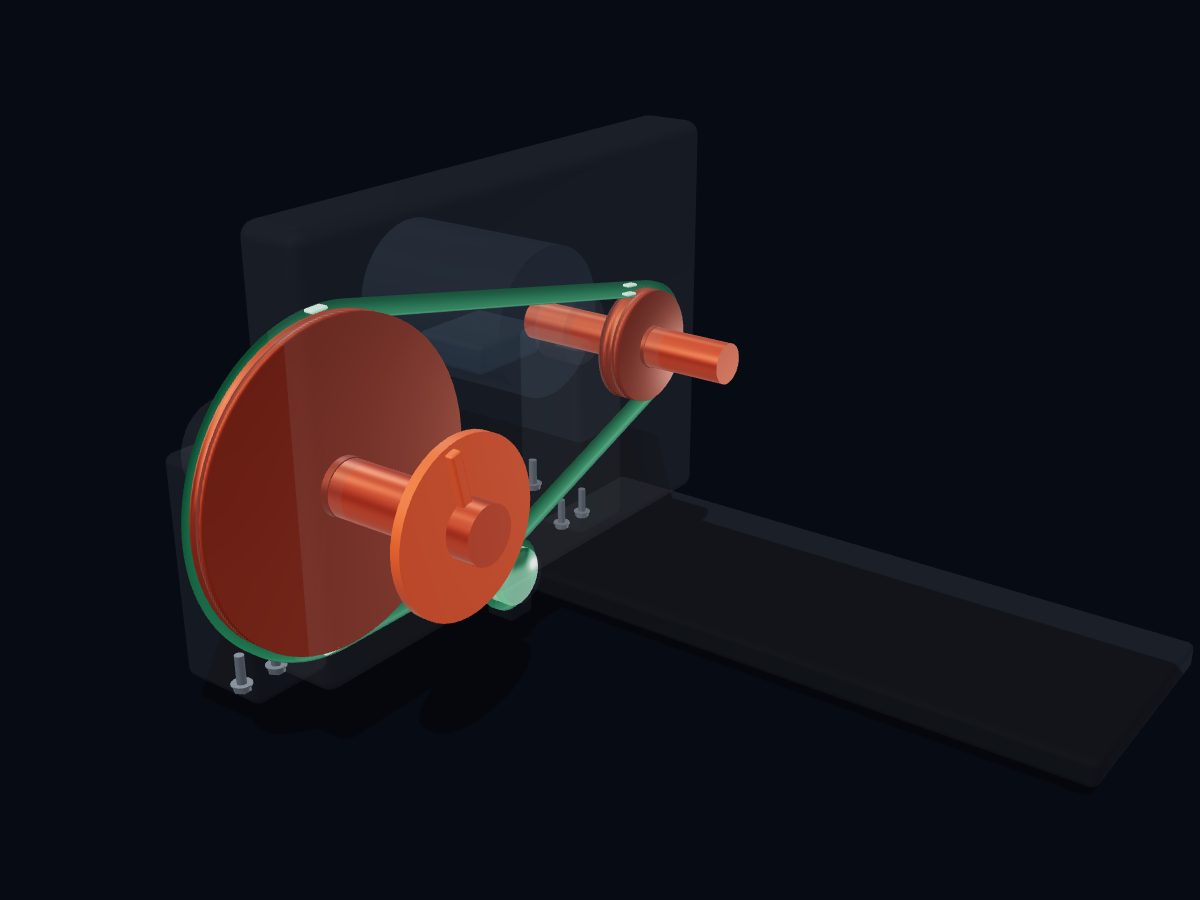
V-belt drives run fans, pumps, compressors and workshop machines everywhere, from engine rooms to factory floors. The Engine-X V-belt drive guide explains speed ratio and the parts in 3D. This post covers the practical side: how tight the belt should be, how to align it, and how to read a belt that has already failed.
How does a V-belt grip the pulley?
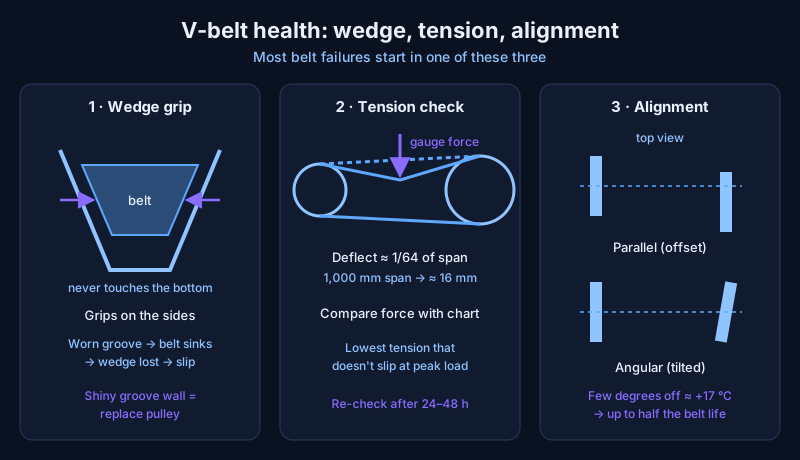
A V-belt grips the pulley by wedging its two sloping sides into the V-shaped groove. Belt tension pulls the belt down into the groove, and the angled walls turn that pull into a much larger side force, so friction on the sidewalls carries the load. A healthy V-belt rides on its sides and never touches the bottom of the groove.
This wedge is why a V-belt can carry more power than a flat belt of similar width. It is also why worn grooves are so damaging. When the groove walls wear, the belt sinks deeper, the wedge loses its grip, and the belt slips even at the right tension. Acorn Industrial says new belts on worn pulleys can lose up to 50% of their life, and a bright, shiny groove wall is the visual sign that a pulley needs replacing.
How tight should a V-belt be?
A V-belt should be as loose as possible while still not slipping. IBT Industrial Solutions defines proper tension as the lowest tension at which the belt won't slip or squeal under peak load. Both directions cause damage:
| Tension | What happens |
|---|---|
| Too loose | Slip, squeal, heat, glazing, fast belt and groove wear, lost power |
| Correct | Belt grips at peak load with the lowest bearing and shaft load |
| Too tight | Extra load on bearings and shafts, higher motor current, cracked bushings, early bearing failure |
Tameson warns that tension by feel is unreliable, because different belts feel different when correctly tensioned. A tension gauge is the proper tool.
How do you check V-belt tension with the deflection method?
The force-deflection method checks V-belt tension by pushing the belt sideways at mid-span and measuring the force needed to move it a set distance:
- Switch off and isolate the machine.
- Measure the span — the straight length of belt between the two pulley contact points.
- Work out the deflection: about 1/64 of the span. For a 1,000 mm span that is about 16 mm; Tameson's 48-inch example gives 19 mm.
- Push the belt at mid-span with a pencil-type tension gauge, at right angles to the belt, until it deflects by that amount. On multi-belt drives, IBT lines up the gauge with the neighbouring belts; on single-belt drives, with a straightedge across the pulleys.
- Read the force and compare it with the belt maker's chart. Below the range, increase centre distance; above it, reduce it.
New belts need more care. Tameson notes that a new belt is set at about 1.3 times normal tension because it has not been run in, and Acorn says most V-belt drives need re-tensioning within 24–48 hours of installation as the belt seats into the grooves. Skipping that re-check is one of the most common reasons a brand-new belt starts squealing after a day.
Why does pulley alignment matter for V-belts?
Pulley alignment matters because a misaligned V-belt enters the groove at an angle and rubs one sidewall harder than the other. Gates' alignment bulletin says just a few degrees of misalignment can raise belt temperature by about 30 °F (around 17 °C), which can cut belt life by as much as half. There are two kinds:
- Parallel (offset) misalignment. The shafts are parallel, but one pulley sits further along its shaft than the other, so the grooves are not in one plane.
- Angular misalignment. The pulleys are in roughly the right place, but one shaft is tilted, so the pulley faces are not parallel.
A straightedge or a laser alignment tool across both pulley faces shows both kinds. Gates also describes a quick noise test for automotive belts: spray a little water on a noisy belt — if the noise gets louder, the belt is slipping from low tension; if it goes quiet, suspect misalignment.
How do you read a failed V-belt?
A failed V-belt usually shows what killed it. Acorn Industrial's failure list matches symptoms to causes:
| Symptom on the belt | Likely cause |
|---|---|
| Glazed, hard, shiny sidewalls | Long-term slip from low tension or worn grooves, plus heat |
| Burn marks, squeal (spin burn) | Low tension, worn pulleys, oil or too little wrap on a small pulley |
| Wear on one side only | Misalignment |
| Cracked underside | Heat, pulleys that are too small, or misalignment |
| Soft, swollen belt | Oil or grease contamination (or belt dressing) |
| Split cover | Belt prised over the pulley, wrong tension or wrong belt size |
Two habits come out of this table. First, never lever a belt over the pulley flange — move the motor in, fit the belt, then tension it. Second, on a multi-belt drive, replace the whole set at once, so every belt shares the load equally. Acorn also notes that ordinary rubber belts have a continuous limit of roughly 60–85 °C, so a hot, poorly ventilated guard can age belts on its own.
The engineering takeaway
A V-belt is a friction wedge, and every common failure is that wedge being too loose, too tight, crooked or worn. Set tension with a gauge, re-check after the first day, align the pulleys and inspect the grooves whenever you change belts. As with pump cavitation, the failed part is often the victim, not the cause. If you are still choosing a drive type, compare the options in belt vs chain vs gear drive.