A marine diesel engine usually overheats because sea water stops carrying its heat away: the seacock was left closed, the sea strainer is blocked, the sea water pump's rubber impeller is worn or broken, or the heat exchanger tubes are scaled up. The coolant side (belt, coolant level, thermostat) comes next. Checking in that order finds most faults fast.
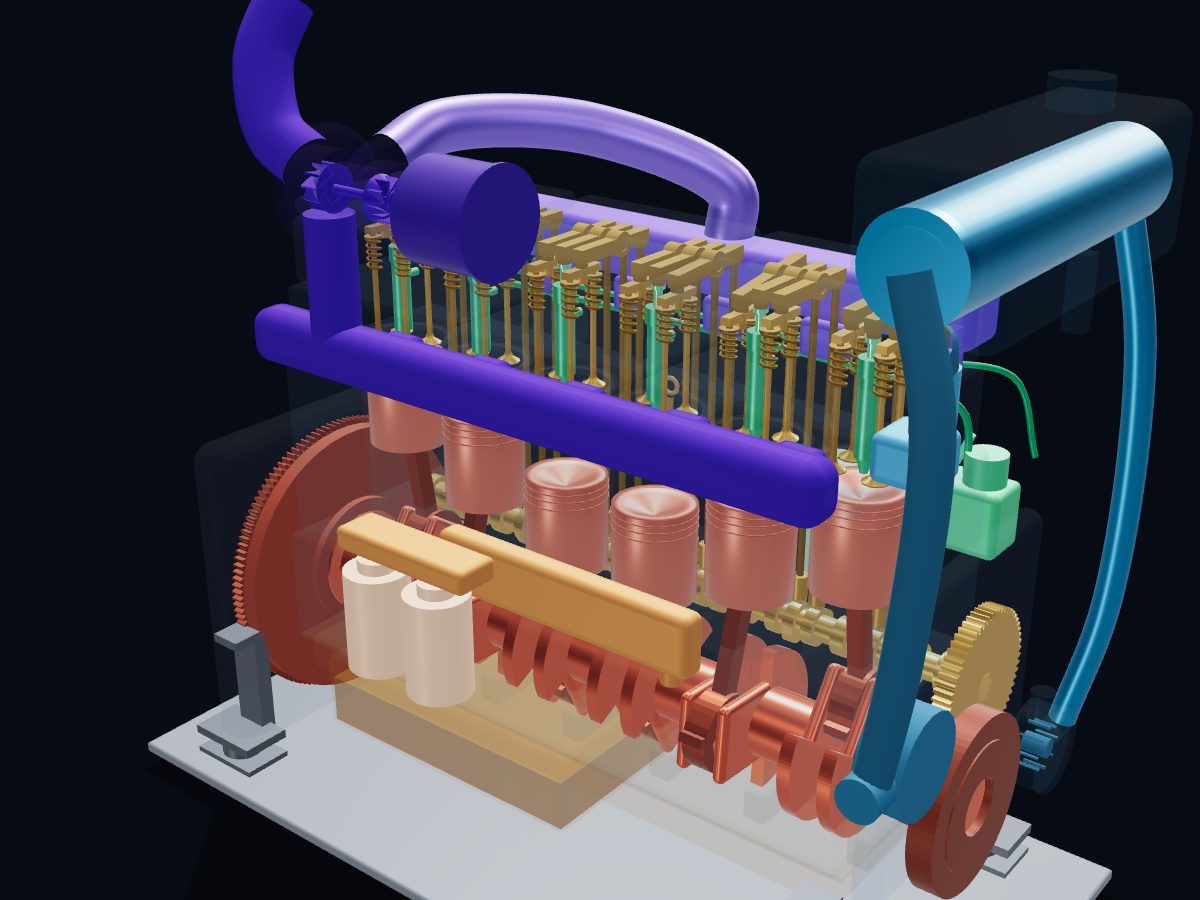
To see why, it helps to know that most inboard diesels have not one cooling circuit but two, and they only meet inside the heat exchanger. You can follow both circuits part by part in the new Engine-X marine diesel engine 3D model, an inline-six in the style of the Cummins NT855 Big Cam, and the marine diesel engine guide explains the rest of the engine.
How does a marine diesel cooling system work?
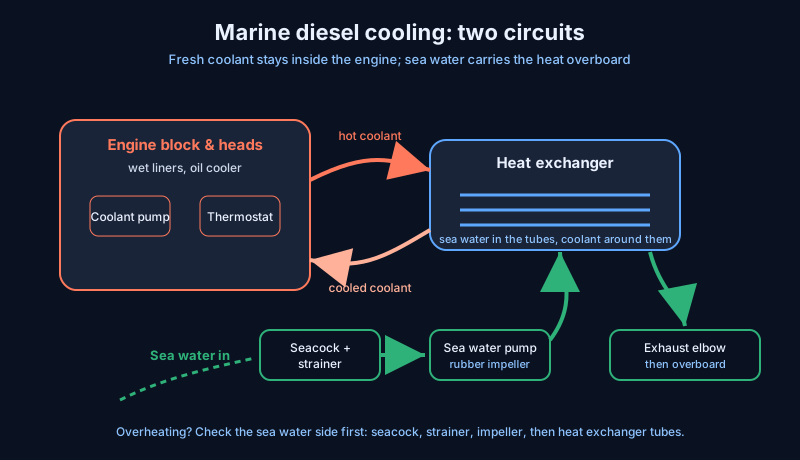
A marine diesel cooling system works like a car's radiator system, except that the radiator is a heat exchanger and the "air" is sea water. A heat exchanger is a vessel where two fluids pass close to each other through thin metal walls, so heat moves from the hot one to the cold one without the fluids mixing.
The two circuits, as described by NauticEd:
- Fresh water (coolant) circuit. A mix of fresh water and antifreeze is pumped through the block, the cylinder liners and the heads, where it picks up combustion heat. The thermostat keeps it inside the engine until it is warm, then sends it to the heat exchanger.
- Sea water (raw water) circuit. An engine-driven pump with a flexible rubber impeller draws sea water through the seacock and strainer, pushes it through the tubes of the heat exchanger, and sends it overboard, usually mixed into the exhaust at the water-cooled elbow.
Because the coolant stays in a sealed loop, the engine's water jackets never see salt water, which keeps out corrosion and scale. Big engines such as the NTA855-M are offered with either heat exchanger cooling or keel cooling, according to the Cummins marine specification sheet; keel cooling runs the coolant through pipes on the outside of the hull instead of through a heat exchanger. The trade-offs between heat exchanger types are covered in Shell and tube vs plate heat exchanger.
| Circuit | Fluid | Pump | Main parts |
|---|---|---|---|
| Fresh water | Coolant (water + antifreeze) | Centrifugal coolant pump | Block, liners, heads, thermostat, expansion tank |
| Sea water | Sea, river or lake water | Rubber impeller pump | Seacock, strainer, heat exchanger tubes, exhaust elbow |
Why does a marine diesel engine overheat?
A marine diesel engine overheats when either circuit stops moving heat, and the sea water circuit is the usual culprit because it takes in whatever floats past the hull. Boats.com's fault-finding guide lists the checks in roughly this order:
- Seacock. After maintenance the sea water seacock is sometimes left shut. Check it first; it costs nothing.
- Sea strainer. Weed, debris or a plastic bag can block it. Clear it, restart and look for water coming out with the exhaust.
- Impeller. The rubber vanes take a permanent set with age, lose efficiency and can break up. Running the pump dry, even briefly at high revs, can destroy it.
- Drive belt. A loose belt slips under load and stops driving the pumps properly.
- Coolant level and the coolant pump. On a closed system, check the level in the expansion tank once the engine has cooled.
- Scale in the heat exchanger. Limescale and marine growth narrow the tubes slowly, so the engine runs a little hotter every season.
- Thermostat. One stuck closed makes the engine overheat within minutes of starting.
How do you check a sea water pump impeller?
A sea water pump impeller is checked by taking off the pump's faceplate and looking at the rubber vanes: they should be springy, uncracked and all present. Diesel Pro Power lists the warning signs of a failing raw water pump as less water from the exhaust outlet, a fast-rising temperature, a damaged impeller and corrosion on the pump housing.
If vanes are missing, the pieces have gone downstream, usually into the inlet of the heat exchanger tube bundle, and they must be found and removed or they will block flow again. That is why many owners carry a spare impeller and change it on a schedule rather than waiting for it to fail.
The coolant pump is a different machine: a small centrifugal pump, the same principle as in the Engine-X centrifugal pump guide. Its failure signs are coolant leaks at the seal, noisy bearings and overheating under long, heavy load.
What should you check after an overheat?
After a marine diesel engine has overheated, check the damage the heat may have done, not only the cause. Boats.com recommends three checks:
- The impeller, even if it was not the cause: a hot, dry run can ruin it.
- The oil: a milky emulsion under the oil filler cap points to a failed head gasket letting coolant into the oil.
- The rubber exhaust hoses: without cooling water, hot exhaust gas can delaminate them from the inside.
Salt water is also what makes the sea water side corrode, and keeping it out of the engine is the main reason for the closed coolant loop. How metals in sea water are protected is explained in Corrosion and cathodic protection on ships.
The engineering takeaway
A marine diesel engine has two cooling circuits: a sealed coolant loop that protects the engine, and a sea water loop that carries the heat overboard. Because the sea water side meets weed, silt, salt and scale, most overheating starts there. Check the seacock, strainer and impeller first, then the heat exchanger tubes, and only then suspect the thermostat. Open the 3D marine diesel engine and turn on the Marine cooling system to see where each part sits.