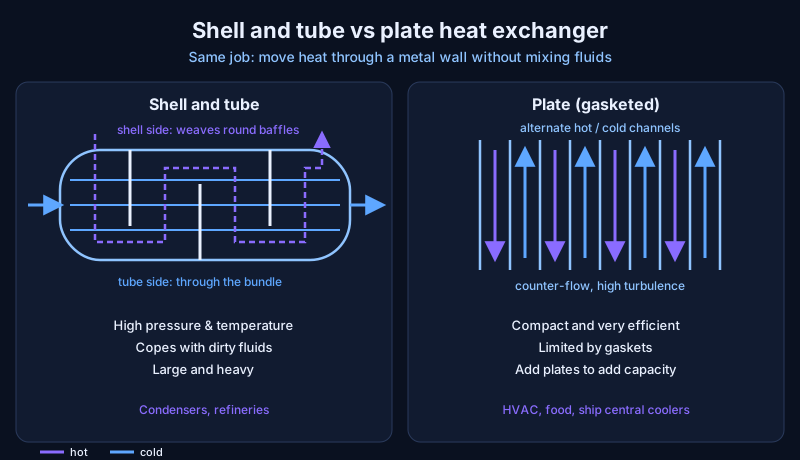
A shell-and-tube heat exchanger passes one fluid through tubes inside a large shell, while a plate heat exchanger passes both fluids between thin, corrugated metal plates. Plates are more compact and efficient; shell-and-tube units cope better with high pressure, high temperature and dirty fluids.
Both types move heat from a hot fluid to a cold one through a metal wall without mixing them.
Heat exchangers are everywhere in industry — refineries, power plants, food factories, HVAC — and a ship's engine room is full of them. Alfa Laval lists the main engine-room heat loads as the jacket water cooler, lube oil cooler, diesel oil cooler and charge air cooler, plus the auxiliary engines. All of that heat has to go somewhere.
How does a shell and tube heat exchanger work?
A shell-and-tube heat exchanger works by sending one fluid through many small tubes and the other fluid around the outside of those tubes inside a cylindrical shell. Heat passes through the tube walls from the hotter fluid to the colder one. The main parts are:
- Tube bundle — dozens to thousands of tubes fixed into a tube sheet at each end.
- Shell — the outer pressure vessel that holds the shell-side fluid.
- Baffles — plates across the shell that force the shell-side fluid to zig-zag across the tubes instead of running straight through, which increases turbulence and heat transfer.
- Channel heads (end covers) — direct the tube-side fluid into and out of the tubes, sometimes in several passes.
The design is strong and simple. Thick round tubes and a round shell hold pressure well, and there are few gaskets. Inzonex describes shell-and-tube units as tolerating pressure and temperature extremes that would destroy plate seals, and coping with dirty fluids because the passages are wider.
How does a plate heat exchanger work?
A plate heat exchanger works by stacking thin, pressed metal plates in a frame so that the gaps between them form channels, with hot and cold fluids flowing in alternate channels. Each plate has a corrugated pattern and a gasket that decides which fluid flows across it.
Every plate therefore has hot fluid on one side and cold fluid on the other, separated by a very thin wall.
The corrugations are the key. They make the fluid swirl even at low flow rates, and that turbulence strips away the slow boundary layer next to the metal, where most resistance to heat flow sits. Alfa Laval says the turbulence across the whole plate also reduces fouling. Plate units are usually arranged in counter-flow: the two fluids run in opposite directions, so a temperature difference is kept along the whole length and the cold fluid can leave almost as hot as the hot fluid enters.
Why is a plate heat exchanger smaller than a shell and tube?
A plate heat exchanger is smaller because it packs a huge heat-transfer area into a small volume and moves heat faster across each square metre.
Alfa Laval, which makes both types, claims its gasketed plate units can be up to five times more efficient than shell-and-tube designs, use about one-tenth of the floor space and weigh less than one-sixteenth as much. Those are maker's figures, but the direction is widely accepted.
Plates also make capacity easy to change: add or remove plates in the same frame. A shell-and-tube unit's capacity is fixed when it is built.
Shell and tube vs plate heat exchanger: which should you choose?
| Shell and tube | Plate (gasketed) | |
|---|---|---|
| Size and weight | Large, heavy | Compact, light |
| Efficiency | Lower per unit volume | Very high, close temperature approach |
| Pressure and temperature | High — robust construction | Limited by gaskets and plate thickness |
| Dirty or fibrous fluids | Copes well (wider passages) | Narrow channels can block |
| Cleaning | Pull or rod-clean the tube bundle | Open the frame and clean plates |
| Changing capacity | Fixed | Add or remove plates |
| Typical uses | Steam condensers, refineries, high-pressure duties | HVAC, food, marine central coolers, clean process water |
Inzonex puts the risk plainly: on a dirty duty, a plate unit can foul solid in weeks, while shell-and-tube units can run for years between overhauls. That is why the choice depends on the fluid as much as the heat load.
Why do ships use plate heat exchangers for central cooling?
Ships use plate heat exchangers for central cooling because they keep sea water out of most of the engine room. In a central cooling system, described by Alfa Laval, sea water is pumped from a sea chest through a coarse strainer, passes through titanium central coolers and goes back overboard.
Fresh water on the other side of those coolers then circulates round the ship to cool the engines and other equipment.
This layout means only the central coolers and a short sea-water line need corrosion-resistant materials. Titanium resists sea-water corrosion, and thin titanium plates make it affordable. A bypass valve on the fresh-water side holds the low-temperature circuit at a steady temperature. Shell-and-tube units still appear on board where pressure or fluid type demand them. The same engine-room heat loads include the charge air cooler that feeds a two-stroke engine's scavenge air.
How are heat exchangers maintained?
Heat exchangers are maintained by cleaning the heat-transfer surface and checking that the wall between the fluids is still tight. A thin layer of scale or marine growth acts like insulation, so performance drops long before anything fails.
- Plate units: loosen the tightening bolts, slide back the pressure plate, clean each plate and replace damaged gaskets. Alfa Laval notes no tube bundle has to be pulled.
- Shell-and-tube units: remove the end covers, clean the tubes with brushes or high-pressure water, and plug or replace leaking tubes.
- Both: pressure-test after reassembly to prove there is no leak between the two sides — a leak in a cooler can mix sea water, fresh water or oil.
The engineering takeaway
Both heat exchangers do the same job; they trade strength for compactness. Plates win when the fluids are clean and pressures moderate — high turbulence, close approach, small footprint. Shell-and-tube wins when the duty is hot, high-pressure or dirty. The right choice starts with the fluid, not the catalogue. For another case where the fluid's condition decides the outcome, see pump cavitation and NPSH — the sea-water pumps feeding these coolers must not cavitate either. To see the plates, gaskets and alternate hot and cold channels for yourself, open the plate heat exchanger in 3D, and read how ships rely on one in central cooling systems.
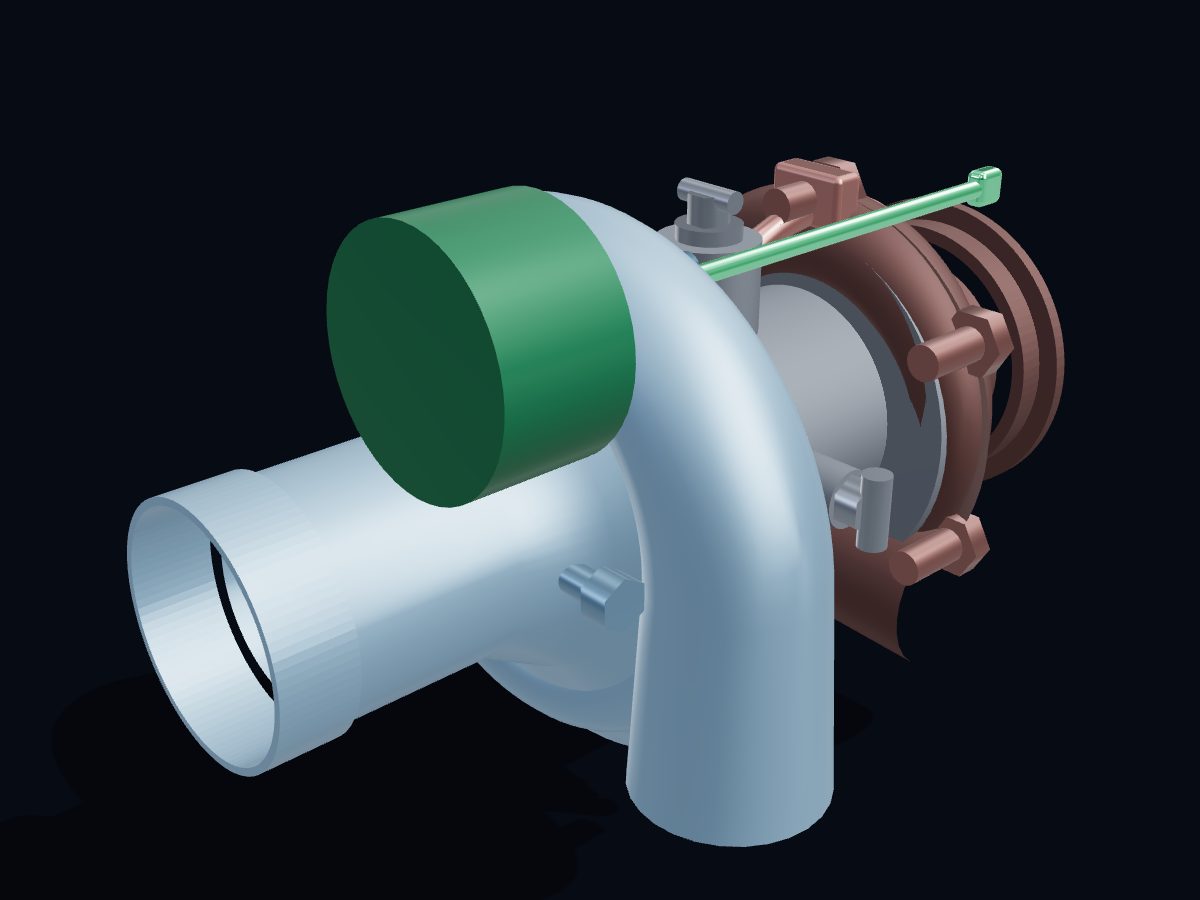 Turbocharger
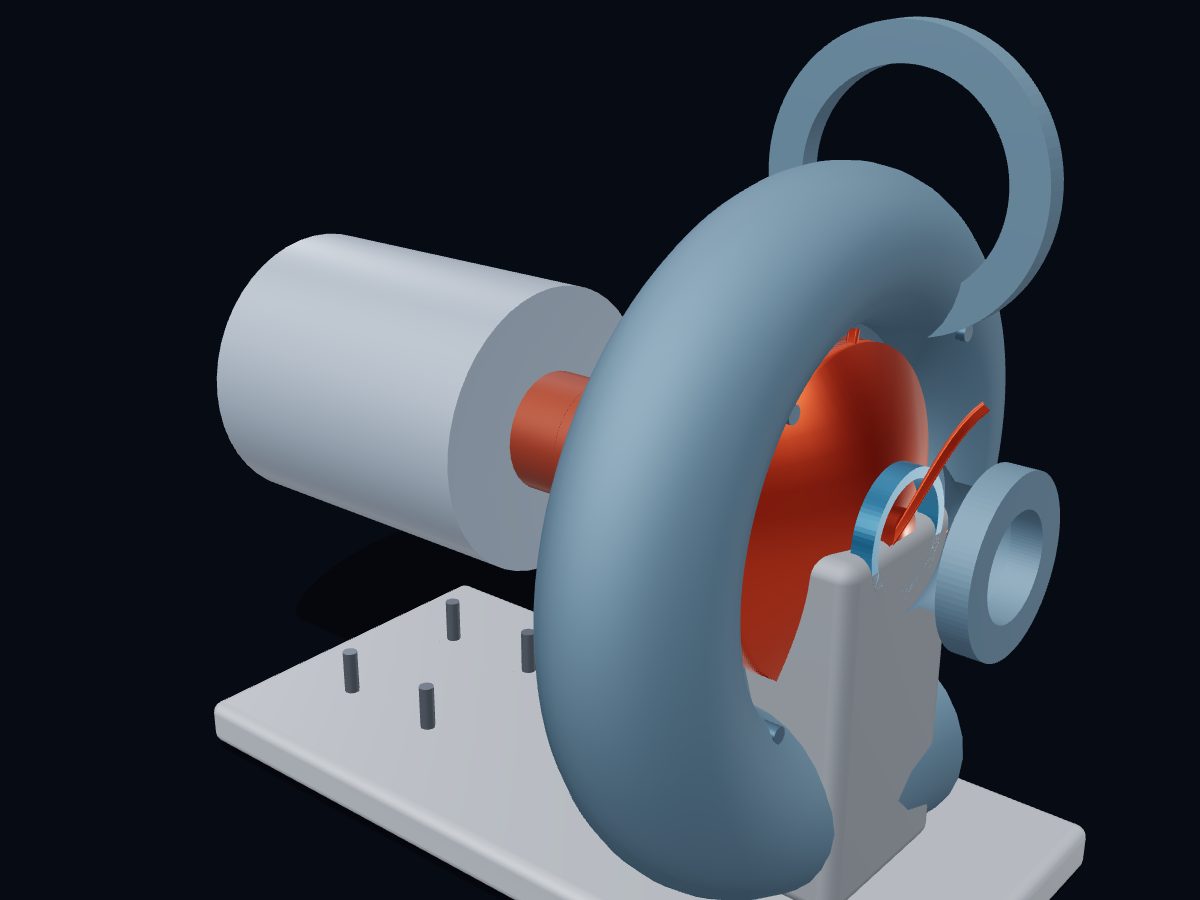 Centrifugal Pump
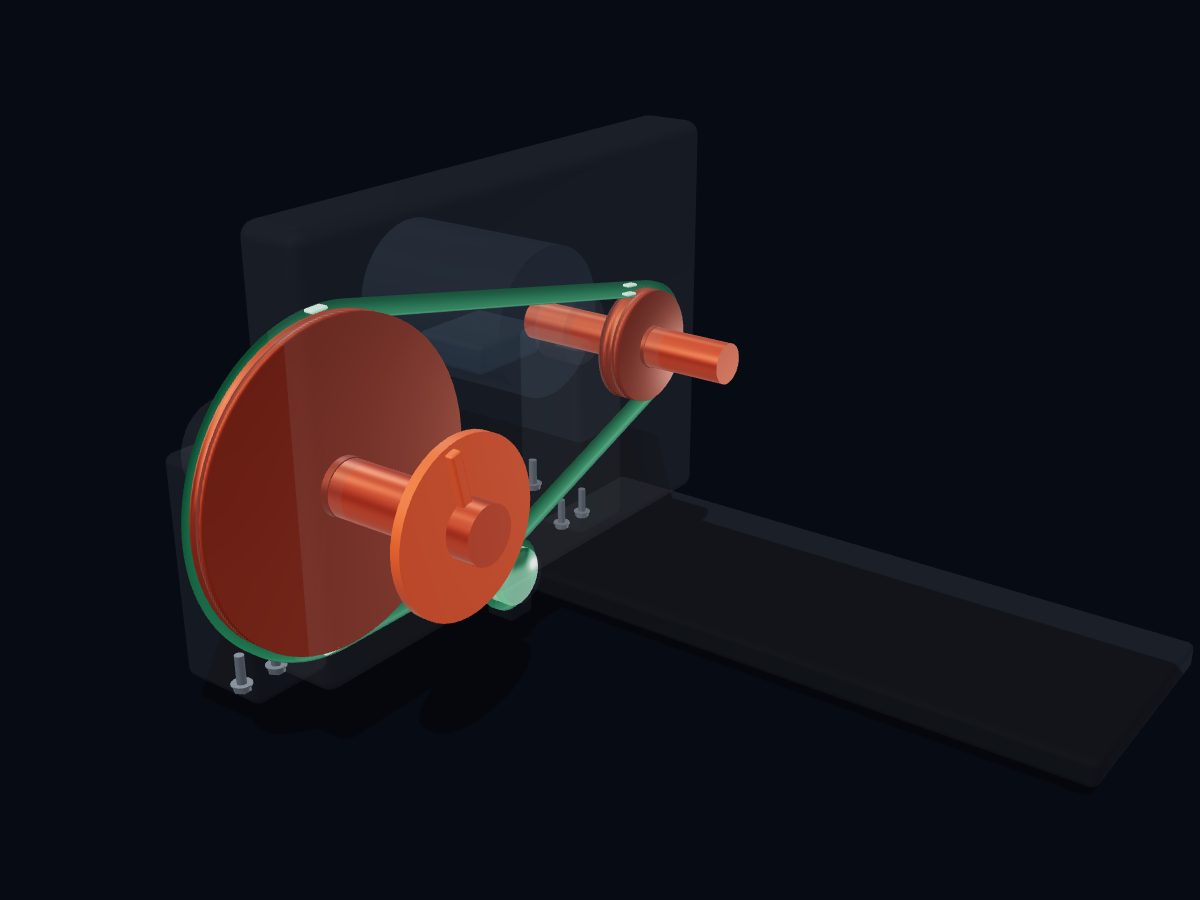 V-Belt Pulley Drive
 Helical Gear Reducer
 Marine Diesel Engine
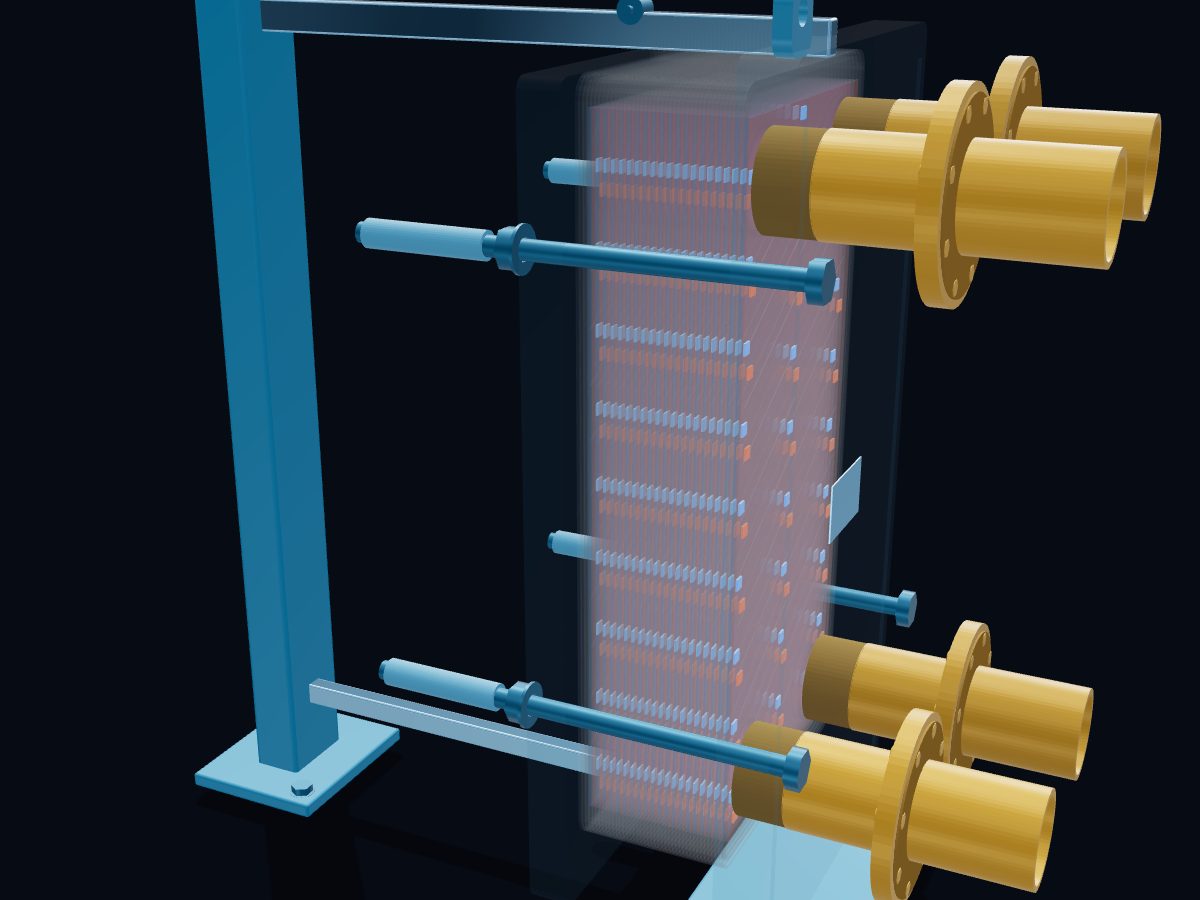 Plate Heat Exchanger
 Reciprocating Air Compressor
 Planetary Gearbox