Engine‑X machine guide
How does a marine diesel engine work?
By Parth Parmar, mechanical design engineer · Updated
A marine diesel engine burns fuel in a four-stroke cycle: it draws in air, squeezes it until it is hot enough to ignite fuel sprayed into it, lets the burning gas push the pistons down, then pushes the exhaust out. In an inline-six a cylinder fires every 120°, and sea water carries the heat away through a heat exchanger.
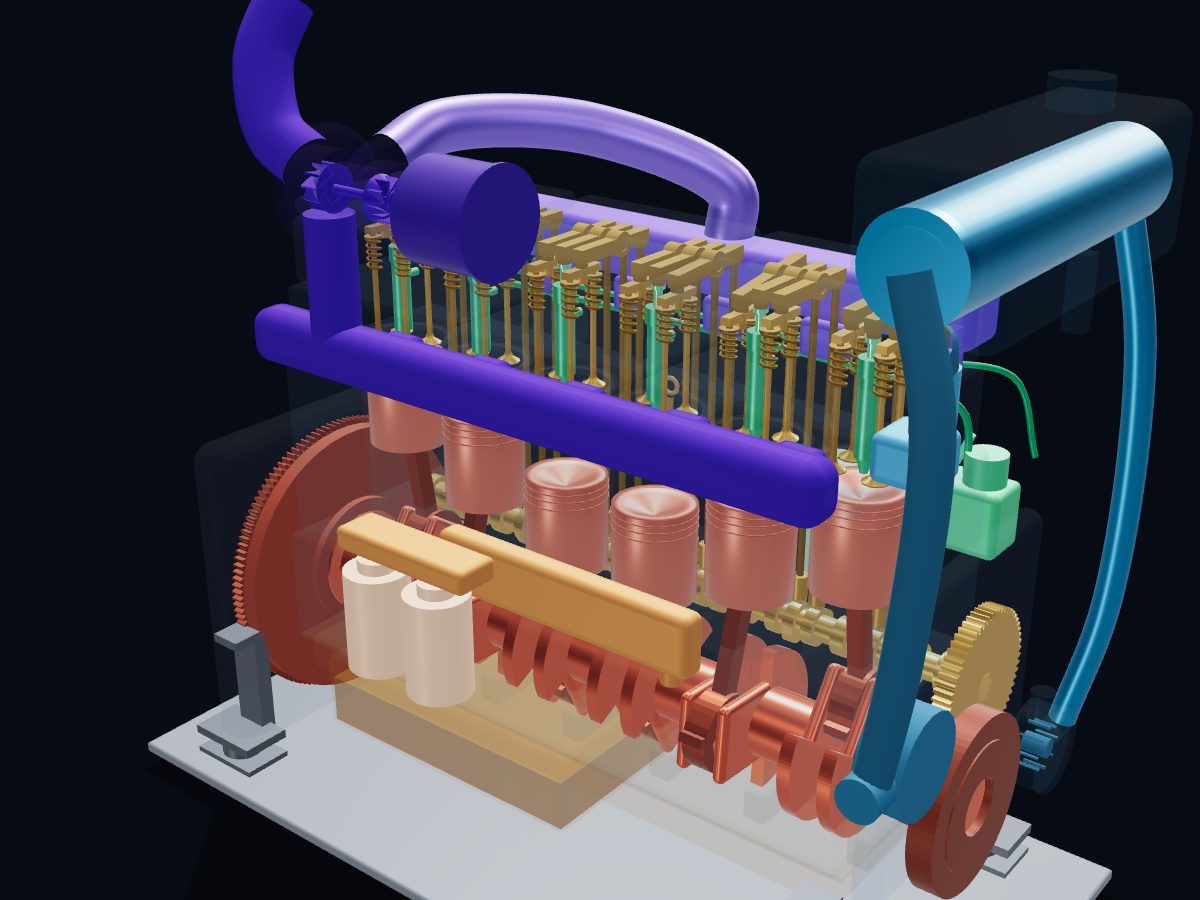
See it run: six pistons, a half-speed camshaft, 24 valves and six unit injectors moving in true timing. Explode it, cut it open and X‑ray it in 3D, free in your browser.
Open the 3D marine diesel engine →Or download the free 3D model (GLB, STL, AR).
Key facts
| Type in the 3D model | Inline-6, 4-stroke, turbocharged and aftercooled marine diesel (NT855 Big Cam style) |
|---|---|
| Bore × stroke | 140 × 152 mm (5.50 × 6.00 in) |
| Displacement | 14.0 L (855 in³) |
| Marine rating (NTA855-M) | About 242–298 kW (325–400 hp) at 1800 rpm |
| Firing order | 1-5-3-6-2-4, one cylinder every 120° |
| Fuel system | Cummins PT (pressure-time) pump with camshaft-driven unit injectors |
| Valves | 4 per cylinder (24), push tubes, rocker levers and crossheads |
| Cooling | Fresh water through a heat exchanger cooled by sea water (or keel cooling) |
| Dry weight | About 1,390–1,430 kg (NT / NTA marine) |
How it works, step by step
- Intake: the piston goes down with the intake valves open and pulls in air that the turbocharger has compressed and the aftercooler has cooled.
- Compression: both valves close and the piston rises, squeezing the air until it is hot enough to ignite diesel fuel.
- Injection: near the top of the stroke, the injector cam pushes the unit injector plunger down and sprays the metered fuel into the bowl in the piston crown.
- Power: the fuel burns and the pressure drives the piston down; the connecting rod turns the crankshaft.
- Exhaust: the exhaust valves open and the rising piston pushes the gas out through the water-cooled manifold to spin the turbocharger.
- The cycle takes two crank turns, so the camshaft turns at half speed. With six cylinders, a power stroke starts every 120° of crank rotation.
Main parts of a marine diesel engine
- Block, wet liners and three cylinder heads — each head covers two cylinders, as on the real engine.
- Crankshaft, pistons and connecting rods — six throws on seven main bearings, with a front vibration damper and a rear flywheel.
- Camshaft and valve train — three lobes per cylinder drive the intake valves, the injector and the exhaust valves through push tubes and rocker levers.
- PT fuel system — PT pump, filter, supply and drain lines, six unit injectors.
- Turbocharger and aftercooler — more air in, cooled, for more power.
- Marine cooling — heat exchanger and expansion tank, sea water pump, coolant pump, thermostat, water-cooled exhaust manifold and elbow.
- Lubrication — oil pan, oil cooler, filters and dipstick.
What is the firing order of an inline 6 diesel engine?
Most inline-six engines, the NT855 included, fire 1-5-3-6-2-4, numbered from the front. The crank throws sit in pairs 120° apart (1 and 6, 2 and 5, 3 and 4), so one cylinder fires every 120° and the firing jumps between the front and rear halves of the crankshaft.
| Crank angle | 0° · 120° · 240° · 360° · 480° · 600° |
|---|---|
| Cylinder firing | 1 · 5 · 3 · 6 · 2 · 4 |
| Throws together | 1 & 6, 2 & 5, 3 & 4 (each pair 120° from the next) |
In the 3D model the firing strip under the speed slider lights up each cylinder as it fires. When cylinder 1 starts its power stroke, cylinder 6, with its piston also at the top, is just finishing its exhaust stroke and starting intake.
How does the Cummins PT fuel system work?
A gear pump in the PT (pressure-time) pump supplies fuel at low pressure; its governor and the throttle set that pressure. Each unit injector meters fuel for as long as its metering hole is open, so the amount depends on pressure × time, and the camshaft drives the injector plunger down to inject at over 1,300 bar.
- PT pump: a gear pump draws fuel through the filter; the governor and throttle set the supply pressure.
- Low-pressure rail: fuel runs to all six injectors through the supply line, and unused fuel returns through the drain line, cooling the injectors.
- Unit injector: the injector cam lobe, push tube and rocker drive the plunger down near the end of compression and force the metered fuel into the cylinder.
How is a marine diesel engine cooled?
Most use two circuits. Fresh coolant circulates through the block and heads like in a truck engine; a sea water (raw water) pump pushes sea water through the tubes of a heat exchanger, where it picks up the heat and goes overboard, usually through the exhaust. Keel cooling instead runs the coolant through pipes outside the hull.
- The fresh water pump circulates coolant through the block, wet liners, heads and oil cooler.
- The thermostat keeps it inside the engine until it is warm, then sends it through the heat exchanger shell.
- The sea water pump's rubber impeller pulls sea water through the hull strainer and pushes it through the heat exchanger tubes (and often the aftercooler).
- The warmed sea water is injected into the water-cooled exhaust elbow and leaves the boat with the exhaust gas.
What is a Cummins Big Cam engine?
Big Cam is the name for the NT855 versions built from 1976, which got a camshaft with larger 2.5 in journals (up from 2 in) and bigger lobes. The stronger injector lobes raised injection pressure from about 11,000 to 14,000 psi; Big Cam I to IV followed until the mid-1980s.
This Engine‑X model is an educational model in the NT855 Big Cam style. It follows the published layout and dimensions, but it is not a Cummins drawing, and Engine‑X is not affiliated with Cummins.
Common questions
What does NTA855 mean?
N is the Cummins N-series (the 14-litre family), T means turbocharged, A means aftercooled, and 855 is the displacement in cubic inches (14.0 litres). A suffix shows the use: M for marine, G for generator sets.
Why does a marine diesel engine overheat?
The usual causes are on the sea water side: a worn or burnt rubber impeller in the sea water pump, a blocked sea strainer or intake, or heat exchanger tubes clogged with scale or marine growth. On the fresh water side, check the coolant level, the thermostat and the belt.
Why is an inline-six engine so smooth?
Its six throws are arranged so the front three cylinders mirror the rear three. The shaking forces of the pistons cancel out at both first and second order, so an inline-six needs no balance shafts, and overlapping power strokes every 120° give an even torque.
What does the aftercooler do on a diesel engine?
Compressing air in the turbocharger heats it. The aftercooler cools that air again before it enters the cylinders, so it is denser: more air fits in, more fuel can burn, and combustion and exhaust temperatures stay lower. The A in NTA855 stands for aftercooled.
What are wet cylinder liners?
Wet liners are replaceable sleeves that the pistons run in, with coolant touching their outside directly. They cool well and make an overhaul simpler: a worn bore is fixed by fitting new liners instead of machining the block.
Sources
References for the facts on this page, and further reading:
- Cummins — NT855 / NTA855-M marine engine specification sheet
- Cummins — NT855 engine (14 L, PT fuel system)
- SlashGear — Which Cummins diesel engine was called "Big Cam" and what made it so special?
- Owner//Driver / Roadtrains — How the Cummins PT fuel system works
- SAE Technical Paper 800922 — Evolution of the NT-855 engine
- Wikipedia — Straight-six engine (balance and firing order)
More machine guides
Compare: Turbocharger vs supercharger: what's the difference?
How does a turbocharger work? · How does a centrifugal pump work? · How does a gear reducer work? · How does a V-belt pulley drive work? · How does a plate heat exchanger work? · How does a reciprocating air compressor work? · How does a planetary gearbox work?
Need an interactive 3D page like this for your own machine? See Work with Engine‑X.