Engine‑X machine guide
How does a planetary gearbox work?
By Parth Parmar, mechanical design engineer · Updated
A planetary gearbox has a central sun gear, several planet gears around it on a carrier, and an outer ring gear with internal teeth. Hold the ring still and drive the sun: the planets roll round inside the ring and turn the carrier slowly. The ratio is 1 + ring teeth ÷ sun teeth.
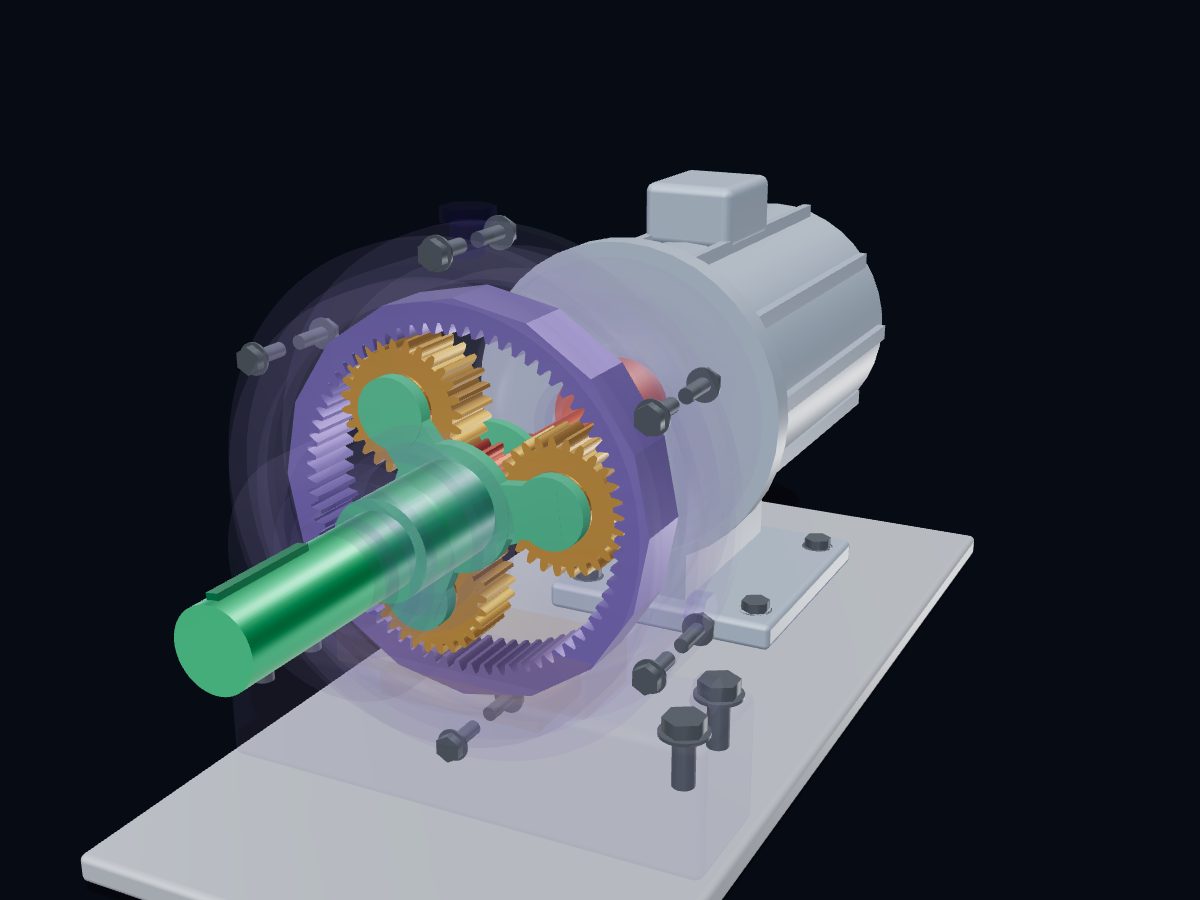
See it run: watch the sun spin fast, the planets spin backwards and the carrier creep round, then explode and X‑ray the gearbox in 3D, free in your browser.
Open the 3D planetary gearbox →Or download the free 3D model (GLB, STL, AR).
Key facts
| Type in the 3D model | Single-stage planetary reducer: sun input, three planets, ring gear fixed, carrier output |
|---|---|
| Teeth | Sun 18, planets 3 × 27, ring 72 (internal), module 2.5 mm |
| Ratio | 1 + 72 ÷ 18 = 5 : 1 |
| Speed | 1440 rpm in (4-pole motor, 50 Hz) → 288 rpm out, same direction |
| Torque | About 9.9 N·m in from 1.5 kW → about 50 N·m out, less a few percent for friction |
| Pitch diameters | Sun Ø45 mm, planets Ø67.5 mm, ring Ø180 mm |
| Tooth-count rules | Ring = sun + 2 × planet (18 + 54 = 72); (sun + ring) ÷ 3 planets = 30, a whole number |
| Bearings | Needle roller bearings in the planets; two ball bearings carry the output |
How it works, step by step
- The motor turns the input shaft and the 18-tooth sun gear at about 1440 rpm.
- The sun drives all three 27-tooth planets at once, each spinning on its pin the opposite way to the sun.
- The planets also mesh with the 72-tooth ring gear, which is held still in the housing, so they have to roll round inside it.
- Rolling round the ring, the planets carry their pins, and the carrier, with them: one carrier turn for every five sun turns.
- The carrier is the output: 288 rpm, the same direction as the motor, with about five times the torque.
- Three planets share the load and their tooth forces balance at the centre, so the box stays compact and the shafts see no net side force.
Main parts of a planetary gearbox
- Sun gear and input shaft — the fast, low-torque centre of the set.
- Planet gears — three idlers that mesh with both the sun and the ring.
- Planet carrier and output shaft — hold the planet pins; the slow, high-torque output.
- Ring gear — internal teeth, held still in the housing.
- Needle bearings, pins and thrust washers — let each planet spin freely on the carrier.
- Housings, bearings and seal — line everything up, hold the oil and carry the output load.
How do you calculate a planetary gear ratio?
Hold one member still and use the tooth counts. With the ring fixed, sun in and carrier out, the ratio is 1 + ring ÷ sun. With the sun fixed, ring in and carrier out, it is 1 + sun ÷ ring. With the carrier fixed, sun in and ring out, it is ring ÷ sun, and the ring turns backwards.
| Ring fixed (this model) | Sun → carrier: 1 + 72 ÷ 18 = 5 : 1, same direction |
|---|---|
| Sun fixed | Ring → carrier: 1 + 18 ÷ 72 = 1.25 : 1, same direction |
| Carrier fixed | Sun → ring: 72 ÷ 18 = 4 : 1, reversed |
| Two members locked together | 1 : 1, the whole set turns as one |
All of these come from one equation (Willis): (ring + sun) × carrier speed = ring × ring speed + sun × sun speed, with speeds in rpm and counts in teeth (tec-science, Woodgears).
What are the rules for planetary gear tooth counts?
Three rules. The ring must have as many teeth as the sun plus two planets, so a planet fits on each side of the sun. For evenly spaced planets, sun teeth + ring teeth divided by the number of planets must be a whole number. And the planets must be small enough not to touch each other.
| Coaxial rule | 72 = 18 + 2 × 27 ✓ |
|---|---|
| Equal spacing | (18 + 72) ÷ 3 = 30 ✓ |
| Planets clear each other | Centres 97 mm apart, tips Ø72.5 mm ✓ |
Break the spacing rule and the planets will not all mesh at 120° apart; you would have to space them unevenly.
Planetary vs helical gearbox: which is better?
A planetary gearbox gives more torque in a smaller, rounder case with the input and output on one line, because several planets share the load and their forces cancel at the centre. A parallel-shaft helical gearbox is simpler, offsets the output shaft, and is easy to inspect and repair. Choose by space, ratio and shaft layout.
- Planetary: compact and coaxial, high torque density, big ratios when stages are stacked; more parts in a small space.
- Helical (parallel shaft): simple layout, shafts side by side, in-line helical reducers are usually 95–98% efficient (Machine Design).
- See the helical gear reducer guide and its 3D model to compare.
Common questions
Why is it called a planetary gear?
The planet gears orbit the central sun gear the way planets orbit the sun. The same layout is also called epicyclic gearing.
Why does the carrier turn the same way as the sun?
With the ring held still, the planets roll round the inside of the ring in the direction the sun pushes them, so the carrier follows the sun, only slower. The planets themselves spin the other way.
Why do planetary gearboxes use three planets?
Several planets share the torque, so each mesh carries only part of it, and their pushes on the sun balance out. Three evenly spaced planets is a common, compact choice; more planets share the load further if they fit.
Where are planetary gears used?
In most automatic car transmissions, some CVT and hybrid drives, portal axles, wind turbines, helicopter and aircraft drives, augers, robots and other industrial machinery.
Can you get a bigger ratio from a planetary gearbox?
Yes, by stacking stages: the carrier of one stage drives the sun of the next, and the ratios multiply. Two 5 : 1 stages give 25 : 1.
Sources
References for the facts on this page, and further reading:
- tec-science — Planetary gears: Willis equation and ratios for each fixed member
- Woodgears.ca (Matthias Wandel) — Planetary gear ratio calculations and spacing rules
- Mechanical-Engineering.com — Planetary gears: a masterclass for mechanical engineers
- The Drive — What is a planetary gear? Uses in transmissions, axles and machinery
- Machine Design — Gear efficiency: key to lower drive cost
Related reading on the blog
Spur, helical, bevel or worm? How to choose the right gear type · Helical vs worm gear reducer: which wastes less power? · Ball, roller or journal bearing? How bearing types work
More machine guides
Compare: How does a gear reducer work? (helical) · Belt vs chain vs gear drive: which is better?
How does a turbocharger work? · How does a centrifugal pump work? · How does a V-belt pulley drive work? · Turbocharger vs supercharger: what's the difference? · How does a marine diesel engine work? · How does a plate heat exchanger work? · How does a reciprocating air compressor work?
Need an interactive 3D page like this for your own machine? See Work with Engine‑X.