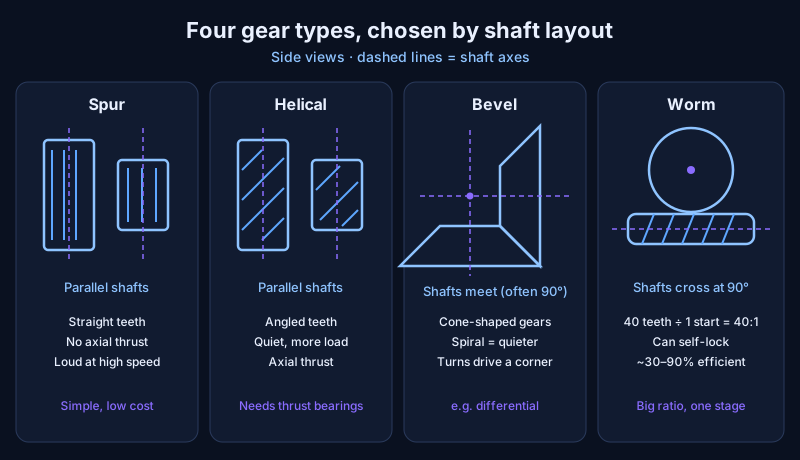
The right gear type depends first on how the two shafts sit: spur and helical gears connect parallel shafts, bevel gears connect shafts that meet at an angle, and worm gears connect shafts that cross at right angles without meeting.
After that, the choice comes down to noise, load, side thrust on the bearings and how much power you can afford to lose.
Gears do the same job as belts and chains — carry power from one shaft to another at a new speed — but with teeth instead of friction, so they never slip. The belt vs chain vs gear drive comparison on Engine-X covers when gears beat the other two. This guide goes one level deeper: which gear.
How does a gear change speed and torque?
A gear pair changes speed and torque through its tooth ratio. When a small gear (the pinion) drives a larger gear, the larger gear turns slower and with more torque, because the teeth must pass the contact point at the same rate on both.
A 20-tooth pinion driving a 60-tooth gear gives a 3:1 reduction: one-third the speed, about three times the torque (minus losses).
Every gear type below follows this rule. What changes is the shape of the teeth and the direction the shafts point.
What are spur gears and when are they used?
Spur gears are gears with straight teeth cut parallel to the shaft, and they connect parallel shafts. They are the simplest gears to make accurately, and MISUMI notes they are efficient, with minimal power lost to slippage.
The weakness is noise. Each spur tooth comes into contact across its whole width at once, so every engagement is a small impact. At high speed those impacts add up to a loud whine. Spur gears also push no load along the shaft (no axial thrust), which keeps the bearings simple. A design note from MechRef: with the common 20° pressure angle, a pinion should have at least about 18 teeth to avoid problems with tooth shape.
Typical uses: simple gear trains, pumps, hand tools, and machines where speed is moderate and cost matters.
Why are helical gears quieter than spur gears?
Helical gears are quieter than spur gears because their teeth are cut at an angle to the shaft, so each tooth enters contact gradually, from one end to the other, instead of all at once.
More than one tooth also shares the load at any moment. Gear Solutions explains this as an extra "overlap" contact ratio that spur gears do not have, which gives helical gears lower noise and vibration and higher load capacity.
The price is axial thrust. Because the teeth are angled, they push the shaft sideways along its axis as well as turning it. Interesting Engineering notes that helical gears therefore need thrust bearings, and MISUMI adds that sliding along the angled teeth makes them slightly less efficient than spur gears. Double-helical (herringbone) gears cancel this thrust by using two opposite helices side by side.
Typical uses: industrial gearboxes, vehicle transmissions, marine reduction gearboxes and anything that runs fast and needs to be quiet.
What are bevel gears used for?
Bevel gears are cone-shaped gears that connect two shafts which intersect, most commonly at 90°. They turn the drive around a corner. Interesting Engineering gives the classic example: the vehicle differential, which lets two wheels on one axle turn at different speeds through a corner.
Straight bevel gears behave like spur gears — simple but noisy. Spiral bevel gears have curved teeth that engage gradually, like helical gears, so they are stronger and quieter, but they are harder to make and create axial thrust. MISUMI notes that spiral bevel gears should be bought as matched pairs, since they mesh reliably only with gears from the same maker.
Typical uses: differentials, right-angle gearboxes, hand drills, and power take-offs.
How does a worm gear work, and why is it self-locking?
A worm gear works like a screw turning a toothed wheel: the worm (a threaded shaft) meshes with the worm wheel at right angles. Each turn of a single-start worm moves the wheel by just one tooth, so the ratio is simply wheel teeth ÷ worm starts. A 40-tooth wheel with a single-start worm gives 40:1 in one compact stage.
FIRGELLI notes single pairs ranging from about 5:1 to well over 300:1.
The worm slides across the wheel teeth rather than rolling, and sliding means friction. That gives worm gears two linked properties:
- Lower efficiency. FIRGELLI gives a range of roughly 30% for strongly self-locking designs up to about 90% for designs that allow back-driving; MechRef quotes 50–90%. The lost power turns into heat in the oil.
- Self-locking. When the friction angle is larger than the worm's lead angle, the wheel cannot drive the worm backwards. The load stays put even with the motor off — useful for hoists, gates and valve actuators. FIRGELLI's example: a friction coefficient of 0.12 gives a friction angle of about 6.8°, so a 5° lead angle self-locks.
Worm gears are quiet, but they also put a high thrust load on the worm shaft, so its bearings must be sized for it.
Which gear type should you choose?
The gear type you should choose follows from the shaft layout, then the duty:
| Gear type | Shafts | Noise | Axial thrust | Efficiency | Best for |
|---|---|---|---|---|---|
| Spur | Parallel | Loud at speed | None | High | Simple, low-cost, moderate speed |
| Helical | Parallel | Quiet | Yes | High (slightly below spur) | Fast, heavy, quiet drives |
| Bevel (straight / spiral) | Intersecting, often 90° | Loud / quiet | Spiral: yes | High | Turning a drive through an angle |
| Worm | Crossed at 90° | Quiet | High on worm | ~30–90% | Big reduction, holding loads |
The engineering takeaway
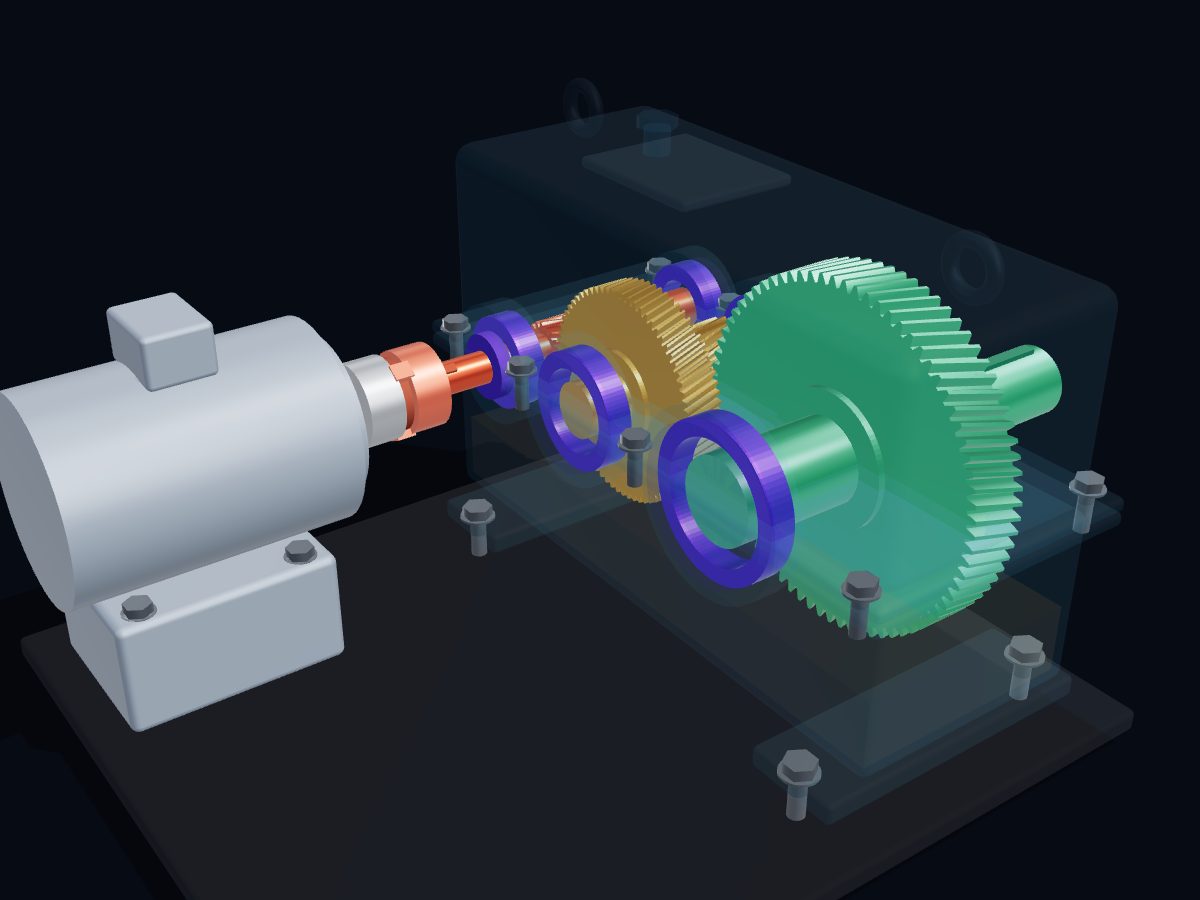
Gear selection is a chain of trade-offs: straight teeth are simple but noisy, angled teeth are quiet but push on the bearings, and sliding teeth give big ratios and self-locking at the cost of heat. Start with the shaft layout, then check speed, noise and whether the load must hold by itself — and always size the bearings for the thrust the gear creates. If a drive keeps slipping or wearing, compare it with how a V-belt fails from tension and alignment; gears trade that slip for precise alignment and good lubrication. See helical gears meshing in a real two-stage gearbox in the 3D gear reducer, and compare them with worm drives in helical vs worm gear reducer.