Engine‑X machine guide
How does a centrifugal pump work?
By Parth Parmar, mechanical design engineer · Updated
A centrifugal pump moves liquid with a spinning impeller. Liquid enters the centre of the impeller (the eye), the vanes throw it outward at high speed, and the spiral volute casing around the impeller slows that fast flow down, turning its speed into pressure that pushes the liquid out of the discharge.
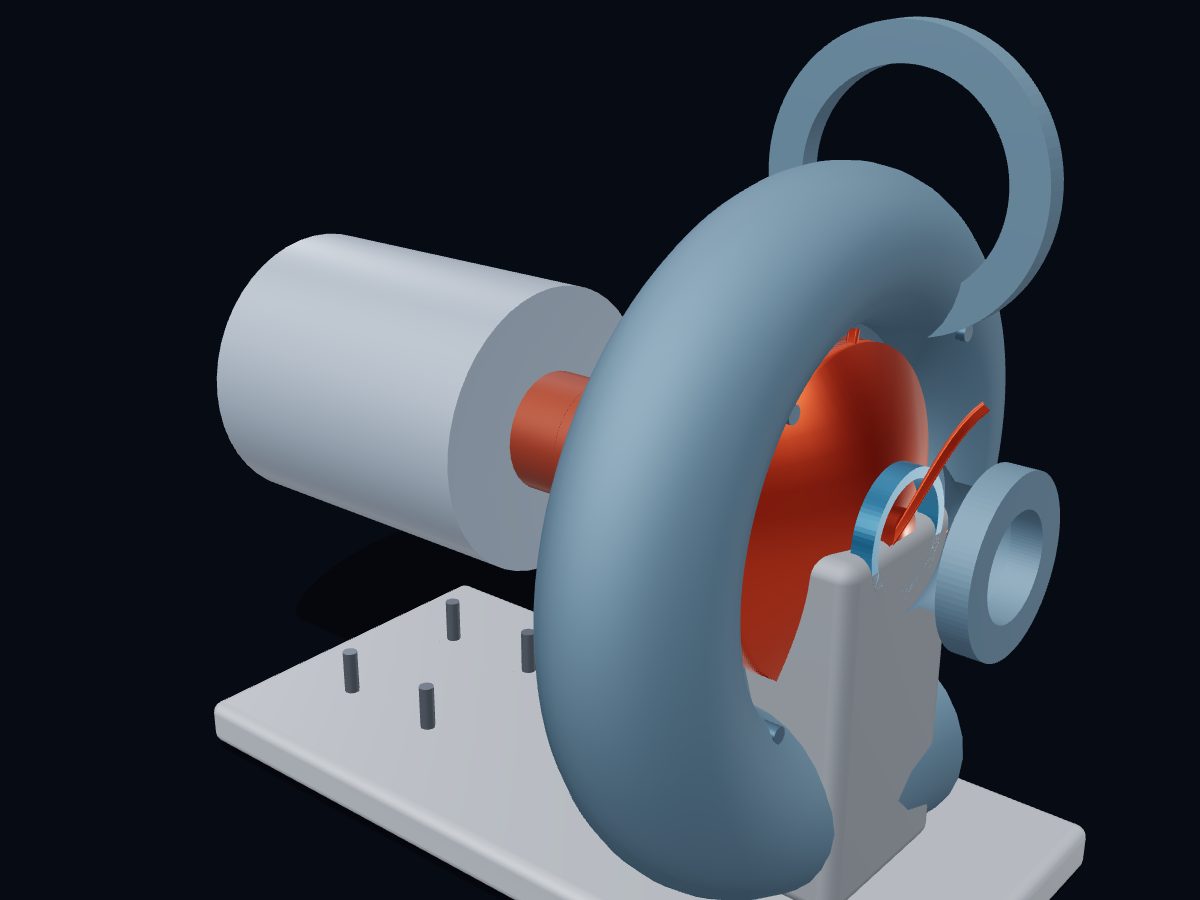
See it move: explode, cut open and X‑ray the centrifugal pump in 3D, free in your browser.
Open the 3D centrifugal pump →Or download the free 3D model (GLB, STL, AR).
Key facts
| Type in the 3D model | Single-stage, end-suction |
|---|---|
| Impeller | 164 mm diameter, 6 backward-curved vanes |
| Drive | About 3 kW motor at 2,900 rpm, direct-coupled |
| Converts | Velocity of the liquid into pressure (head) |
| Shaft seal | Mechanical seal: carbon ring against a ceramic seat |
| Needs priming | Yes: the casing must be full of liquid to start |
How it works, step by step
- The motor turns the pump shaft and impeller through a flexible coupling.
- Liquid flows in along the shaft axis through the suction flange and into the impeller eye.
- The rotating vanes accelerate the liquid outward to the impeller tip.
- The liquid leaves the tip at high speed into the volute, a spiral passage that widens as it wraps around the impeller.
- As the passage widens, the flow slows down and its speed is converted into pressure.
- The pressurised liquid leaves through the discharge flange into the pipeline.
Main parts of a centrifugal pump
- Impeller — the rotating part with vanes that adds energy to the liquid.
- Volute casing — the spiral housing that turns velocity into pressure.
- Shaft, bearings and coupling — carry the motor's torque to the impeller.
- Mechanical seal — stops liquid leaking out along the spinning shaft.
- Wear ring — a replaceable ring that keeps the gap at the impeller eye tight.
How to prime a centrifugal pump
A standard centrifugal pump cannot move air, so the casing and suction line must be full of liquid before it starts.
- Close the discharge valve, or leave it only slightly open.
- Open the air vent or priming plug on top of the casing.
- Fill the casing and suction pipe with liquid through the priming connection until liquid comes out of the vent with no air bubbles.
- Close the vent or priming plug.
- Start the motor.
- Open the discharge valve slowly and check that the pressure gauge rises and the flow is steady.
A foot valve at the bottom of the suction pipe keeps the line full between starts, so the pump does not lose its prime.
How do you read a centrifugal pump curve?
A pump curve plots the head a centrifugal pump can produce against its flow rate. Head is highest at zero flow (the shutoff head) and falls as flow rises. The efficiency curve peaks at the best efficiency point (BEP); running near the BEP keeps power cost and wear low. The curve also shows motor power and the NPSH the pump needs at each flow.
- Find your required flow on the horizontal axis.
- Go up to the head curve for your impeller diameter and read the head the pump will deliver.
- Check that point is close to the BEP, and above the vendor's minimum flow.
- Read the power and NPSH required at that flow, and make sure the NPSH available in your system is higher.
What are the main types of centrifugal pumps?
The common types are end-suction pumps (one impeller, liquid enters along the shaft, like the Engine-X model), split-case pumps (the casing opens along the shaft for big flows and easy service), multistage pumps (several impellers in series for high pressure), vertical inline pumps that fit straight into a pipeline, and submersible pumps that run under the liquid.
Common questions
What does the volute casing do?
The volute collects the fast-moving liquid leaving the impeller. Its cross-section grows steadily around the impeller, so the flow slows down in a controlled way and its velocity is converted into pressure instead of being lost as turbulence.
Why are impeller vanes curved backward?
Backward-curved vanes lean away from the direction of rotation. They give a stable, steadily falling head-versus-flow curve and good efficiency, and the power draw does not keep rising at high flow, which is why they are the usual choice for general-purpose pumps.
Why does a centrifugal pump need priming?
A standard centrifugal pump cannot pump air. If the casing is empty, the impeller just spins in air and creates almost no suction, so the casing and suction pipe must be filled with liquid before starting. Self-priming designs keep liquid in the casing to get around this.
What is cavitation in a pump?
Cavitation happens when the pressure at the impeller eye drops below the liquid's vapour pressure. Vapour bubbles form and then collapse violently as they reach higher pressure, causing noise, vibration, loss of flow and pitting damage on the impeller. Enough suction pressure (NPSH available above NPSH required) prevents it.
What is a mechanical seal?
A mechanical seal is a pair of very flat rings, one turning with the shaft and one fixed in the casing, pressed together by a spring. The thin film between their faces stops the pumped liquid escaping along the shaft with far less leakage than older gland packing.
Sources
References for the facts on this page, and further reading:
- U.S. Department of Energy — DOE Fundamentals Handbook: Mechanical Science (DOE-HDBK-1018/1-93), Pumps
- Hydraulic Institute via Pumps & Systems — Differences between positive displacement and centrifugal pumps
- Fluid Flow Info — Centrifugal pump performance curve explained
Related reading on the blog
Pump cavitation and NPSH explained · How a cooling tower works · Hydrostatic testing: how pipelines are pressure-tested
More machine guides
Compare: Centrifugal vs positive displacement pump: what's the difference?
How does a turbocharger work? · How does a V-belt pulley drive work? · How does a gear reducer work? · How does a planetary gearbox work? · How does a reciprocating air compressor work? · How does a plate heat exchanger work? · Turbocharger vs supercharger: what's the difference? · Centrifugal vs positive displacement pump: what's the difference? · Belt vs chain vs gear drive: which is better? · How does a marine diesel engine work?
Need an interactive 3D page like this for your own machine? See Work with Engine‑X.