Engine‑X machine guide
How does a turbocharger work?
By Parth Parmar, mechanical design engineer · Updated
A turbocharger uses the engine's own exhaust gas to spin a turbine wheel. The turbine sits on the same shaft as a compressor wheel, which pulls in fresh air and pushes it into the engine under pressure. More air lets the engine burn more fuel, so a smaller engine can make the power of a bigger one.
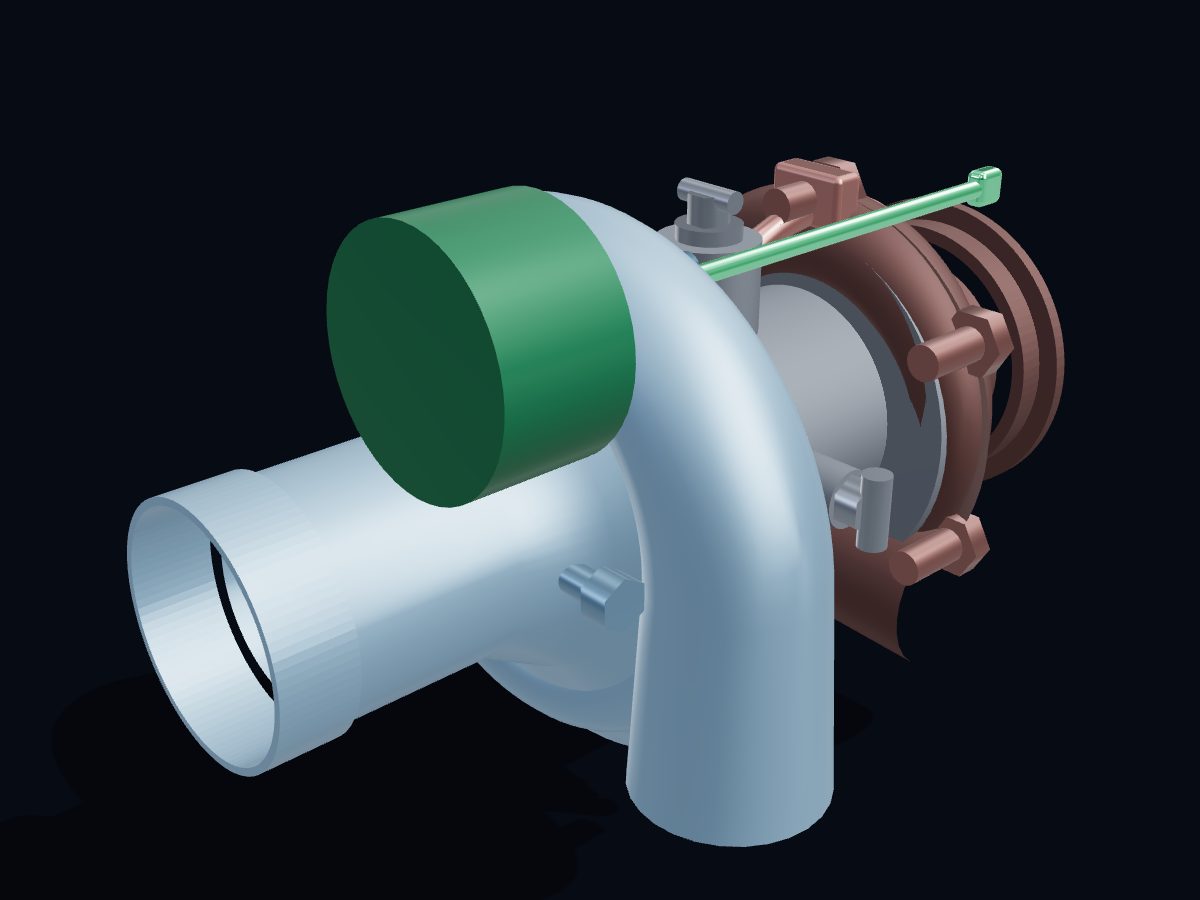
See it move: explode, cut open and X‑ray the turbocharger in 3D, free in your browser.
Open the 3D turbocharger →Or download the free 3D model (GLB, STL, AR).
Key facts
| Driven by | Exhaust gas (no belt from the crankshaft) |
|---|---|
| Shaft speed | About 150,000 rpm at full boost |
| Boost in the 3D model | Up to 2.5 bar absolute |
| Sides | Hot side (turbine) and cold side (compressor) |
| Bearings | Journal and thrust bearings running on engine oil |
| Boost control | Wastegate valve and actuator |
How it works, step by step
- Hot exhaust gas leaves the engine and enters the spiral turbine housing.
- The gas expands through the turbine wheel and spins it, then leaves through the outlet.
- The turbine wheel turns a shared shaft, which turns the compressor wheel on the other end.
- The compressor wheel draws in fresh air and flings it outward at high speed; the diffuser and compressor housing turn that speed into pressure.
- The pressurised air (usually cooled in an intercooler) flows into the engine's intake.
- When boost reaches its limit, the wastegate opens and lets some exhaust bypass the turbine, so the turbo cannot over-speed.
Main parts of a turbocharger
- Turbine wheel and housing — the hot side; extracts energy from exhaust gas.
- Compressor wheel and housing — the cold side; compresses intake air.
- Shaft — joins the two wheels and spins as one rotating group.
- Centre housing (CHRA) — holds the journal and thrust bearings, fed with engine oil and often coolant.
- Wastegate and actuator — bypass valve that limits boost pressure.
What are the signs of a failing turbocharger?
The usual signs of a failing turbocharger are a new whistling or grinding noise, a loss of power, blue or grey exhaust smoke, and higher oil consumption. Smoke and oil use come from oil leaking past a worn shaft seal into the exhaust or intake. The same symptoms can come from boost leaks or engine faults, so check the wider system before replacing the turbo.
- Noise: a sharp rise in whine, or a siren or grinding sound, often means bearing wear and a rotor touching its housing.
- Lack of power: boost no longer builds as it should.
- Smoke: blue/grey smoke from burning oil (on engines without a particulate filter).
- Oil use: the level drops between services with no external leak.
What causes a turbocharger to fail?
Most turbochargers fail because of their oil, not because of a factory defect. Garrett Motion says more than 90% of turbo failures are oil related: oil starvation from blocked or leaking feed pipes or poor priming, and oil contaminated with fine carbon that wears the bearings and shaft. Foreign objects entering a wheel are the next big cause; manufacturing defects are under 1%.
Simple habits protect a turbo: change oil and filter on time, let the engine idle briefly before shutting it down after hard running, and avoid full load while the oil is still cold.
Common questions
What is turbo lag?
Turbo lag is the short delay between pressing the accelerator and feeling full boost. The turbine needs enough exhaust flow to spin the rotating group up to speed, so at low engine speed the boost builds a moment later. Smaller turbos, twin-scroll housings and variable-geometry turbines reduce it.
What is the difference between a turbocharger and a supercharger?
Both force extra air into the engine. A turbocharger is driven by exhaust gas, which would otherwise be wasted, so it is more efficient but can have lag. A supercharger is driven by a belt from the crankshaft, so it responds instantly but takes some engine power to run.
What does a wastegate do?
A wastegate is a valve that lets part of the exhaust gas bypass the turbine wheel. Opening it slows the turbine, which caps boost pressure and protects the engine and the turbo from over-speed.
Why does a turbocharger need oil?
The shaft spins at well over 100,000 rpm on journal bearings that float on a thin film of engine oil. The oil supports the shaft, carries away heat from the hot side and keeps metal parts from touching. Poor or dirty oil is one of the most common causes of turbo failure.
How fast does a turbocharger spin?
A typical car turbocharger spins at around 150,000 rpm at full boost, and small turbos can exceed 200,000 rpm. That makes it the fastest-turning part in the vehicle.
Sources
References for the facts on this page, and further reading:
- Garrett Motion — Turbo Tech 101: Understanding the parts of the turbocharger
- Garrett Motion — How a turbocharger works: types of turbos
- Garrett Motion — Why do turbochargers fail?
Related reading on the blog
How a ship's turbocharger keeps a giant two-stroke engine breathing · Why big ships use two-stroke engines · Ball, roller or journal bearing? How bearing types work
More machine guides
Compare: Turbocharger vs supercharger: what's the difference?
How does a centrifugal pump work? · How does a V-belt pulley drive work? · How does a gear reducer work? · How does a planetary gearbox work? · How does a reciprocating air compressor work? · How does a plate heat exchanger work? · Turbocharger vs supercharger: what's the difference? · Centrifugal vs positive displacement pump: what's the difference? · Belt vs chain vs gear drive: which is better? · How does a marine diesel engine work?
Need an interactive 3D page like this for your own machine? See Work with Engine‑X.