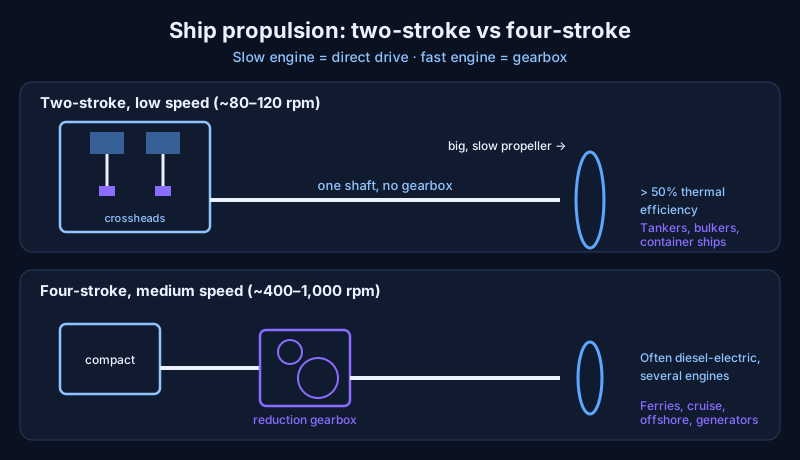
Big ships use two-stroke engines because a slow-speed two-stroke diesel can turn a large propeller directly, with no gearbox, while burning cheap heavy fuel at over 50% thermal efficiency. Smaller and more specialised ships — ferries, cruise ships, offshore vessels — mostly use faster four-stroke engines, which are compact but need a gearbox or an electric drive.
The scale is hard to picture. The Wärtsilä-Sulzer RTA96-C, fitted to the container ship Emma Mærsk in 2006, has 960 mm cylinder bores, a 2.5 m piston stroke and, in its 14-cylinder form, produces about 80,000 kW. It stands 13.5 m tall and weighs over 2,300 tonnes.
What is the difference between a two-stroke and a four-stroke engine?
A two-stroke engine completes its whole cycle in one crankshaft revolution, firing on every turn; a four-stroke engine needs two revolutions and fires every second turn. The four-stroke uses separate piston strokes for intake, compression, power and exhaust. The two-stroke squeezes intake and exhaust into the bottom of the power stroke.
In a marine two-stroke, that exchange is done by uniflow scavenging: as the piston nears the bottom, it uncovers air ports in the cylinder liner, and turbocharged air sweeps upward and pushes the burnt gas out through an exhaust valve in the cylinder head. Engine-X explained this loop in detail in how a ship's turbocharger feeds a two-stroke engine. Because it fires every revolution, a two-stroke gets more power from the same cylinder at the same speed.
Why can a two-stroke engine drive the propeller directly?
A slow-speed two-stroke can drive the propeller directly because it already turns at propeller speed. AM Nautical gives typical speeds of about 80–120 rpm for two-stroke low-speed engines, against 400–1,000 rpm for four-stroke medium-speed engines. A large propeller works best turning slowly, so the engine and propeller can share one shaft.
That brings three practical gains:
- No reduction gearbox — one less large machine to buy, lubricate, lose power in and maintain.
- Reversible engine — Sea-man.org notes these engines are reversible, so the ship goes astern by running the engine backwards, with a simple fixed-pitch propeller.
- Steady operation — on a long ocean passage, the engine runs for days near one load, exactly where it is most efficient.
How efficient are two-stroke marine engines?
Two-stroke marine diesels are the most efficient engines at sea. AM Nautical states that they reach thermal efficiencies above 50%, the highest of any marine prime mover. The RTA96-C, for example, has a quoted specific fuel consumption of 171 g of fuel per kWh.
The efficiency comes from their size and slowness. Large cylinders lose a smaller share of heat through their walls, the long stroke gives combustion time to finish, and turbocharging recycles exhaust energy into charge air. Sea-man.org adds that the large combustion space and long combustion time let them burn heavy fuel oil, the cheapest marine fuel, with alkaline cylinder oil to neutralise its sulphur.
What is a crosshead, and why do big engines need one?
A crosshead is a sliding block between the piston rod and the connecting rod, running in guides, that takes the sideways push of the connecting rod. In a car engine, the connecting rod pushes the piston slightly sideways against the cylinder wall on every stroke. On a 960 mm piston, that side force would wear the liner quickly.
In a crosshead engine, the piston is fixed to a straight vertical piston rod, and only the crosshead feels the side load. Wikipedia notes that this design reduces sideways forces on the piston of the RTA96-C, keeping liner wear to about 30 µm per 1,000 running hours. The crosshead also lets the space under the pistons be sealed off from the crankcase, so dirty combustion products stay out of the crankcase oil.
Where are four-stroke engines used on ships?
Four-stroke engines are used where compactness, flexibility or redundancy matter more than peak efficiency:
| Two-stroke low-speed | Four-stroke medium-speed | |
|---|---|---|
| Speed | ~80–120 rpm | ~400–1,000 rpm |
| Drive to propeller | Direct, no gearbox | Reduction gearbox or diesel-electric |
| Size for the power | Very large and tall | Compact, better power-to-weight |
| Typical ships | Container ships, tankers, bulk carriers | Ferries, cruise ships, offshore support vessels |
| Other uses | Main propulsion only | Also generators on almost every ship |
AM Nautical notes that four-strokes are often used in diesel-electric layouts with several engines, so a ship can keep sailing if one engine fails and can run only as many engines as the load needs. Even ships with a two-stroke main engine use four-stroke auxiliary engines to generate electricity.
The engineering takeaway
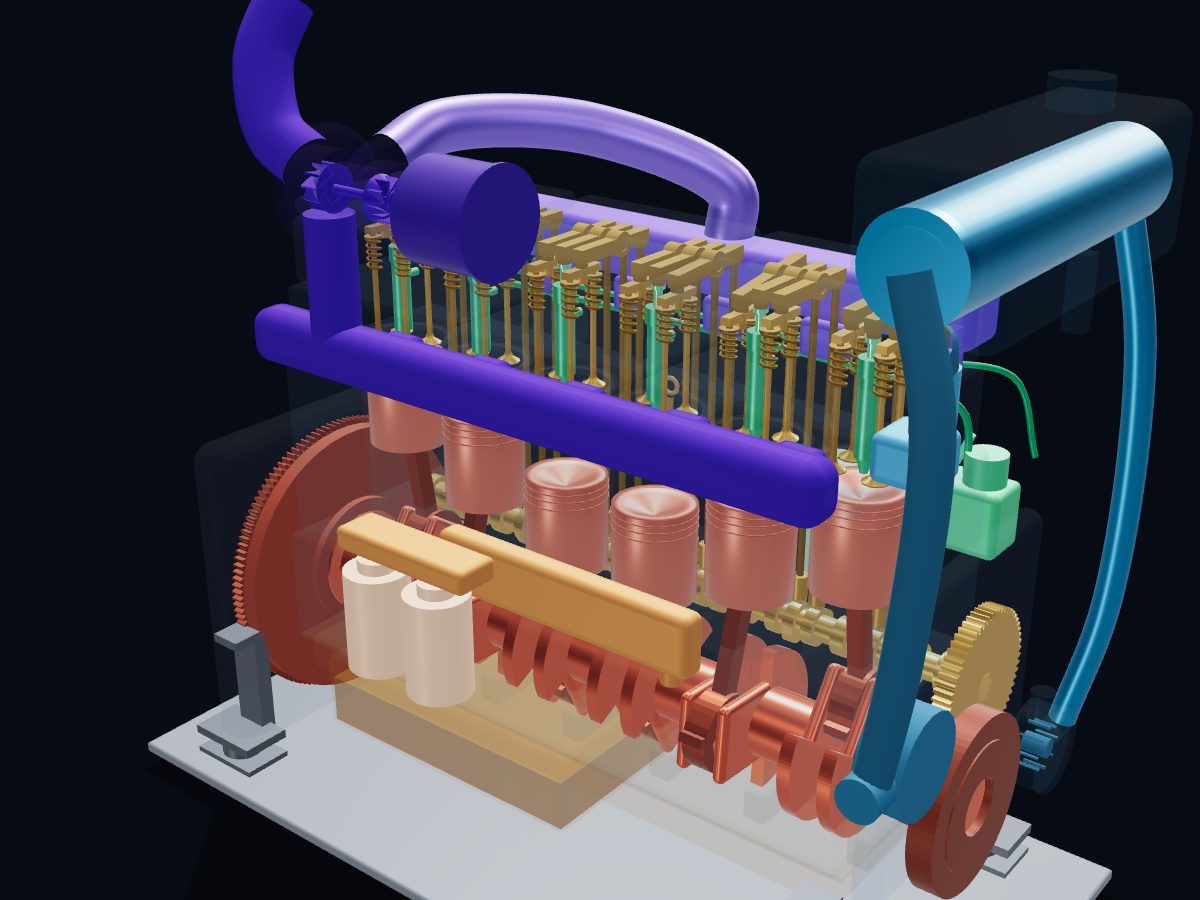
The two-stroke wins on big ships because it matches the propeller: slow, huge and steady. Removing the gearbox, burning heavy fuel and running at its best load for weeks makes it the most efficient way to push a large hull across an ocean. The four-stroke wins wherever space, flexible loads or redundancy matter — and the turbocharger keeps both of them breathing. You can see the basic turbocharger parts in 3D in the Engine-X turbocharger guide. For the other side of the story, explore a four-stroke marine diesel engine in 3D and watch its pistons, camshaft and valves move in true timing.
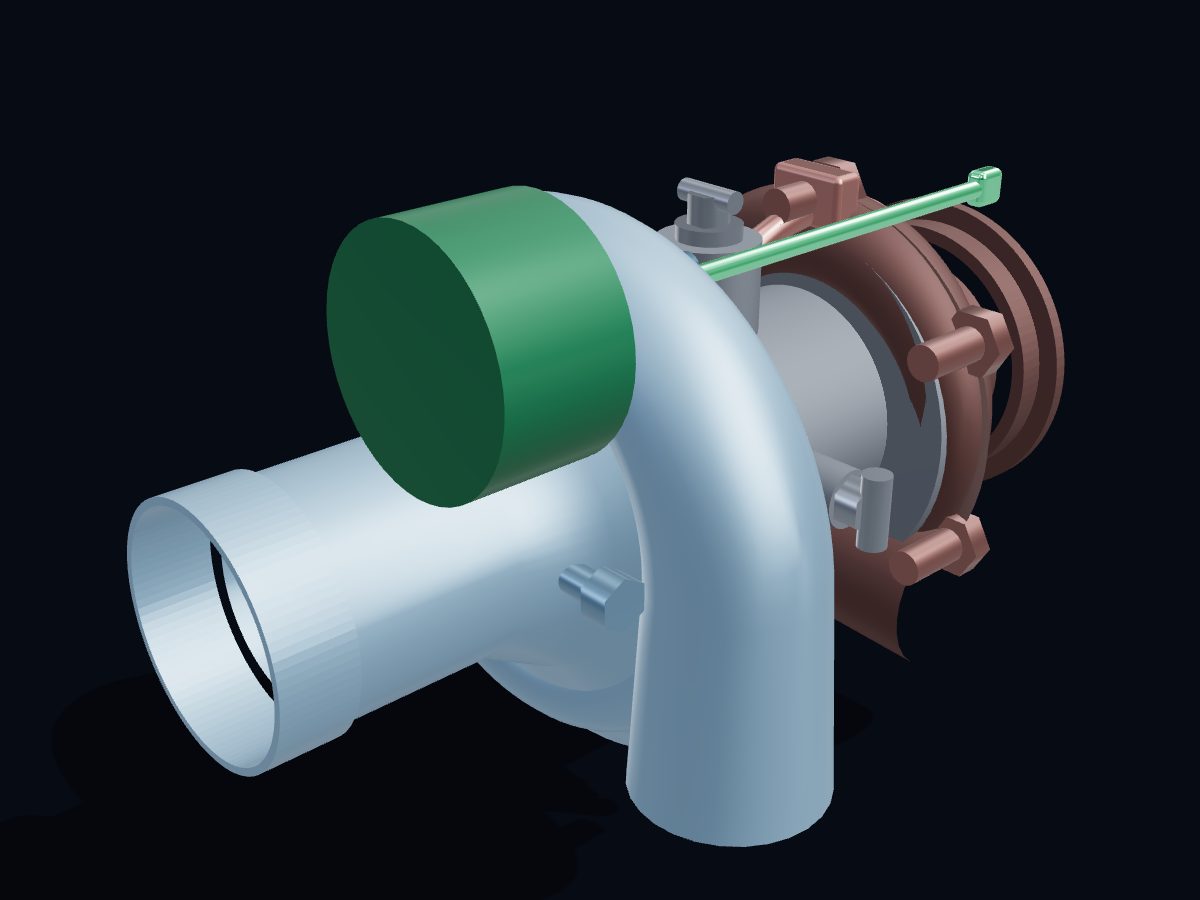 Turbocharger
 Centrifugal Pump
 V-Belt Pulley Drive
 Helical Gear Reducer
 Marine Diesel Engine
 Plate Heat Exchanger
 Reciprocating Air Compressor
 Planetary Gearbox