Engine‑X machine guide
How does a V-belt pulley drive work?
By Parth Parmar, mechanical design engineer · Updated
A V-belt drive passes rotation from one shaft to another through a belt wedged in grooved pulleys. The belt moves at the same speed around both pulleys, so the smaller pulley turns faster and the larger one turns slower. The speed ratio equals the ratio of the pulley diameters.
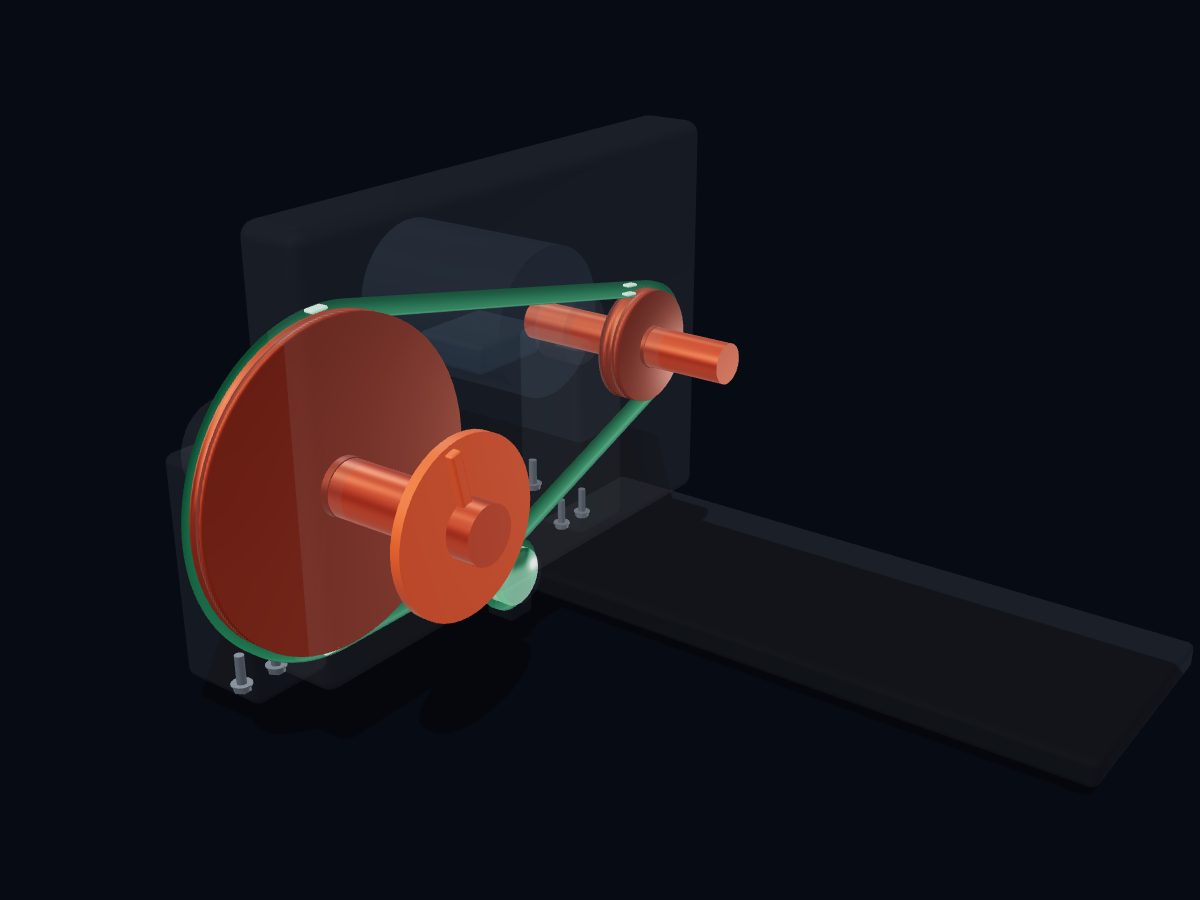
See it move: explode, cut open and X‑ray the v-belt pulley drive in 3D, free in your browser.
Open the 3D v-belt pulley drive →Or download the free 3D model (GLB, STL, AR).
Key facts
| Speed rule | N1 × D1 = N2 × D2 |
|---|---|
| Pulleys in the 3D model | 100 mm driver, 250 mm driven |
| Ratio in the 3D model | 2.5 : 1 speed reduction |
| Motor in the 3D model | About 0.37 kW at 1,440 rpm |
| Driven pulley speed | 1,440 ÷ 2.5 = 576 rpm |
| Direction | Both pulleys turn the same way (open belt) |
How it works, step by step
- The motor turns the driver (small) pulley.
- Friction between the V-belt's sides and the pulley groove grips the belt and pulls it round.
- The belt carries that motion along both straight runs at one constant belt speed.
- Around the larger driven pulley the same belt speed covers a bigger circumference, so the driven shaft turns slower.
- Torque rises in the same ratio as speed falls (minus a few percent of losses).
- An idler pulley presses on the slack side to keep the belt tight as it wears.
Main parts of a v-belt pulley drive
- Driver pulley — on the motor shaft; the input.
- Driven pulley — on the machine shaft; the output.
- V-belt — a rubber belt with a trapezoid cross-section that wedges into the groove.
- Idler pulley — keeps tension in the belt and takes up slack.
- Pillow blocks, base plate and guard — support the shafts and keep hands away from the belt.
How to calculate driven pulley speed
You only need the motor speed and the two pulley diameters.
- Read the motor speed N1 in rpm from its nameplate (for example 1,440 rpm).
- Measure the driver pulley diameter D1 (for example 100 mm).
- Measure the driven pulley diameter D2 (for example 250 mm).
- Calculate the driven speed: N2 = N1 × D1 ÷ D2 (1,440 × 100 ÷ 250 = 576 rpm).
- Check the ratio: D2 ÷ D1 = 2.5, so the driven shaft turns 2.5 times slower and gets about 2.5 times the torque, less a few percent of losses.
For best accuracy use the pitch diameter of each pulley (where the middle of the belt sits), not the outer rim.
How tight should a V-belt be?
A V-belt should be just tight enough not to slip at full load. A common field check is to push the middle of the span: it should deflect about 1/64 inch for every inch of span (about 16 mm per metre) at the force listed for that belt section. New belts are set tighter, then run for a few minutes and re-tensioned, because they stretch and seat in the grooves.
- Too loose: the belt slips, squeals on start-up and glazes or burns.
- Too tight: overloads the shaft bearings and wears the belt early.
- Best tool: a belt tension gauge, using the maker's figures for new and used belts.
What are the types of V-belts?
Classical V-belts (sections A, B, C, D) are the traditional wide profile. Narrow wedge belts (SPZ, SPA, SPB, SPC, or 3V/5V/8V) carry more power in less width. Cogged belts have notches on the inside so they bend round small pulleys and run cooler, and banded belts join several belts with a top band so they don't flip or jump off.
Common questions
How do you calculate pulley speed?
Use N1 × D1 = N2 × D2, where N is speed in rpm and D is pulley diameter. So driven speed N2 = N1 × D1 ÷ D2. For example, a 1,440 rpm motor with a 100 mm driver pulley and a 250 mm driven pulley gives 1,440 × 100 ÷ 250 = 576 rpm.
Why is the belt V-shaped?
The V shape wedges into the pulley groove. Belt tension pushes the sides of the belt against the groove walls, which multiplies the friction force, so a V-belt can carry much more power without slipping than a flat belt of the same tension.
What does the idler pulley do?
An idler pulley carries no load. It presses on the belt to keep it at the right tension and can be moved to take up slack as the belt stretches and wears.
Belt drive or gear drive: which is better?
A belt drive is cheaper, quieter, absorbs shock and can connect shafts far apart, but it can slip slightly and needs re-tensioning. A gear drive keeps an exact ratio, carries more torque in less space and needs no tensioning, but it is noisier, costs more and needs lubrication.
Do both pulleys turn in the same direction?
Yes. In an open belt drive both pulleys turn the same way. To reverse the direction you need a crossed belt, where the belt is twisted into a figure of eight between the pulleys, or a gear pair.
Sources
References for the facts on this page, and further reading:
- Engineers Edge — V-belt design: speed ratio and rated horsepower equations
- U.S. Department of Energy — Replace V-belts with notched or synchronous belt drives (Motor Systems Tip Sheet #5)
- Gates — Belt tension tech note (TSB015)
- Belt tensioning instructions (deflection method)
Related reading on the blog
Why V-belts slip, squeal and fail · Spur, helical, bevel or worm? How to choose a gear type · Ball, roller or journal bearing? How bearing types work
More machine guides
Compare: Belt vs chain vs gear drive: which is better?
How does a turbocharger work? · How does a centrifugal pump work? · How does a gear reducer work? · How does a planetary gearbox work? · How does a reciprocating air compressor work? · How does a plate heat exchanger work? · Turbocharger vs supercharger: what's the difference? · Centrifugal vs positive displacement pump: what's the difference? · Belt vs chain vs gear drive: which is better? · How does a marine diesel engine work?
Need an interactive 3D page like this for your own machine? See Work with Engine‑X.