Learn Engineering

How a Star-Delta Starter Works, and Why It Cuts Starting Current to a Third

By · · 4 min read

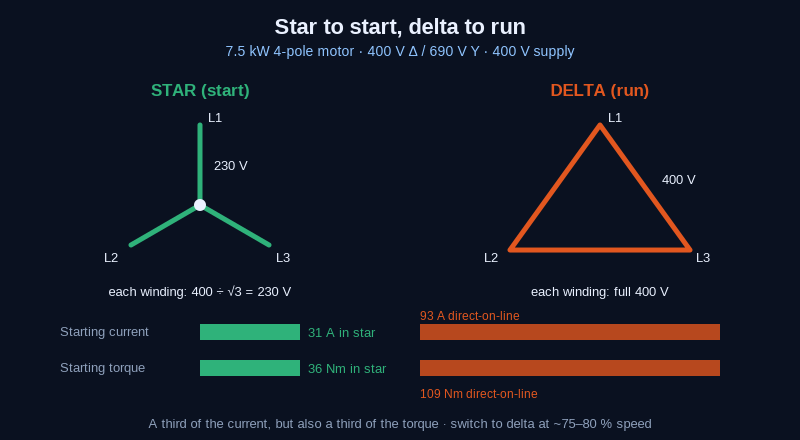
Diagram comparing star and delta connection of a 7.5 kW 400 V motor: in star each winding gets 230 V and the motor starts at 31 A and 36 Nm, in delta each winding gets 400 V and a direct start would take 93 A and 109 Nm
Diagram: Engine-X
In short

A star-delta starter runs a motor up in star, at 58 % of the voltage, then switches to delta. Worked through on a 7.5 kW 4-pole motor: starting current falls from 93 A to 31 A, but starting torque falls by the same third.

Key takeaways
Contents
  1. Why not just switch the motor straight on?
  2. How does starting in star reduce the current?
  3. What is the catch?
  4. Which motors can be started in star-delta?
  5. How the starter switches over
  6. Why the change-over can still kick
  7. Setting the overload relay
  8. The engineering takeaway

A star-delta starter starts a three-phase motor with its windings in star, so each winding gets only 58 % of the line voltage. That cuts the starting current and the starting torque to about a third. Once the motor is near full speed, a timer switches the windings to delta and the motor runs at full voltage.

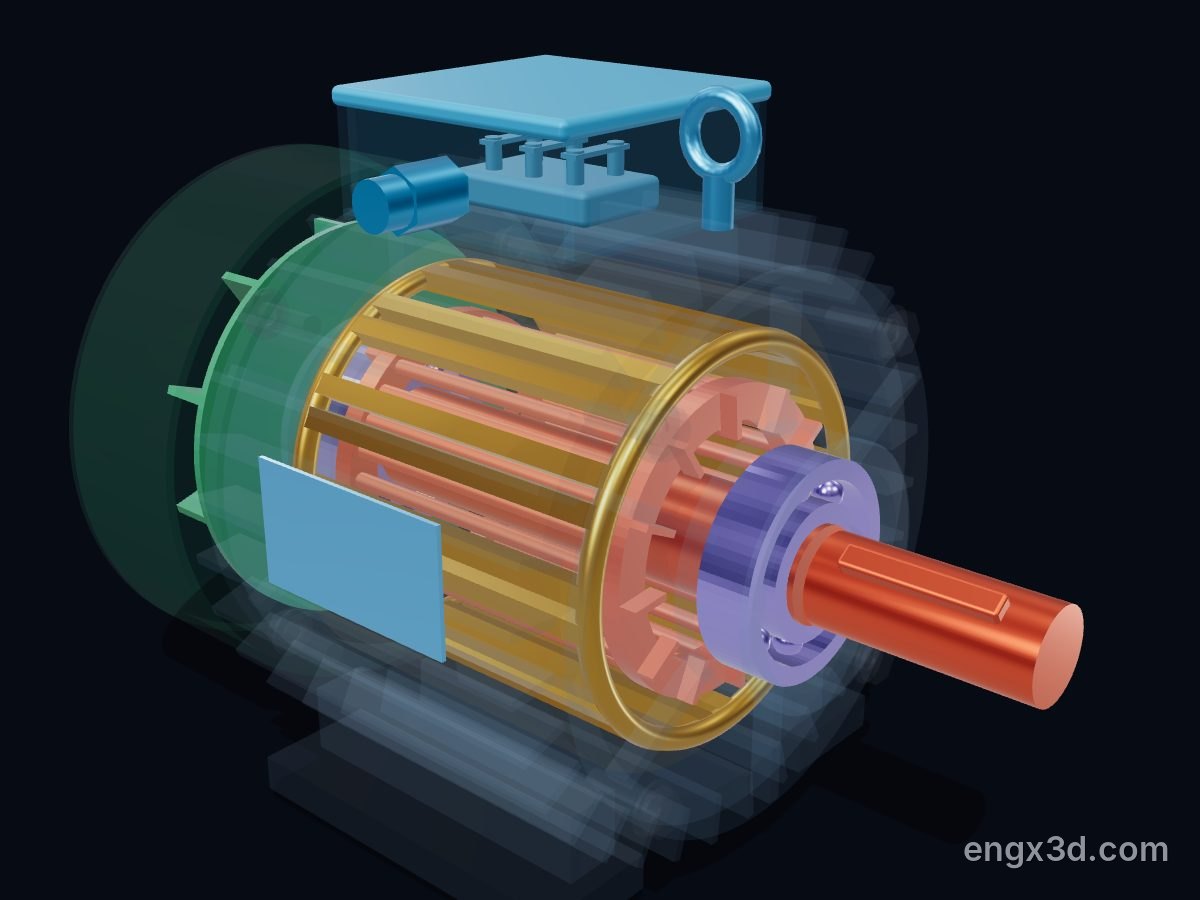
The numbers below use the 7.5 kW 4-pole motor in the Engine-X induction motor 3D model, the same one as in how to read a motor nameplate. The induction motor guide explains the stator, rotor cage and slip part by part.

Why not just switch the motor straight on?

Because a motor at standstill draws a huge current. A direct-on-line (DOL) start typically takes 600 to 900 % of full-load current (AuCom). On a weak supply, a generator or a long cable, that dips the voltage for everything else on the same board.

Our motor's data sheet gives 14.26 A full-load current and a starting current of 6.5 times that (SEVA):

DOL starting current = 6.5 × 14.26 = 93 A

How does starting in star reduce the current?

In star, each winding sits between one line and the star point, so it gets the line voltage divided by √3. In delta, each winding sits between two lines and gets the full line voltage (EEPower). On a 400 V supply:

With 1/√3 of the voltage, each winding draws 1/√3 of the current. In delta the line current is also √3 times the winding current, while in star the two are the same. The two factors multiply, so the line current in star is one third of a direct start in delta (Bitzer):

Star starting current ≈ 93 ÷ 3 = 31 A

What is the catch?

Torque. A motor's torque goes with the square of the voltage, so at 1/√3 of the voltage it falls to (1/√3)² = one third as well (Bitzer). The data sheet gives 49.4 Nm rated torque and a starting torque of 2.2 times that (SEVA):

Direct-on-line (delta) Star-delta (in star)
Voltage per winding 400 V 230 V
Starting current 93 A 31 A
Starting torque 109 Nm 36 Nm
Torque vs rated 49.4 Nm 2.2 × 0.73 ×

In star the motor gives less than its rated torque at standstill. That is fine for a centrifugal pump or a fan, which need little torque until they speed up. It is not fine for a loaded conveyor, a crusher or a compressor starting against pressure; Bitzer notes that the load torque in star must stay under a third of the DOL torque, so compressors are usually started unloaded.

Which motors can be started in star-delta?

The motor must run in delta at the supply voltage, and all six winding ends (U1, V1, W1, U2, V2, W2) must come out to the terminal box (Bitzer, EEPower).

On a 400 V supply that means a nameplate marked 400 V Δ / 690 V Y. A motor marked 230 V Δ / 400 V Y already runs in star on 400 V, so it cannot be started in star-delta there: switching it to delta would put 400 V on windings made for 230 V.

How the starter switches over

A star-delta starter has three contactors, a timer and an overload relay:

  1. Main and star contactors close. The motor starts in star at a third of the DOL current.
  2. The timer runs while the motor speeds up. It should change over at about 75–80 % of full speed (Bitzer), about 1,150 rpm on this 4-pole motor.
  3. The star contactor opens. The motor is off the supply for a moment, so the delta contactor cannot close while star is still in. This is called an open transition.
  4. The delta contactor closes. The motor now runs at full voltage and full torque.

On small pumps the time in star is short. Wilo allows no more than 3 seconds in star for its Flumen pumps (Wilo). Larger, heavier loads take longer, so follow the maker's figure.

Why the change-over can still kick

In the short gap between star and delta the motor slows down a little, and its spinning rotor keeps a voltage of its own in the windings. If delta closes when that voltage is out of step with the supply, AuCom puts the spike at up to 200 % of the locked-rotor current and 400 % of the locked-rotor torque (AuCom).

So a timer set too short, changing over before the motor is near speed, throws away most of the benefit. Closed-transition starters bridge the gap with resistors, but AuCom notes they are rarely used. Where a soft start matters more, a soft starter or a VFD is the usual answer.

Setting the overload relay

The overload relay usually sits in the motor lines, after the main contactor, inside the delta loop. There it carries the winding current, not the line current, which is 1/√3 = 0.58 of it. Schneider's rule is to set it to full-load current × 0.58 (Schneider Electric):

Overload setting = 14.26 × 0.58 ≈ 8.3 A

If the relay is in the supply cable before the starter instead, set it to the full 14.26 A (Wilo). Setting 14.26 A on a relay in the delta loop is a common mistake, and it leaves the motor almost unprotected.

The engineering takeaway

Star-delta trades torque for current: a third of the current, a third of the torque. It suits pumps and fans that start light, needs a 400 V Δ motor with six terminals on a 400 V supply, and works only if the timer lets the motor reach near full speed before the change-over.
TL;DR A star-delta starter starts the motor in star, so each winding gets 1/√3 of the line voltage and the motor draws a third of the direct-on-line current and torque, then switches to delta once the motor is near full speed.

Frequently asked questions

Why is a star-delta starter used?

To cut the starting current. A direct-on-line start draws six to nine times full-load current, which dips the supply voltage. Starting in star cuts that to about a third, so a 7.5 kW motor starts at about 31 A instead of 93 A.

What is the disadvantage of a star-delta starter?

Starting torque drops to a third as well, so the motor may not start a load that needs high torque from standstill. The switch to delta can also cause a short current and torque spike if the motor slows down during the change-over.

What should the star-delta timer be set to?

Long enough for the motor to reach about 75–80 % of full speed before it changes to delta. For small pumps and fans this is often only a few seconds; check the motor and pump maker's limit, as some pump makers allow no more than 3 seconds in star.

What is the overload relay setting in a star-delta starter?

When the relay sits in the motor lines, inside the delta loop, it carries the phase current, so set it to 0.58 × the motor's full-load current. For a 14.26 A motor that is about 8.3 A. A relay in the supply cable is set to the full-load current.

Can any motor be started in star-delta?

No. It must be wound to run in delta at the supply voltage, with all six winding ends brought out to the terminal box. On a 400 V supply that means a motor marked 400 V Δ / 690 V Y.

Sources
Induction Motor 3D model
Free 3D model · download

Induction Motor

7.5 kW, 4-pole three-phase squirrel-cage motor, IEC 132M: stator windings, aluminium rotor cage, bearings and cooling fan. Real scale, every part named. Download the whole machine as GLB or STL, grab any of its 21 parts as its own STL, or view it in AR on your phone.

Free for personal and educational use (CC BY-NC 4.0), credit Engine‑X.

LinkedInWhatsAppX
See the Induction Motor in 3D
Induction Motor7.5 kW, 4-pole three-phase squirrel-cage motor, IEC 132M: stator windings, aluminium rotor cage, bearings and cooling fan. TurbochargerExhaust-driven turbine spinning a compressor, with journal bearings and a wastegate. V-Belt Pulley DriveTwo pulleys and a V-belt reducing speed with true belt kinematics. Centrifugal PumpEnd-suction pump with a backward-curved impeller and volute casing. Helical Gear ReducerTwo-stage helical gearbox, 16 : 1, with meshing helical gears and tapered roller bearings. Marine Diesel EngineInline-6, 14 L marine diesel in the NT855 Big Cam style: pistons, camshaft, 24 valves, PT injectors, turbo and sea water cooling. Plate Heat ExchangerGasketed plate-and-frame exchanger, 41 plates, DN100, with hot and cold water in alternate channels. Reciprocating Air CompressorTwo-stage piston compressor, 12 bar, with reed valves, an intercooler, a V-belt drive and an air tank. Planetary GearboxSingle-stage planetary reducer, 5 : 1: sun, three planets, fixed ring gear and carrier output. Turbofan Jet EngineTwo-spool high-bypass turbofan in the CFM56-7B style: 61-inch fan, booster, 9-stage compressor, combustor and turbines. Gate ValveNPS 4 Class 150 OS&Y wedge gate valve: rising stem, bolted bonnet, graphite packing and handwheel. Car DifferentialRear-axle open differential, 41 : 11 = 3.73 : 1: ring and pinion, spider and side gears, axle shafts. Car Engine2.0 L inline-four petrol engine, DOHC 16-valve: crankshaft, pistons, chain-driven camshafts, valves, spark plugs and injectors. Manual Gearbox5-speed manual transaxle with VW 02T ratios: input and output shafts, five gear pairs, synchronisers, shift forks and final drive. Butterfly ValveNPS 6 lug butterfly valve, concentric and rubber seated, with a 24 : 1 worm gear operator: disc, stem, seat, gearbox and handwheel. Hydraulic Pump & Cylinder16 cm³/rev gear pump, tank, relief valve and 4/3 valve driving a 63/36 mm double-acting tie-rod cylinder.

Explode, X‑ray and cut them open, free in your browser.

Need your machine in 3D?

Engine‑X builds interactive 3D websites for pumps, valves, gearboxes and other machines that buyers can rotate, explode and section, plus 3D explainers for colleges and trainers. Free quote within 24 hours, 3 rounds of revisions included.

Get a free quote → What's included

Mechanical engineer and designer from India. He has designed and drafted marine engineering projects in AutoCAD and SolidWorks, and works in ship repair and dry docking, with hands-on experience in piping, valves, fabrication and pressure testing. He builds Engine-X, a free interactive 3D atlas that shows how real machines work inside.

About · LinkedIn · Contact