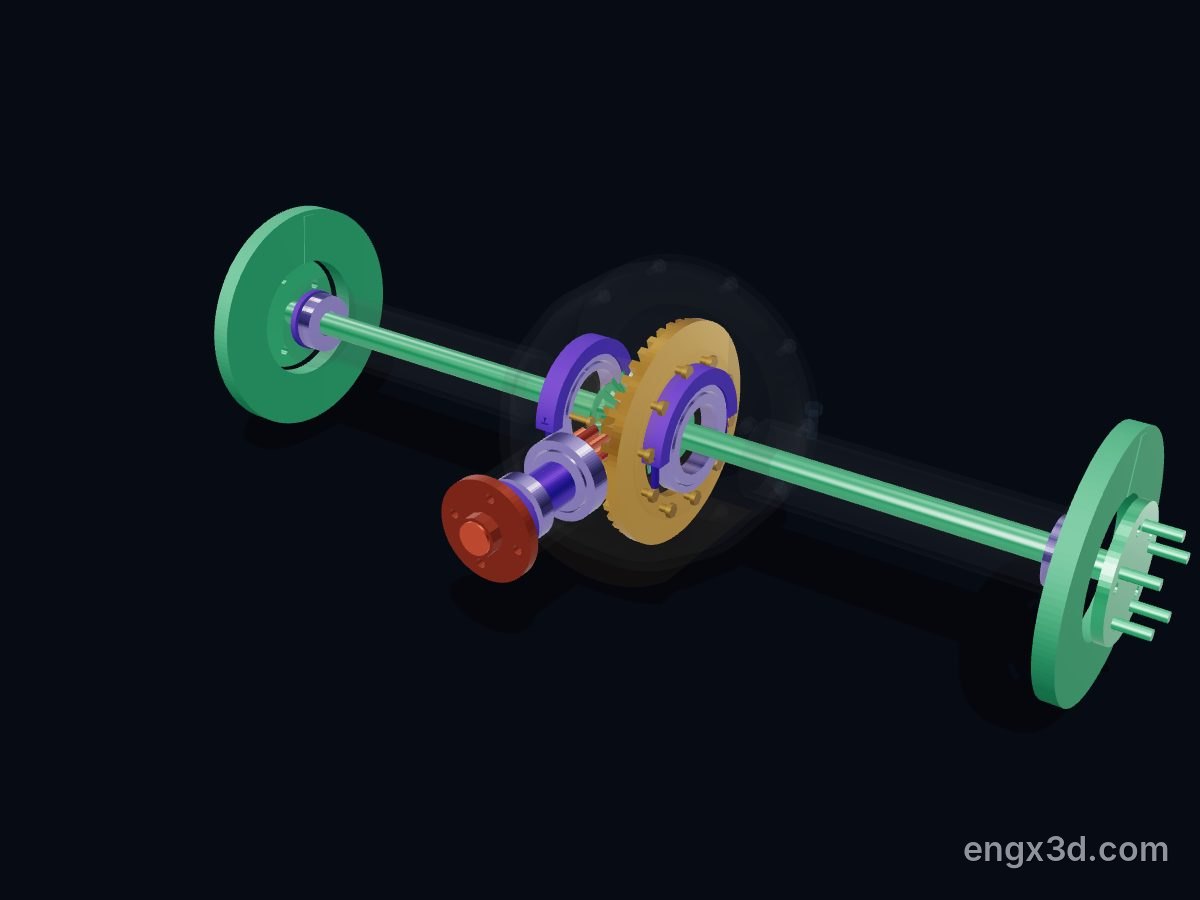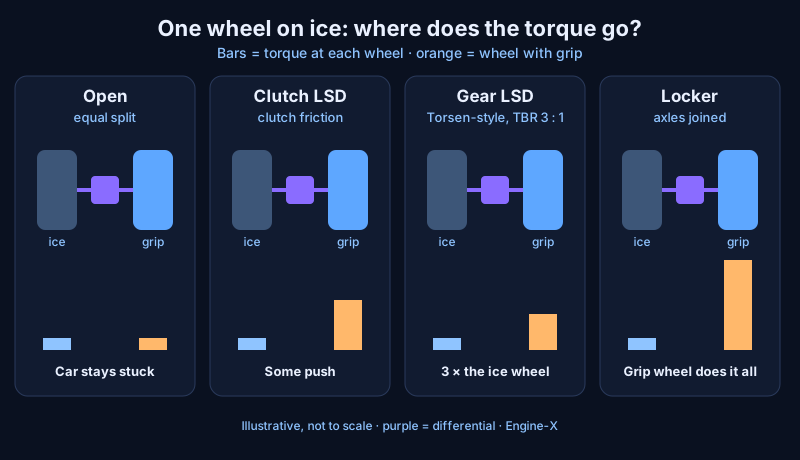
An open differential always splits engine torque equally between the two wheels, which is why one wheel spins on ice and the car goes nowhere. Limited-slip differentials add friction to send more torque to the wheel with grip, and lockers join both axles so the wheels turn as one. Each type trades traction against smooth cornering.
You can watch the spider gears let the wheels run at different speeds in the new Engine-X car differential 3D model, and the car differential guide explains every part from the drive pinion to the axle flanges.
Why does one wheel spin when a car is stuck?
One wheel spins because an open differential always gives both wheels the same torque. The spider gears push equally on both side gears. If one wheel sits on ice, it can only take a tiny torque before it slips, and the wheel with grip gets exactly the same tiny torque.
The result is the classic "one-tyre fire": all the engine speed goes to the spinning wheel while the other sits still (Speedway Motors). The open diff is not broken; it is doing its job of letting the wheels turn at different speeds, which the outside wheel needs in every corner (EngineerFix).
How does a limited-slip differential work?
A limited-slip differential (LSD) acts like an open diff most of the time but resists one wheel spinning much faster than the other. It does that with friction, so the wheel with grip can be given more torque than the slipping wheel. There are two common mechanical kinds:
- Clutch-type (Positraction). Stacks of friction discs and steel plates sit between the side gears and the case, pre-loaded by springs. Under power, the side gears push outward and squeeze the clutches, tying the axles together harder the more torque goes in. A 1-way LSD locks only on acceleration, a 1.5-way adds some locking when slowing down, and a 2-way locks equally on both, which drifters like (Speedway Motors, Jalopnik). The clutches wear slowly and need gear oil with a friction modifier.
- Gear-type (Torsen, Eaton Truetrac). No clutches: helical or worm gears do the work. Torque on the helical teeth creates thrust that pushes the gears against the case walls, and that friction grows with torque (Torsen). Nothing wears out like a clutch, but if one wheel has zero grip it still gets no torque; a light touch of the brake can give the diff something to push against (Speedway Motors).
Viscous couplings, which thicken silicone fluid as the wheels slip, and electronic e-LSDs, which clamp clutches with an actuator under computer control, do the same job in other ways (Jalopnik).
What is torque bias ratio?
Torque bias ratio (TBR) is the number that rates a gear-type differential. It is the ratio of high-traction to low-traction torque the diff can hold before the two wheels start slipping relative to each other (Torsen). A higher TBR sends more of the torque to the wheel with grip and feels more aggressive.
For example, with a TBR of 3 : 1, if the slippery wheel can take 100 N·m, the wheel with grip can be given up to 300 N·m, so the axle delivers 400 N·m instead of the 200 N·m an open diff would allow.
Open, limited-slip, locker and spool compared
| Type | How it works | Traction with one wheel on ice | Cornering | Best for |
|---|---|---|---|---|
| Open | Spider gears, equal torque | Lowest: both wheels get the slipping wheel's torque | Smoothest | Normal road cars |
| Clutch LSD | Clutch packs and springs add friction | Good | Smooth, slight chatter possible | Daily drivers, track, drifting (2-way) |
| Gear LSD (Torsen-style) | Helical gear friction, set by TBR | Good, but none if a wheel has zero grip | Smooth, no clutches to wear | Daily drivers, road racing |
| Automatic locker | Locks the axles when torque is applied | Full: both wheels turn together | Clunks and jolts, pushes wide | Off-road, street-strip |
| Selectable locker | Air or electric, switched on by the driver | Full when locked | Open when unlocked | Off-road 4×4 |
| Spool | Axles permanently joined | Full | Tyres scrub and chirp in turns | Drag racing, rock crawling |
Sources: Speedway Motors, Jalopnik, Torsen.
Which differential should you choose?
Choose by where the car spends its time. For ordinary road driving an open differential, backed by the car's traction control, is fine.
For spirited road and track driving a limited-slip diff gives traction out of corners without hurting turn-in. For rock crawling and serious off-road work a selectable locker gives full traction only when it is switched on, and spools belong on drag strips and crawlers, not daily roads.
Whatever the type, the ring and pinion in front of it decide the overall ratio and the torque multiplication, the same way the gear stages do in an industrial reducer; see helical vs worm gear reducers and the post on gear types: spur, helical, bevel and worm.
The engineering takeaway
An open differential is a torque splitter: equal torque, free speeds, so the weakest wheel sets the limit. Limited-slip diffs break that rule with friction, from clutches or from helical gear thrust, and lockers break it completely by forcing equal speeds. More locking means more traction and less smooth turning, so the right differential is the one that matches the road the car actually drives on.