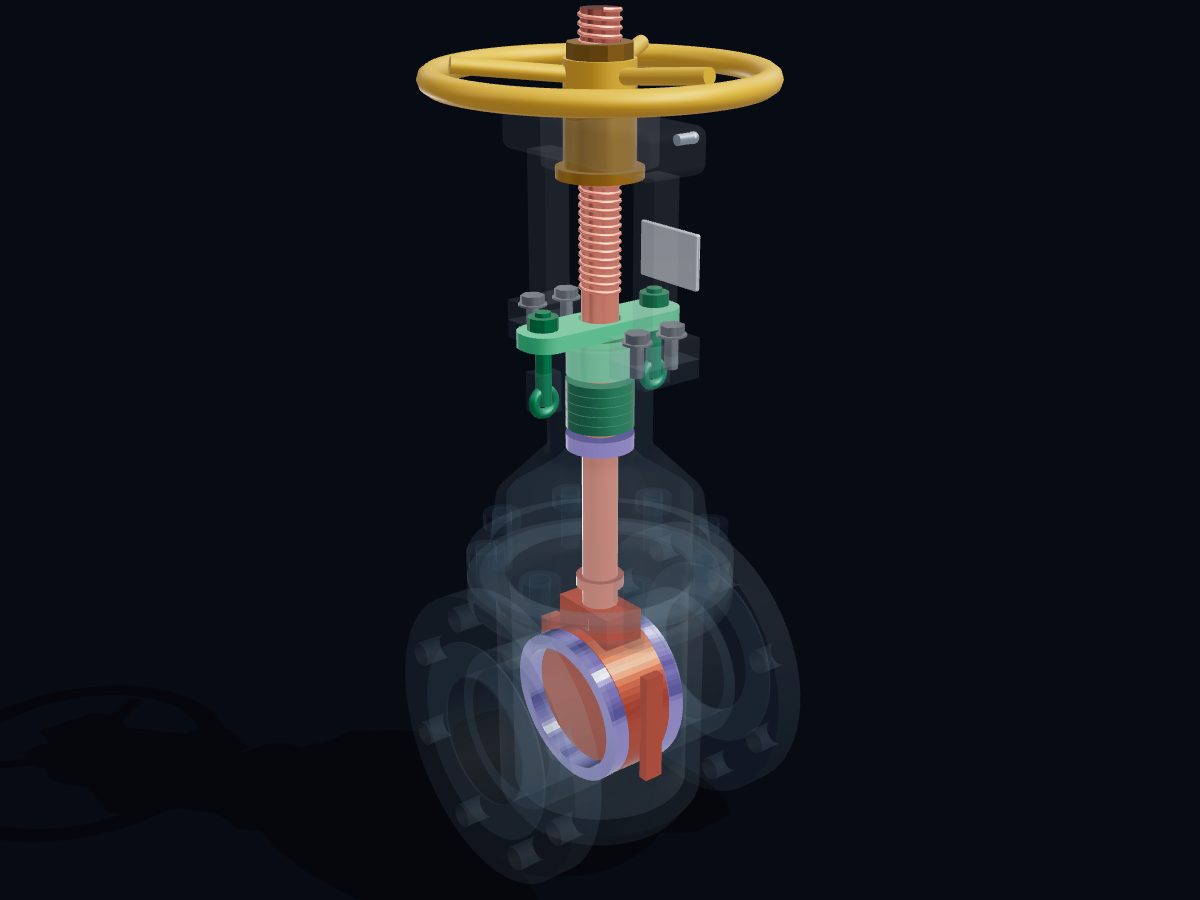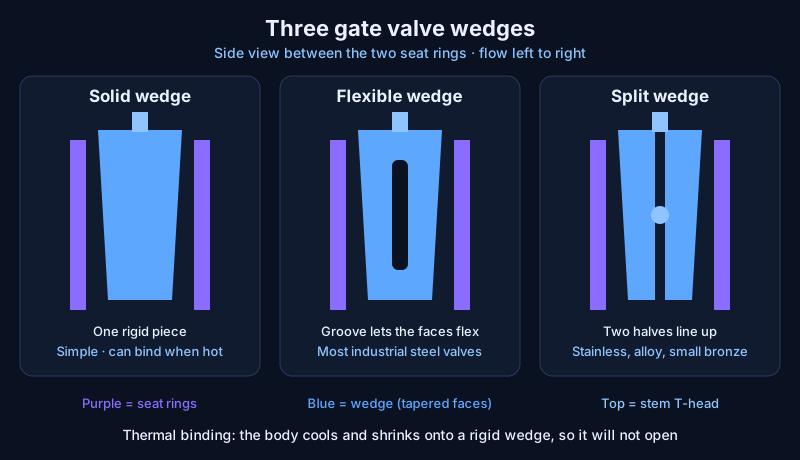
A gate valve wedge comes in three main types: solid, flexible and split. A solid wedge is one rigid piece, a flexible wedge has a groove round its edge so its faces can bend, and a split wedge is two halves. The type decides how well it seals and whether it jams when the line heats up or cools.
The wedge (also called the gate or disc) is the part that actually shuts a gate valve: the stem pushes it down between two seat rings until its tapered faces jam against them. You can watch a solid wedge drop onto its seats in the new Engine-X gate valve 3D model, and the gate valve guide explains every part from the body to the handwheel.
How does a gate valve wedge seal?
A gate valve wedge seals by force. Its two faces are tapered, so the wedge is thicker at the top than at the bottom, and the seat rings in the body lean to match. Turning the handwheel clockwise drives the stem down until the wedge is squeezed between both seats; the harder it is pushed, the tighter the metal-to-metal contact.
That taper is useful: as the seats and wedge wear, the wedge simply goes a little lower before it seals. It also means the wedge seals against flow from either side, so a wedge gate valve is bidirectional. The weak point is the same squeeze: anything that changes the gap between the seats changes how the wedge fits.
Solid, flexible and split wedges compared
| Wedge type | How it is made | Strength | Weak point | Typical use |
|---|---|---|---|---|
| Solid | One rigid piece | Simple, strong, cheap | Can jam if the seats distort | Bronze and iron valves, water service, small forged steel valves |
| Flexible | One piece with a groove round its edge | Faces flex to follow distorted seats | Groove can trap solids | Most industrial carbon steel valves |
| Split | Two halves, often with a ball-and-socket joint | Each half lines up with its own seat | Debris can pack between the halves | Stainless, high-alloy and small bronze valves |
| Parallel slide / double disc | Two parallel discs | Seals by position, not by force | Seats are often spring-loaded | Large refinery and pipeline valves |
Valve Magazine describes the solid wedge as the oldest design and the flexible wedge as the most common type on industrial commodity valves, because it handles temperature changes and pipe stress (Valve Magazine).
What is thermal binding in a gate valve?
Thermal binding is a gate valve wedge getting stuck because the metal around it has moved. A valve closed tight while the line is hot cools down later; the body and seats shrink onto the solid wedge and grip it so hard that the handwheel cannot open it. Pipe loads that bend the body do the same thing.
A flexible wedge reduces thermal binding because its groove lets the two faces bend inward a little as the seats close in. A split wedge does it by letting each half move separately. Neither design makes a gate valve a throttling valve, though: half open, the fast flow under the wedge erodes the seats and the wedge can chatter against them (Crane O&M). For controlling flow, a globe valve is the right tool, as the earlier post on gate, globe, butterfly and check valves explains.
Rising stem (OS&Y) or non-rising stem?
The stem is the second big choice on a gate valve, and there are two common layouts:
- OS&Y rising stem. OS&Y means outside screw and yoke. The stem thread sits outside the body, held by a yoke on top of the bonnet. The handwheel turns a yoke nut at a fixed height and the non-turning stem rises, so a tall stem shows the valve is open. The thread stays clean and can be greased. This is the usual industrial arrangement and the one in the Engine-X model, where 18 handwheel turns lift the wedge 108 mm.
- Non-rising stem (NRS). The stem turns but does not rise; its thread runs inside a nut in the wedge, in the line fluid. It needs little headroom, so it suits buried waterworks valves and tight spaces such as ship machinery spaces, but there is no stem to show the position and the thread is exposed to the fluid (Valve Magazine).
How do you choose the right gate valve wedge?
The choice of gate valve wedge comes down to temperature swings, cleanliness and size:
- Cool, clean, steady service (water, low-temperature lines): a solid wedge is simple and fine.
- Lines that heat up and cool down, or see pipe loads (steam, hot oil, most process lines): a flexible wedge.
- Stainless or alloy valves, or where seat alignment may drift: a split wedge.
- Large lines that must seal by position: a parallel slide or double-disc design.
Whatever the wedge, the valve is tested before it leaves the factory: under API 598 the shell is tested at 1.5 times the rated pressure and the seat at 1.1 times, as covered in hydrostatic testing explained.
The engineering takeaway
A gate valve seals by squeezing a tapered wedge between two seats, so anything that moves the seats affects the seal. Solid wedges are simple but can bind; flexible and split wedges trade a little simplicity for tolerance of heat and pipe loads. Pair the right wedge with an OS&Y stem, run the valve fully open or fully shut, and a gate valve will isolate a line for decades.