Engine‑X machine guide
How does a gate valve work?
By Parth Parmar, mechanical design engineer · Updated
A gate valve opens and closes a pipe by sliding a flat gate (the wedge) across it. Turning the handwheel winds a threaded stem that lifts the wedge clear of the bore, so flow passes straight through; turning it back pushes the wedge down between two seat rings to shut the line tight.
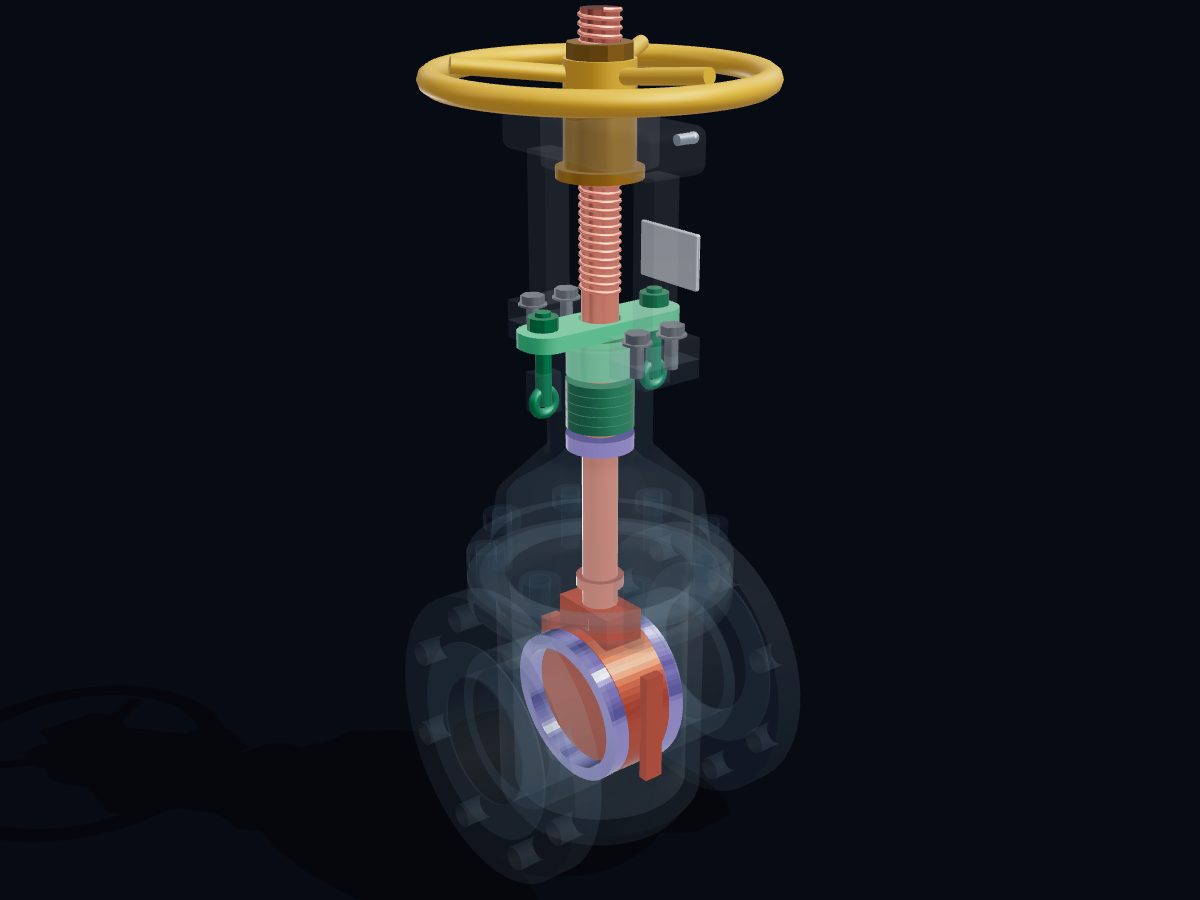
See it work: turn on X‑ray and watch 18 handwheel turns lift the wedge clear of the bore, then explode and cut open the valve in 3D, free in your browser.
Open the 3D gate valve →Or download the free 3D model (GLB, STL, AR).
Key facts
| Type in the 3D model | NPS 4 (DN100) flanged wedge gate valve, OS&Y, bolted bonnet, rising stem |
|---|---|
| Pressure class | Class 150: 19.6 bar (285 psig) at ambient temperature in WCB cast steel (ASME B16.34) |
| Face to face | 229 mm (9.00 in), ASME B16.10 |
| End flanges | ASME B16.5 NPS 4 Class 150: Ø228.6 mm, eight 5/8″ bolts on a Ø190.5 mm circle |
| Materials | WCB body and bonnet, F6 (13% Cr) stem, seats hard-faced with Stellite 6, graphite packing |
| Factory tests (API 598) | Shell 1.5 × rated pressure (about 428 psi), seat 1.1 × (about 314 psi), with water |
| In the model | 108 mm wedge travel, 6 mm stem lead, 18 handwheel turns from shut to open |
| Use | On/off isolation only: fully open or fully shut, never throttling |
How it works, step by step
- Turning the handwheel anticlockwise turns the yoke nut, which sits in the yoke at a fixed height.
- The yoke nut's internal thread drives the stem. The stem cannot turn (the wedge is held in guides), so it can only rise.
- The stem lifts the wedge out of the bore and up into the bonnet. Fully open, the bore is clear and the flow passes straight through with very little pressure drop.
- At full open, a collar on the stem seats against the backseat bushing, a second seal behind the packing.
- Turning the handwheel clockwise drives the stem down. The tapered wedge jams between the two seat rings and shuts off the flow from either side.
- All the time, graphite packing squeezed by the gland stops the line fluid leaking out along the moving stem.
Main parts of a gate valve
- Body and bonnet — the cast-steel pressure shell; the bolted bonnet closes the cavity the wedge rises into.
- Wedge (gate) — the tapered disc that closes the bore by jamming against the seats.
- Seat rings — two hard-faced rings in the body that the wedge seals against.
- Stem — the threaded rod that lifts and lowers the wedge; in an OS&Y valve it rises without turning.
- Packing, gland and gland flange — the stem seal where the stem leaves the bonnet.
- Yoke, yoke nut and handwheel — the frame and nut that turn the handwheel's rotation into the stem's up-and-down movement.
- Bonnet gasket and studs — seal and clamp the body-to-bonnet joint.
Why can't a gate valve be used for throttling?
A partly open gate valve squeezes all the flow through a thin gap under the wedge. The fast, turbulent jet wears away the seat and wedge faces (wire drawing), and the loose wedge rattles against its seats. Once the faces are cut, the valve no longer shuts tight. Use a globe valve to control flow; keep gate valves fully open or fully shut.
- Seat erosion: high-velocity flow under the wedge cuts grooves in the seating faces.
- Vibration: a partly open wedge can chatter against the seats and damage them (Valve Magazine).
- Lost shut-off: once the faces are wire-drawn, the valve passes even when fully shut (Project Materials).
What is the difference between a gate valve and a globe valve?
A gate valve lifts its wedge completely out of a straight-through bore, so it has very low pressure drop but is only for on/off service. A globe valve lowers a disc onto a seat across an S-shaped flow path, so it throttles well but always costs more pressure drop. Gate valves isolate; globe valves control.
| Gate valve | Globe valve | |
|---|---|---|
| Flow path | Straight through | S-shaped |
| Pressure drop, fully open | Very low | High |
| Throttling | No: seats erode | Yes: designed for it |
| Disc travel | Full bore (many turns) | Short |
| Face to face, NPS 4 Class 150 | 229 mm | 292 mm |
| Typical use | Line and equipment isolation | Flow control, bypasses |
What are the main types of gate valves?
Gate valves differ in the wedge and in the stem. A solid wedge is simple and strong; a flexible wedge has a groove round its edge so it can flex and not jam when the body heats or the pipe pulls; a split wedge is two halves. The stem is either rising (OS&Y, threads outside) or non-rising (threads inside, in the fluid).
- Solid wedge: one piece; common on bronze, iron, water and small forged steel valves. It can jam (thermal binding) if the body distorts.
- Flexible wedge: grooved round its edge so it flexes; the most common type on industrial steel valves.
- Split wedge / parallel slide: two halves or parallel discs that seal by position rather than by force.
- OS&Y rising stem: thread outside the valve, stem height shows open or shut; the usual industrial choice.
- Non-rising stem (NRS): the stem turns and threads into the wedge; compact, used in waterworks and tight spaces.
How do you fix a leaking gate valve?
First find where it leaks. A leak at the stem is the packing: tighten the two gland nuts evenly, a little at a time, only until it stops; if it will not stop, repack the valve with the line isolated. A leak at the bonnet joint means tightening the bonnet nuts or a new gasket. A seat leak is usually dirt on the seats.
- Stem (gland) leak: tighten the gland nuts evenly; over-tightening wears the stem and makes the valve stiff. Repack if it keeps leaking (Crane O&M).
- Bonnet joint leak: tighten the bonnet nuts near the leak; if it persists, isolate and drain the line and fit a new gasket.
- Seat leak (passing valve): flush the line, then shut gently, open one turn and shut again a few times to clear dirt. If it still passes, open the bonnet and inspect the seats and wedge.
- Stiff handwheel: grease the stem thread and yoke nut; never use a long bar on the rim to force it.
Common questions
Which way do you turn a gate valve to close it?
Clockwise to close and anticlockwise to open, seen from the handwheel. On an OS&Y valve you can also check the stem: a stem standing high above the handwheel means the valve is open.
What does OS&Y mean on a valve?
Outside screw and yoke. The stem thread sits outside the valve body, carried by a yoke, so it stays clean and greased and the rising stem shows whether the valve is open.
How many turns does it take to open a gate valve?
It depends on the size and the stem thread. The wedge has to rise about one bore diameter, so the number of turns is that travel divided by the thread lead. The Engine‑X NPS 4 model lifts its wedge 108 mm at 6 mm per turn: 18 turns.
Is a gate valve bidirectional?
Yes. A wedge gate valve seals against flow from either side, because the wedge presses on both seat rings.
What is the backseat in a gate valve?
A seat at the top of the bonnet that the stem collar presses against when the valve is fully open. It seals the stem from the inside, a back-up to the packing.
Sources
References for the facts on this page, and further reading:
- Valve Magazine — The fundamentals of gate valves
- Project Materials — Globe vs gate valve
- Werner Sölken (wermac.org) — Face-to-face dimensions of flanged valves, ASME B16.10
- The Engineering ToolBox — ASME B16.5 flanges and bolt dimensions
- Project Materials — What is API 598?
- Bonney Forge — 4" Class 150 RF WCB cast steel gate valve data
- Crane Fluid Systems — Gate valve operation and maintenance
Related reading on the blog
Gate, globe, butterfly or check valve? How each works and when to use it · Hydrostatic testing explained: how pipelines are pressure-tested for leaks
More machine guides
How does a turbocharger work? · How does a centrifugal pump work? · How does a V-belt pulley drive work? · How does a gear reducer work? · Turbocharger vs supercharger: what's the difference? · Centrifugal vs positive displacement pump: what's the difference? · How does a marine diesel engine work? · How does a plate heat exchanger work? · How does a reciprocating air compressor work? · How does a planetary gearbox work? · How does a turbofan jet engine work?
Need an interactive 3D page like this for your own machine? See Work with Engine‑X.