Engine‑X machine guide
How does a turbofan jet engine work?
By Parth Parmar, mechanical design engineer · Updated
A turbofan jet engine has a big fan at the front driven by a gas turbine core. The core squeezes part of the air, burns fuel in it and uses the hot gas to spin turbines that drive the compressor and fan. Most of the air bypasses the core, and that cool, slower bypass stream gives most of the thrust.
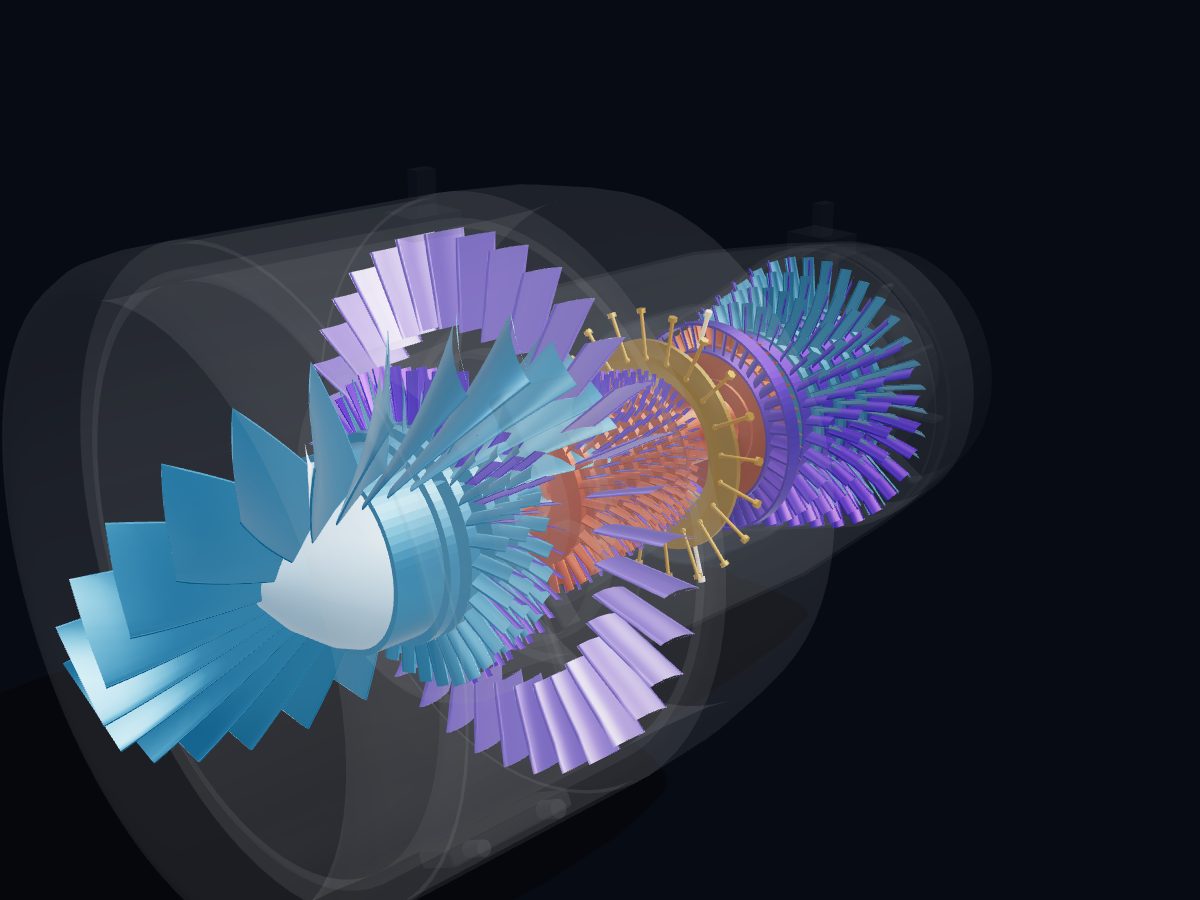
See it run: turn on X‑ray and watch the fan and the core spool turn at their true speed ratio, then explode the nacelle and cut the engine open in 3D, free in your browser.
Open the 3D turbofan engine →Or download the free 3D model (GLB, STL, AR).
Key facts
| Type in the 3D model | Two-spool, high-bypass turbofan in the style of the CFM56-7B (Boeing 737 NG); educational model, not affiliated with CFM International |
|---|---|
| Fan | 61 in (1,549 mm) diameter, single stage |
| Stages | 3-stage booster (LPC), 9-stage HPC, annular combustor, 1-stage HPT, 4-stage LPT |
| Rotor speed limits | N1 (fan) 5,382 rpm (104%), N2 (core) 15,183 rpm (105%) |
| Bypass ratio | About 5.1 to 5.5 : 1 |
| Overall pressure ratio | About 32 : 1 (32.3 for the -7B18) |
| Take-off thrust | 19,500 to 27,300 lbf depending on the rating |
| Size and weight | 2,508 mm long, about 2,386 kg dry |
| Control | Dual-channel FADEC (full authority digital engine control) |
How it works, step by step
- Suck: the 61-inch fan draws a huge mass of air into the inlet.
- Split: behind the fan the splitter divides the air. About five parts flow down the bypass duct for every one that enters the core.
- Squeeze: in the core the 3-stage booster and the 9-stage high-pressure compressor squeeze the air about 32 times.
- Bang: in the annular combustor fuel from the nozzles burns continuously in the compressed air.
- Blow: the hot gas expands through the single-stage high-pressure turbine, which drives the HP compressor, then the 4-stage low-pressure turbine, which drives the fan and booster through the low-pressure shaft inside the HP shaft.
- The hot core jet and the cool bypass stream leave through their nozzles. The bypass stream, a large mass of air speeded up a little, gives most of the thrust.
Main parts of a turbofan engine
- Fan and spinner — the big front rotor that moves most of the air; driven by the low-pressure turbine.
- Booster (low-pressure compressor) — three stages on the fan shaft that give the core air a first squeeze.
- High-pressure compressor — nine stages of rotor blades and stator vanes on the core shaft.
- Combustor — one ring-shaped chamber with fuel nozzles and igniters where the fuel burns.
- High-pressure turbine — one stage that drives the HP compressor; the hottest, hardest-working blades in the engine.
- Low-pressure turbine — four stages that drive the fan and booster.
- Two shafts (spools) — the LP shaft runs inside the hollow HP shaft, so fan and core can turn at different speeds.
- Nacelle, frames and accessories — inlet, fan case, cowls, thrust reverser, accessory gearbox, FADEC and mounts.
What is the difference between a turbofan and a turbojet?
A turbojet pushes all its air through the core, so all its thrust comes from a small, very fast, hot jet. A turbofan adds a fan that blows a large mass of extra air around the core. Moving more air a little faster takes less fuel than moving less air much faster, so turbofans use much less fuel and are quieter.
| Turbofan | Turbojet | |
|---|---|---|
| Air through the core | A small share; most air bypasses | All of it |
| Where the thrust comes from | Fan (bypass) stream plus core jet | Core jet only |
| Jet speed | Lower | Very high |
| Fuel use | Much lower | High |
| Noise | Quieter | Loud |
| Typical use | Airliners (high bypass), fighters (low bypass) | Early jets, missiles |
What is bypass ratio in a jet engine?
Bypass ratio is the mass of air that flows around the core divided by the mass that flows through it. In the CFM56-7B family it is about 5.1 to 5.5 : 1, so roughly five kilograms of air bypass the core for every kilogram that is burned with fuel. Higher bypass ratios cut fuel burn and noise but need a bigger fan.
Fighter engines use low bypass ratios (well under 1 : 1) so they can stay slim and use an afterburner. Airliner engines keep raising the ratio: bigger, slower fans move more air more gently.
Why does a jet engine have two shafts (spools)?
A big fan and a small high-pressure compressor work best at very different speeds. Two spools let each run at its own speed: the fan, booster and low-pressure turbine on one shaft, the high-pressure compressor and turbine on another, hollow shaft around it. In the CFM56-7B the core spool is limited to 15,183 rpm and the fan to 5,382 rpm.
Pilots watch both speeds as N1 (fan) and N2 (core), in percent. In the Engine‑X model the core spool turns about 2.8 times faster than the fan, the ratio of the two 100% speeds.
Common questions
How hot does a jet engine get inside?
The gas leaving the combustor is hotter than the turbine blades' melting point; the blades survive because cooling air flows through them. On the CFM56-7B the displayed exhaust gas temperature limit at take-off is 950 °C.
What does the FADEC do?
It is the engine's computer. It reads the thrust lever and the engine sensors and sets the fuel flow and compressor geometry, with two independent channels for safety.
Why do turbofans have a thrust reverser?
To help stop the aircraft on landing. Blocker doors turn the bypass air forward, which takes load off the wheel brakes, especially on wet or short runways.
How is a jet engine started?
An air starter, fed with compressed air, spins the core spool through the accessory gearbox. Once the core is turning fast enough, fuel is added and the igniters light it; then the engine speeds up on its own.
Which aircraft use the CFM56-7B?
The Boeing 737 Next Generation family (737-600 to 737-900). Its smaller 61-inch fan was chosen so the engine fits under the low 737 wing.
Sources
References for the facts on this page, and further reading:
- EASA — Type-Certificate Data Sheet E.004, CFM56-7B series
- CFM International — CFM56-7: an in-depth look at the new industry leader
- Aircraft Commerce — CFM56-7B specifications
- Purdue University — CFM56 engine data
- NASA Glenn Research Center — Turbofan engine
- Aerospaceweb — Turbojet, turbofan and turboprop
Related reading on the blog
A CO₂ loop that squeezes extra power from gas turbine exhaust · Ball, roller or journal bearing? How bearing types work
More machine guides
How does a turbocharger work? · How does a centrifugal pump work? · How does a V-belt pulley drive work? · How does a gear reducer work? · Turbocharger vs supercharger: what's the difference? · Centrifugal vs positive displacement pump: what's the difference? · How does a marine diesel engine work? · How does a plate heat exchanger work? · How does a reciprocating air compressor work? · How does a planetary gearbox work? · How does a gate valve work?
Need an interactive 3D page like this for your own machine? See Work with Engine‑X.