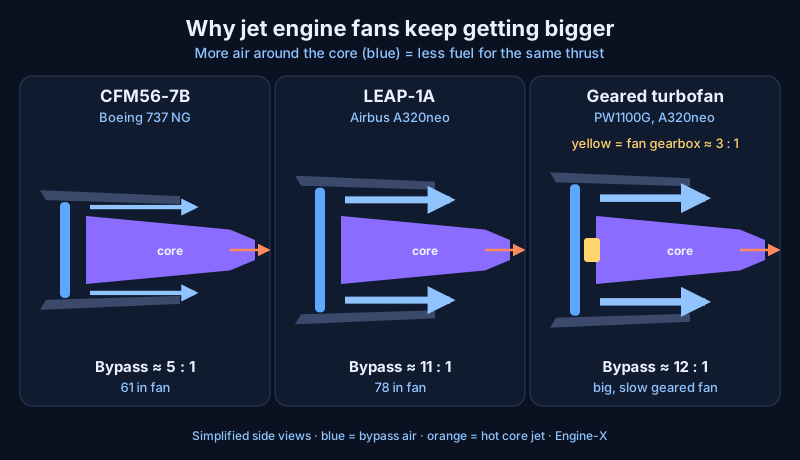
Jet engine fans keep getting bigger because a bigger fan moves more air more slowly, and that is the cheapest way to make thrust. The CFM56-7B has a 61-inch fan and about 5 : 1 bypass, the LEAP-1A a 78-inch fan and 11 : 1, and Pratt & Whitney's geared turbofan about 12 : 1.
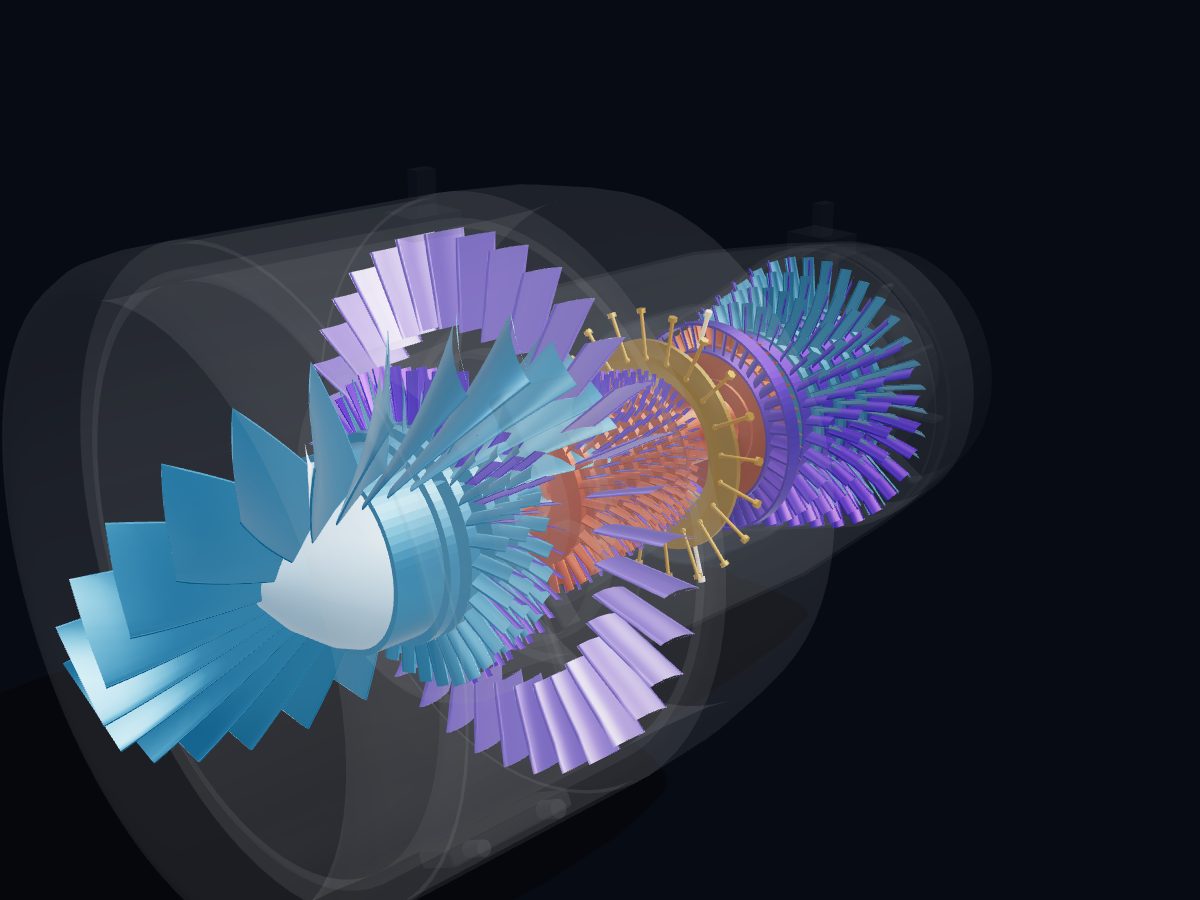
You can see where the bypass air goes in the new Engine-X turbofan 3D model, built in the CFM56-7B style, and the turbofan guide walks through every stage from the fan to the exhaust.
Why does moving more air save fuel?
Every jet engine makes thrust the same way: it pushes air backwards faster than it came in. The thrust depends on how much air it moves and how much it speeds that air up. The fuel cost depends on the energy left behind in the exhaust jet, and that energy grows with the square of the jet speed.
So there are two ways to get the same thrust:
- A little air, very fast. A turbojet pushes all its air through the core and blasts it out at high speed. Lots of energy is wasted in that fast jet.
- A lot of air, a little faster. A turbofan's big fan gives a huge mass of air a gentle push. Same thrust, much less wasted energy, so less fuel.
NASA puts it simply: because the core's fuel flow barely changes when a fan is added, a turbofan gets more thrust for nearly the same fuel (NASA Glenn). That is why high-bypass engines are nearly as efficient as turboprops while still flying at airliner speeds.
What is bypass ratio?
Bypass ratio is the air that goes around the core divided by the air that goes through it. Behind the fan, a ring called the splitter divides the flow.
On the CFM56-7B about five parts go down the bypass duct for every one that enters the core, where it is compressed about 32 times, burned with fuel and expanded through the turbines (EASA TCDS E.004, Aircraft Commerce). The cool bypass stream gives most of the take-off thrust.
CFM56 vs LEAP vs geared turbofan compared
| Engine (aircraft) | Fan | Bypass ratio | Fuel burn vs older engines | How the fan is driven |
|---|---|---|---|---|
| CFM56-7B (Boeing 737 NG) | 61 in (1,549 mm), 24 titanium blades | about 5.1–5.5 : 1 | baseline | Directly by a 4-stage LP turbine |
| LEAP-1A (Airbus A320neo) | 78 in (198 cm), 18 woven carbon composite blades | 11 : 1 | about 15% lower than the CFM56 | Directly by the LP turbine |
| PW1100G GTF (Airbus A320neo) | large, slow-turning fan | about 12.2 : 1 | about 16% lower than the previous generation | Through a roughly 3 : 1 planetary gearbox |
Sources: EASA, Aircraft Commerce, Aerospace Manufacturing, Wikipedia LEAP, Wikipedia PW1000G.
The LEAP's 18 composite blades are 25% fewer than the CFM56-7B's 24, and CFM says the new fan delivers nearly half of the engine's roughly 15% fuel saving (Aerospace Manufacturing). Pratt & Whitney claims about 16% lower fuel burn for the geared turbofan than the previous generation (Wikipedia PW1000G).
Why does a geared turbofan need a gearbox?
A geared turbofan needs a gearbox because a big fan and its turbine want opposite speeds. The fan blade tips must stay below about the speed of sound, so the bigger the fan, the slower it has to turn. The low-pressure turbine that drives it works best spinning fast; slowed to fan speed, it needs extra stages.
In a direct-drive engine like the CFM56 the fan and LP turbine share one shaft, so the designer compromises. The geared turbofan puts a planetary gearbox of about 3 : 1 between them: the fan turns roughly 4,000–5,000 rpm while the LP spool turns roughly 12,000–15,000 rpm (Wikipedia PW1000G). The gearbox is the same planetary idea used in industrial reducers, explained in helical vs worm gear reducers (Wikipedia: Geared turbofan).
What stops fans getting even bigger?
The fan cannot grow forever. Four things push back:
- Weight. A bigger fan needs a bigger case, a bigger nacelle and more structure.
- Drag. The nacelle's wetted area grows with the fan, eating into the fuel saving.
- Ground clearance. Under-wing engines need room above the runway; a tall fan needs taller landing gear or a new wing.
- Tip speed. Without a gearbox, a larger fan forces a slower, heavier LP turbine.
Fighter jets show the other end: they use low-bypass turbofans with afterburners because supersonic flight needs a fast exhaust jet (NASA Glenn). The same trade between gas speed and wasted energy shows up in the turbines on ships, covered in why ship engines use turbochargers.
The engineering takeaway
Thrust is mass flow times the change in speed, but fuel burned follows the energy wasted in the jet. Bigger fans move more air more gently, so bypass ratio has climbed from about 5 : 1 on the CFM56-7B to 11 : 1 on the LEAP-1A and about 12 : 1 on the geared turbofan. The limits are weight, drag, clearance and tip speed, and the gearbox is how engineers buy a little more fan without paying for it in the turbine.