Engine‑X machine guide
How does a car differential work?
By Parth Parmar, mechanical design engineer · Updated
A differential lets a car's two driven wheels turn at different speeds while both are driven. The driveshaft pinion turns a ring gear bolted to the differential case; inside, spider gears drive both side gears and axles. Straight ahead they turn together; in a turn the spider gears spin so the outer wheel can go faster.
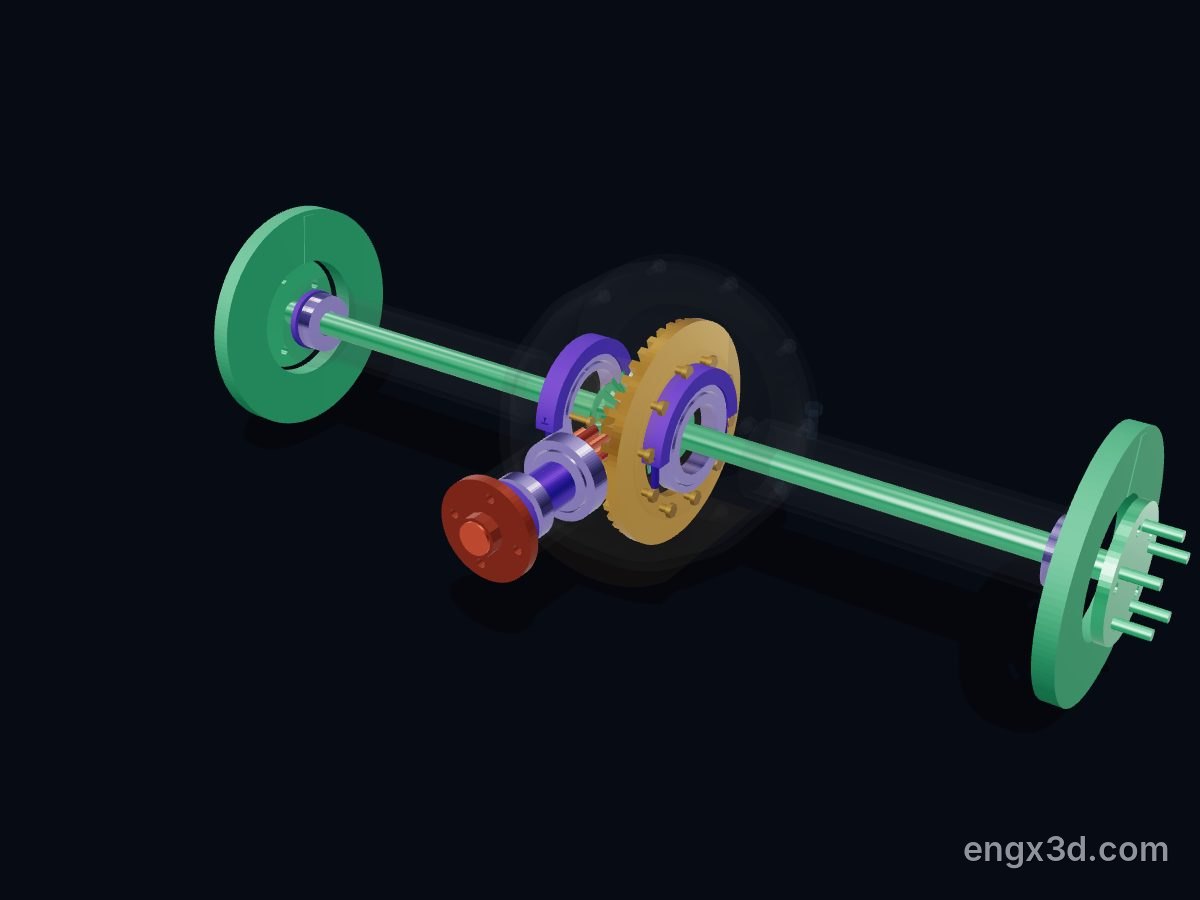
See it work: watch the strip go from straight ahead to a right and left turn, and watch the spider gears start to spin, then explode and cut open the axle in 3D, free in your browser.
Open the 3D car differential →Or download the free 3D model (GLB, STL, AR).
Key facts
| Type in the 3D model | Rear-axle open differential (rear-wheel-drive car), 8.8-inch ring gear class |
|---|---|
| Final drive ratio | 41 : 11 = 3.73 : 1 (a common Ford 8.8-inch set) |
| Ring gear | 41 teeth, about 8.8 in (223.5 mm) across, held by 10 bolts |
| Inside the case | 2 spider gears on a cross shaft, 2 side gears splined to the axles |
| Speed rule | Ring gear speed = average of the two wheel speeds |
| Torque split (open diff) | Always equal, 50 : 50, between the two wheels |
| Bearings | Tapered roller: two carrier bearings and two pinion bearings |
| Oil | Hypoid gear oil with EP additives, API GL-5 (often 75W-90) |
How it works, step by step
- The driveshaft turns the drive pinion at the front of the axle.
- The 11-tooth pinion turns the 41-tooth ring gear through 90°: the axle turns 3.73 times slower than the driveshaft, with 3.73 times the torque (less friction).
- The ring gear is bolted to the differential case, so the case and the cross shaft inside it turn with the ring gear.
- The cross shaft carries two spider gears, which mesh with the two side gears. Each side gear is splined to one axle shaft.
- Driving straight, both wheels need the same speed, so the spider gears do not spin on their shaft: case, side gears and axles all turn as one.
- In a turn the inner wheel slows. The spider gears start to spin on the cross shaft and speed the outer side gear up by exactly as much as the inner one slows down.
Main parts of a differential
- Drive pinion — the small gear on the end of the driveshaft.
- Ring gear (crown wheel) — the big gear that turns the drive through 90° and sets the final drive ratio.
- Differential case (carrier) — bolted to the ring gear; holds the gears that do the differential work.
- Spider gears and cross shaft — small bevel gears that let the two wheels turn at different speeds.
- Side gears and axle shafts — one side gear and one axle per wheel.
- Carrier and pinion bearings — tapered roller bearings whose preload and shims set the gear mesh.
- Axle housing and cover — the banjo housing with its tubes, the rear cover and the gear oil.
Why do cars need a differential?
In a turn the outer wheel travels a longer arc than the inner wheel in the same time, so it has to turn faster. If both driven wheels were locked to one shaft, one tyre would have to slip and scrub: it wears tyres, strains the axle and makes the car push straight on. The differential lets the speeds differ while still driving both wheels.
What is the difference between an open and a limited-slip differential?
An open differential always splits the torque equally, so it can only send to the wheel with grip as much torque as the slipping wheel can take: one wheel on ice spins and the car stays put. A limited-slip differential (LSD) uses clutches or gears to limit how much the wheels can turn apart, so the wheel with grip still gets torque.
| Open | Limited-slip (LSD) | Locker / spool | |
|---|---|---|---|
| Wheels turn at different speeds | Freely | Yes, but resisted | Locker: only when unlocked; spool: never |
| One wheel on ice | That wheel spins, car stays | Torque still reaches the gripping wheel | Both wheels driven |
| How | Spider and side gears | Clutch packs or helical gears | Locking mechanism or solid spool |
| Typical use | Most road cars | Performance and street cars | Off-road, drag racing |
What are the signs of a bad differential?
Listen and look. A whine or howl that changes with speed points to worn or badly set ring and pinion gears or bearings; a clunk when taking up drive points to wear or too much backlash; grinding or popping in turns points to the spider gears or the wrong oil in a limited-slip unit; oil on the cover or pinion seal means low oil, the main cause of failure.
- Check the oil first: differentials have no pump or filter, only splash lubrication, so a low level quickly overheats the gears (Underhood Service).
- Use the right oil: hypoid gears slide as well as roll and need GL-5 extreme-pressure oil; limited-slip units often need a friction modifier too.
- A whining unit is already damaged: topping up the oil will not cure the noise, only stop it getting worse.
How do you work out the final drive ratio?
Divide the ring gear teeth by the pinion teeth. For this model, 41 ÷ 11 = 3.73, so the driveshaft turns 3.73 times for every turn of the wheels. Wheel speed is driveshaft speed ÷ 3.73; in a turn the two wheels split around that value, one faster and one slower by the same amount.
| Final drive | 41 ÷ 11 = 3.73 : 1 |
|---|---|
| Driveshaft at 2,000 rpm | 2,000 ÷ 3.73 ≈ 536 rpm at the ring gear |
| Straight ahead | Both wheels ≈ 536 rpm |
| Turn, outer wheel 10% faster | Outer ≈ 590 rpm, inner ≈ 483 rpm (average still 536) |
Common questions
Why does one wheel spin when a car is stuck?
An open differential always gives both wheels the same torque. The wheel on ice or mud can only take a little torque before it slips, so the wheel with grip gets that same little torque and the car does not move.
What does a 3.73 gear ratio mean?
The driveshaft turns 3.73 times for each turn of the wheels. A higher number gives quicker acceleration and better towing; a lower number gives lower engine speed on the highway.
What is a hypoid gear?
A ring and pinion with curved teeth where the pinion sits below the centre of the ring gear. It runs quietly and lets the driveshaft sit lower, but its teeth slide, so it needs GL-5 extreme-pressure oil.
Do front-wheel-drive cars have a differential?
Yes. It is built into the transaxle, between the two front drive shafts. All-wheel-drive cars have one for each axle and often a centre differential as well.
What are spider gears?
The small bevel gears on the cross shaft inside the differential case. They mesh with both side gears and spin only when the two wheels turn at different speeds.
Sources
References for the facts on this page, and further reading:
- EngineerFix — How does an open differential work?
- Speedway Motors — Types of differentials: limited slip vs posi vs locker
- JEGS — Richmond Gear Ford 8.8 in. 3.73 ring and pinion kit (41/11 teeth, 10 bolts)
- Jalopnik — Why hypoid differential gear oil is different
- Underhood Service — Care and feeding of differentials
Related reading on the blog
Spur, helical, bevel or worm? How to choose the right gear type · Ball, roller or journal bearing? How bearing types work and how to choose
More machine guides
Compare: Belt vs chain vs gear drive: which is better?
How does a turbocharger work? · How does a centrifugal pump work? · How does a V-belt pulley drive work? · How does a gear reducer work? · Turbocharger vs supercharger: what's the difference? · Centrifugal vs positive displacement pump: what's the difference? · How does a marine diesel engine work? · How does a plate heat exchanger work? · How does a reciprocating air compressor work? · How does a planetary gearbox work? · How does a turbofan jet engine work? · How does a gate valve work? · How does a car engine work? · How does an induction motor work? · How does a manual gearbox work? · How does a butterfly valve work?
Need an interactive 3D page like this for your own machine? See Work with Engine‑X.