Engine‑X machine guide
How does a butterfly valve work?
By Parth Parmar, mechanical design engineer · Updated
A butterfly valve controls flow with a round disc mounted on a stem across the pipe. Turned square to the flow, the disc presses into a seat and shuts the pipe; a quarter turn puts it edge-on and the valve is fully open. Any angle in between throttles the flow.
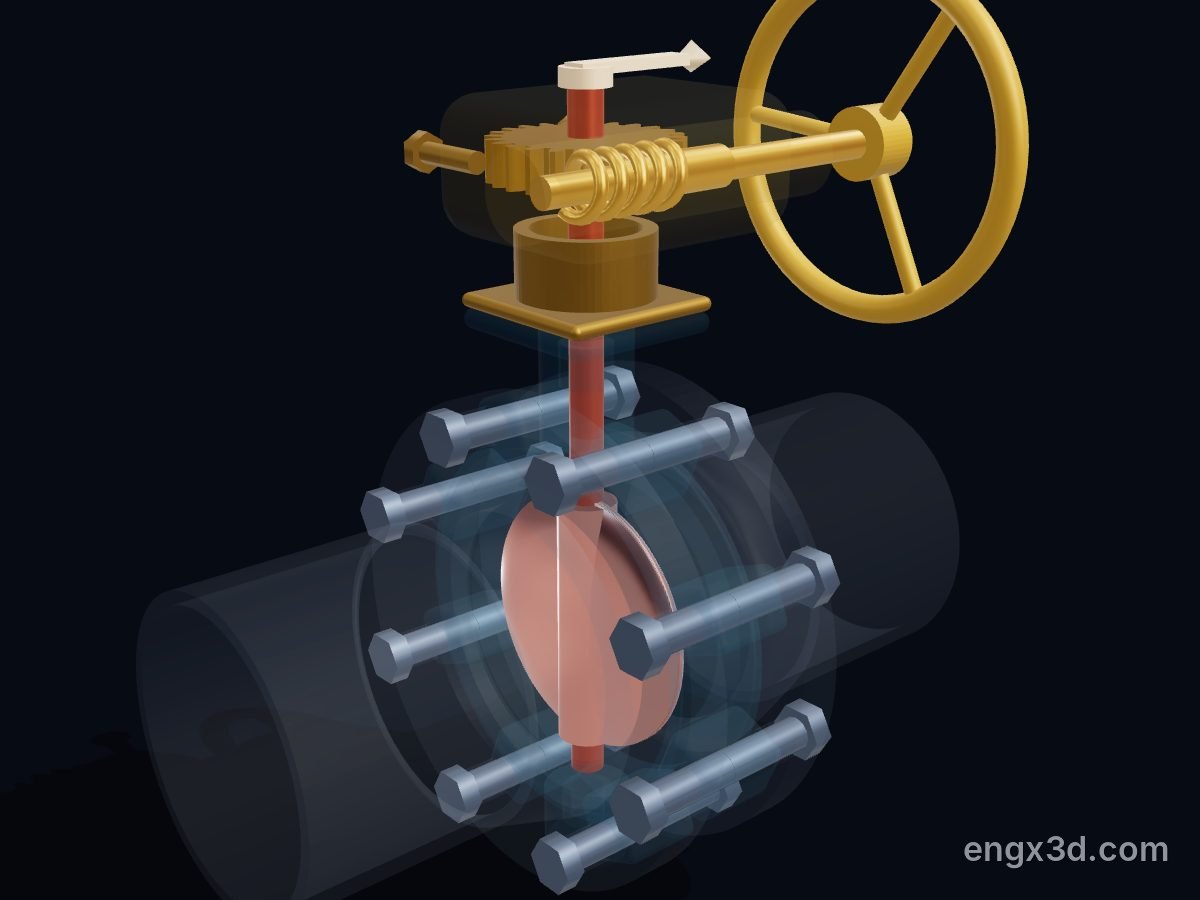
See it work: turn the handwheel six times and watch the worm gear swing the disc a quarter turn from shut to fully open, then cut the valve open to see the disc and rubber seat, free in your browser.
Open the 3D butterfly valve →Or download the free 3D model (GLB, STL, AR).
Key facts
| Type in the 3D model | NPS 6 (DN150) lug-type butterfly valve, concentric (zero offset), rubber seated, API 609 Category A |
|---|---|
| Face to face | 56 mm; even the smaller NPS 4 Class 150 flanged gate valve is 229 mm long |
| Disc and stem | Stainless disc on a Ø19.1 mm stem, pinned; quarter turn (90°) from shut to open |
| Seat | EPDM or NBR rubber liner that also seals against both pipe flanges |
| Pressure rating | 200 psig (14 bar) bidirectional; 150 psig (10 bar) dead-end |
| Flow when fully open | Cv 2790 (Kv 2413) for a 6-inch valve |
| Operator | Worm gear, 24 : 1, so 6 handwheel turns open the valve; gear torque 170 N·m |
| Mating flanges | ASME B16.5 NPS 6 Class 150: Ø279.4 mm, 8 × 3/4 in bolts on Ø241.3 mm |
How it works, step by step
- The valve sits between two pipe flanges. Its rubber seat liner lines the bore and its lips act as the gaskets against both flanges.
- Shut, the disc stands square across the pipe and its edge presses into the rubber seat all the way round, sealing the flow.
- Turning the handwheel turns the worm in the gear operator. The worm turns the worm wheel on top of the stem, 24 times slower.
- The stem turns the disc. After six handwheel turns the disc has swung 90° and stands edge-on to the flow: fully open.
- Stopping part way leaves the disc at an angle, which throttles the flow. The worm drive is self-locking, so the line pressure cannot turn the disc back.
- Two travel stop screws in the operator set the exact shut and open positions, so the disc presses the seat just enough to seal.
Main parts of a butterfly valve
- Body — the short ring between the flanges; lug bodies have tapped lugs for the flange bolts.
- Disc — the round plate that turns in the bore and seals on its edge.
- Stem and disc pins — turn the disc; the pins lock it to the stem.
- Seat liner — the rubber ring the disc seals against, which also seals the flanges.
- Bushings and O-ring — guide the stem and seal it where it leaves the body.
- Gear operator — worm, worm wheel, handwheel, travel stops and position indicator.
- Mounting bracket — joins the operator to the body top plate in line with the stem.
What is the difference between a butterfly valve and a gate valve?
A butterfly valve turns a disc a quarter turn; a gate valve lifts a gate clear of the bore with many handwheel turns. The butterfly valve is much shorter, lighter and quicker, and can throttle, but its disc always sits in the flow. A gate valve opens to a clear full bore but is meant to be fully open or fully shut.
| Butterfly valve (this model) | Gate valve | |
|---|---|---|
| Motion | Quarter turn (90°) | Gate rises out of the bore |
| Face to face | 56 mm (NPS 6, lug) | 229 mm (NPS 4, Class 150 flanged) |
| Throttling | Yes | No, open or shut only |
| When open | Disc stays in the flow | Clear full bore |
See the other one in 3D: how a gate valve works.
What are concentric, double offset and triple offset butterfly valves?
They differ in where the stem sits. In a concentric valve the stem runs through the centre of the disc and pipe, and the disc rubs a rubber seat; it suits water and low pressure, up to about Class 150 and 120 °C. A double offset moves the stem behind the seat and off centre, so the disc lifts away early. A triple offset adds a cone-shaped metal seat that touches only at the end, for steam and hydrocarbons up to Class 900 or more.
- Concentric (API 609 Category A): rubber seat; water, HVAC, fire protection.
- Double offset (Category B): rubber or metal seat; Class 150 to 300 process service.
- Triple offset (Category B): metal seat, bubble-tight; steam, hydrocarbons, high temperature.
What is the difference between a wafer and a lug butterfly valve?
A wafer valve has no bolt lugs: it is clamped between the two flanges by long bolts that pass outside its body. A lug valve has threaded lugs, so each flange bolts to the valve separately. That lets one side be unbolted while the other still holds pressure, which is called dead-end service; this valve is rated 150 psig that way.
Common questions
How many turns does it take to open a butterfly valve?
A lever valve opens in a quarter turn. With a gear operator it depends on the gear ratio: this valve’s 24 : 1 worm gear needs six handwheel turns for the 90° stroke.
Can a butterfly valve be used for throttling?
Yes. Leaving the disc part way open restricts the flow, and a worm gear operator holds it at that angle. Gate valves, by contrast, should only be fully open or fully shut.
Why does a butterfly valve not need flange gaskets?
In a rubber-seated valve the seat liner wraps round onto both faces of the body, and those lips seal against the pipe flanges, doing the job of the gaskets.
Which way should a butterfly valve be installed?
Many concentric rubber-seated valves seal in both directions, but the disc swings into the pipe when it opens, so it needs clearance and should not sit tight against elbows, pumps or check valves. Follow the maker’s flow and stem orientation notes.
What does API 609 cover?
API 609 is the American Petroleum Institute standard for butterfly valves: Category A for concentric rubber-seated valves and Category B for double and triple offset designs.
Sources
References for the facts on this page, and further reading:
- Titan FCI — BF 75 / BF 76 butterfly valve specification sheet (6 in: 56 mm, Ø19.1 mm stem, 200 psig, gear 24 : 1, 170 N·m)
- Emerson Keystone — Figure 990/920 resilient seated butterfly valve data sheet (6 in: Cv 2790, Kv 2413, 10 bar)
- Project Materials — Butterfly valve offset types (concentric, double, triple offset)
- Project Materials — API 609 butterfly valves (Category A and B, materials, operators)
- Engine-X — How a gate valve works (NPS 4 Class 150, ASME B16.10)
Related reading on the blog
Why does a manual gearbox grind?
More machine guides
Compare: Belt vs chain vs gear drive: which is better?
How does a turbocharger work? · How does a centrifugal pump work? · How does a V-belt pulley drive work? · How does a gear reducer work? · Turbocharger vs supercharger: what's the difference? · Centrifugal vs positive displacement pump: what's the difference? · How does a marine diesel engine work? · How does a plate heat exchanger work? · How does a reciprocating air compressor work? · How does a planetary gearbox work? · How does a turbofan jet engine work? · How does a gate valve work? · How does a car engine work? · How does an induction motor work? · How does a manual gearbox work? · How does a car differential work?
Need an interactive 3D page like this for your own machine? See Work with Engine‑X.