Learn Engineering

Why Does a Manual Gearbox Grind? Synchros, Clutch Drag and Gear Oil

By · · 4 min read

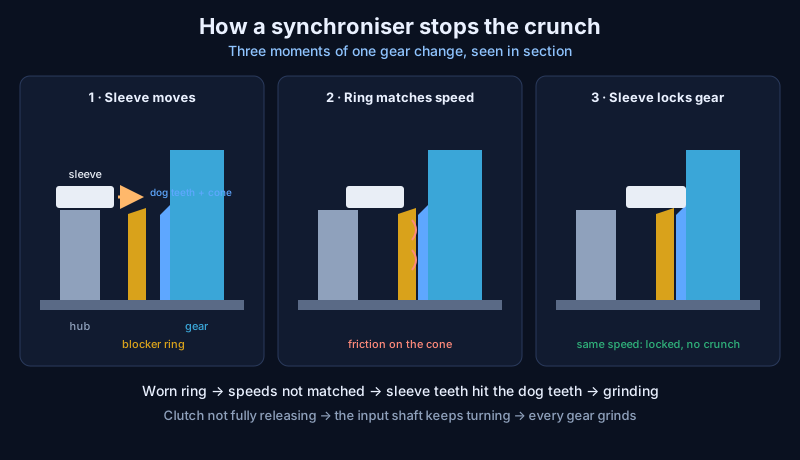
Three-step section diagram of a synchroniser: the sleeve moves towards the gear, the brass blocker ring rubs on the gear cone to match speeds, then the sleeve locks onto the dog teeth; notes explain grinding from a worn ring or a dragging clutch
Diagram: Engine-X
In short

A crunch going into gear has three usual causes: a worn synchro ring, a clutch that does not fully release, or low or wrong gear oil. How to tell them apart from the symptoms, and what each one means inside the gearbox.

Key takeaways
Contents
  1. Why does a gear change need a synchro?
  2. Cause 1: a worn synchro ring
  3. Cause 2: a clutch that does not fully release
  4. Cause 3: low or wrong gear oil
  5. What the symptom tells you
  6. Why does a car pop out of gear?
  7. The engineering takeaway

A manual gearbox grinds when the parts being joined are turning at different speeds. If only one gear crunches, that gear's synchro ring is usually worn. If every gear crunches, the clutch is probably not releasing fully. Low or wrong gear oil makes both worse and quickly wears the gearbox out.

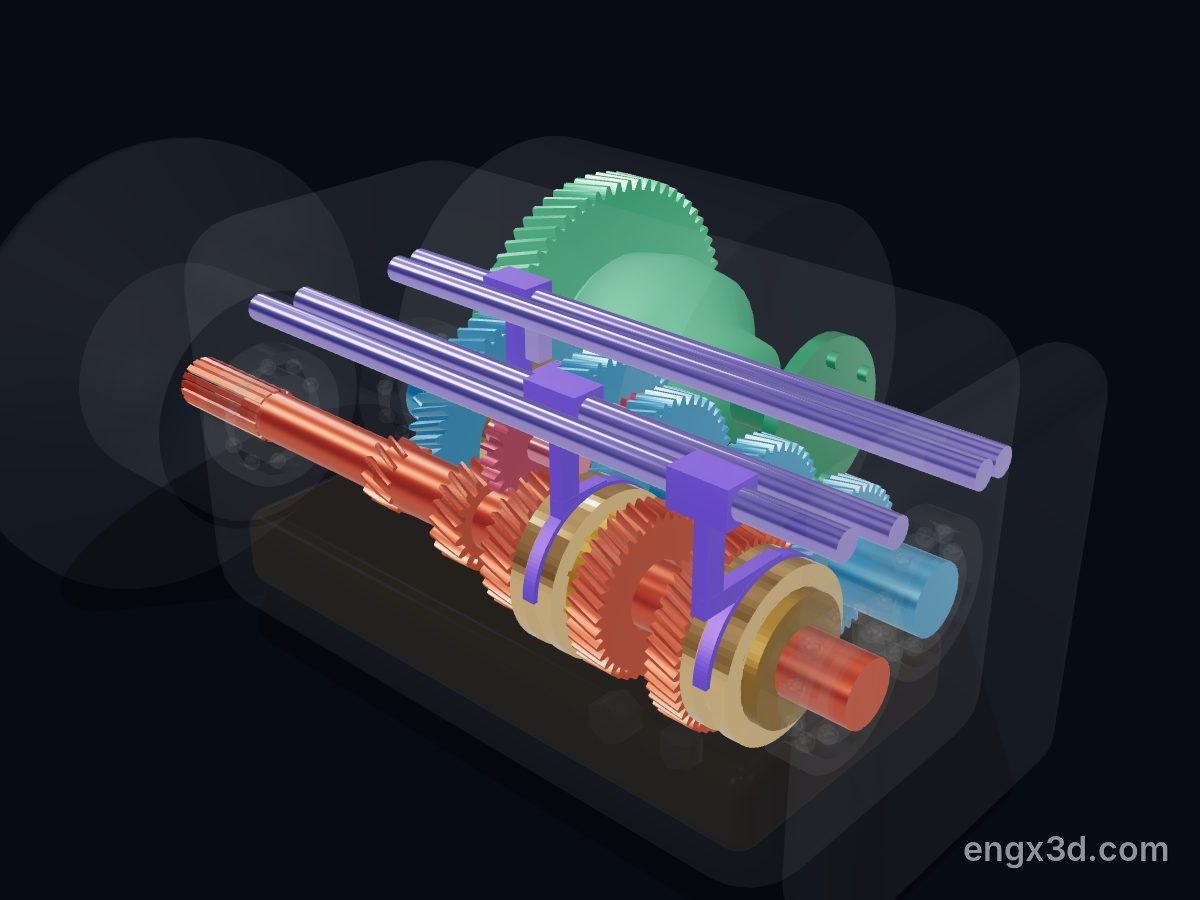
To see exactly where the crunch happens, slide the sleeves of the new Engine-X manual gearbox 3D model through every gear, and read the manual gearbox guide for how the whole box works.

Why does a gear change need a synchro?

Because the gears are always in mesh but turn at different speeds. In a modern gearbox every gear pair stays meshed; one gear of each pair spins freely on its shaft until a synchroniser locks it on (Edumech). Before you select a gear, that free gear and the shaft are almost never at the same speed.

The synchroniser fixes that in a fraction of a second (ASE study guide):

  1. The shift fork pushes the sleeve towards the gear, and the sleeve pushes the blocker ring.
  2. The blocker ring's cone rubs on a cone on the gear. Friction speeds the gear up or slows it down to match the shaft.
  3. Until the speeds match, the ring's pointed teeth hold the sleeve back.
  4. Once they match, the sleeve slides over the gear's dog teeth and locks it to the shaft.

A grind is the sound of the sleeve's teeth hitting the dog teeth while the two are still turning at different speeds.

Cause 1: a worn synchro ring

Synchro rings work by friction, so they are wear parts. Rushed shifts, skipped fluid changes and hard use wear them faster (Jalopnik). As the cone wears, the ring can no longer match the speeds in time and the sleeve arrives too early.

The signs build up slowly. It starts as a slight notchiness or a light click in the lever, then turns into stiff shifts you have to push through, and finally a grind you can feel in your hand. The 2nd gear synchro often fails first, because the lower gears handle bigger and more frequent speed changes (Jalopnik).

A simple check: compare upshifts and downshifts. Upshifts are easier, because the falling engine speed helps the synchro. Downshifts make it speed up the clutch disc and input shaft, so if upshifts are quiet but downshifts crunch or hesitate, the synchros are the likely cause.

Cause 2: a clutch that does not fully release

If every gear grinds, look at the clutch first (AA1Car). When the pedal is down, the clutch should stop the engine driving the input shaft. If it drags, the input shaft keeps being driven while you shift, and no synchro can win that fight.

A dragging clutch can also make shifting stiff and so look like synchro wear (Jalopnik). Causes include a leaking clutch master or slave cylinder, a stretched or misadjusted cable and a worn release mechanism (AA1Car). These are usually cheaper to fix than the gearbox, so rule them out first.

Cause 3: low or wrong gear oil

The synchros, bearings and gears all live on splash lubrication. Low fluid can destroy a manual transmission within a few thousand miles (AA1Car). Oil that is too thick for the weather makes shifting sluggish when cold, and oil that is too thin can raise noise and wear when hot. Factory fills vary from gear oil to automatic transmission fluid or even engine oil, so use what your car's maker specifies (AA1Car).

What the symptom tells you

Symptom Most likely cause
One gear grinds That gear's synchro ring is worn
Every gear grinds Clutch dragging, not fully releasing
Downshifts crunch, upshifts are fine Worn synchros
Stiff or notchy when cold Gear oil too thick for the temperature
Noise in every gear at all speeds Worn shaft bearings or low oil
Pops out of gear under load Worn synchro, dog teeth, fork, rail or detent

The table is drawn from AA1Car and Jalopnik.

Why does a car pop out of gear?

Because the sleeve is not staying fully on the dog teeth. The teeth have a slight reverse taper, so load pulls the sleeve tighter into gear; worn synchros or teeth lose that grip (Jalopnik).

Bent or loose shift forks and rails, worn hub splines, missing interlock parts, too much shaft end play and even a broken engine mount can do the same (AA1Car).

Reverse is a special case: it is usually straight-cut and not synchronised, so it is meant to be selected only with the car stopped (Edumech). A crunch into reverse while rolling is normal behaviour, not a fault, but it still chips the teeth.

The engineering takeaway

A synchro is a small cone clutch whose only job is to match two speeds before the dog teeth meet. When it wears, one gear crunches; when the clutch drags, all of them do; and without the right oil, everything wears faster. Check the oil and the clutch first, because they are the cheap fixes.
TL;DR If only one gear grinds, its synchro ring is usually worn; if every gear grinds, the clutch is probably not fully releasing; low or wrong gear oil makes both worse and can wreck the gearbox quickly.

Frequently asked questions

Why does my car grind going into second gear?

Most often because the 2nd gear synchro ring is worn. Lower gears take larger and more frequent speed changes, especially on downshifts, so their synchros wear first.

Can a clutch problem make the gearbox grind?

Yes. If the clutch does not fully release, the input shaft keeps turning while you shift, so no synchro can match the speeds and every gear grinds. A dragging clutch can also make shifting stiff.

What does it mean when a car pops out of gear?

The sleeve is not staying fully on the gear's dog teeth. Worn synchros, worn dog teeth or hub splines, loose shift forks or rails, worn detents and even a broken engine mount can let it happen.

Is it bad to keep driving with a grinding gearbox?

Each crunch chips the dog teeth and wears the synchro further, so the problem gets worse and can lead to a gear popping out or failing to engage. Check the gear oil level and the clutch first, as they are the cheapest fixes.

Sources
Manual Gearbox 3D model
Free 3D model · download

Manual Gearbox

5-speed manual transaxle with VW 02T ratios: input and output shafts, five gear pairs, synchronisers, shift forks and final drive. Real scale, every part named. Download the whole machine as GLB or STL, grab any of its 42 parts as its own STL, or view it in AR on your phone.

Free for personal and educational use (CC BY-NC 4.0), credit Engine‑X.

LinkedInWhatsAppX
See the Manual Gearbox in 3D
Manual Gearbox5-speed manual transaxle with VW 02T ratios: input and output shafts, five gear pairs, synchronisers, shift forks and final drive. TurbochargerExhaust-driven turbine spinning a compressor, with journal bearings and a wastegate. V-Belt Pulley DriveTwo pulleys and a V-belt reducing speed with true belt kinematics. Centrifugal PumpEnd-suction pump with a backward-curved impeller and volute casing. Helical Gear ReducerTwo-stage helical gearbox, 16 : 1, with meshing helical gears and tapered roller bearings. Marine Diesel EngineInline-6, 14 L marine diesel in the NT855 Big Cam style: pistons, camshaft, 24 valves, PT injectors, turbo and sea water cooling. Plate Heat ExchangerGasketed plate-and-frame exchanger, 41 plates, DN100, with hot and cold water in alternate channels. Reciprocating Air CompressorTwo-stage piston compressor, 12 bar, with reed valves, an intercooler, a V-belt drive and an air tank. Planetary GearboxSingle-stage planetary reducer, 5 : 1: sun, three planets, fixed ring gear and carrier output. Turbofan Jet EngineTwo-spool high-bypass turbofan in the CFM56-7B style: 61-inch fan, booster, 9-stage compressor, combustor and turbines. Gate ValveNPS 4 Class 150 OS&Y wedge gate valve: rising stem, bolted bonnet, graphite packing and handwheel. Car DifferentialRear-axle open differential, 41 : 11 = 3.73 : 1: ring and pinion, spider and side gears, axle shafts. Car Engine2.0 L inline-four petrol engine, DOHC 16-valve: crankshaft, pistons, chain-driven camshafts, valves, spark plugs and injectors. Induction Motor7.5 kW, 4-pole three-phase squirrel-cage motor, IEC 132M: stator windings, aluminium rotor cage, bearings and cooling fan. Butterfly ValveNPS 6 lug butterfly valve, concentric and rubber seated, with a 24 : 1 worm gear operator: disc, stem, seat, gearbox and handwheel.

Explode, X‑ray and cut them open, free in your browser.

Need your machine in 3D?

Engine‑X builds interactive 3D websites for pumps, valves, gearboxes and other machines that buyers can rotate, explode and section, plus 3D explainers for colleges and trainers. Free quote within 24 hours, 3 rounds of revisions included.

Get a free quote → What's included

Mechanical engineer and designer from India. He has designed and drafted marine engineering projects in AutoCAD and SolidWorks, and works in ship repair and dry docking, with hands-on experience in piping, valves, fabrication and pressure testing. He builds Engine-X, a free interactive 3D atlas that shows how real machines work inside.

About · LinkedIn · Contact