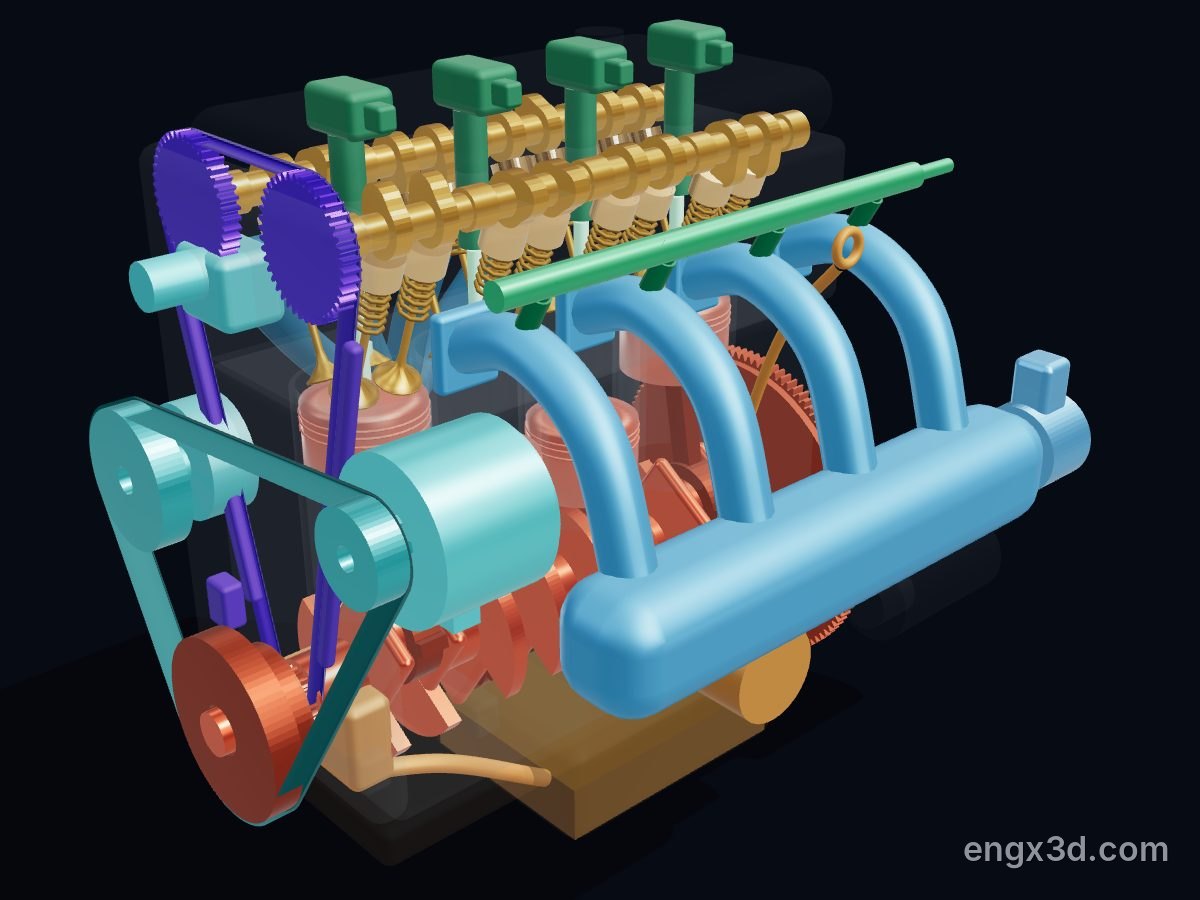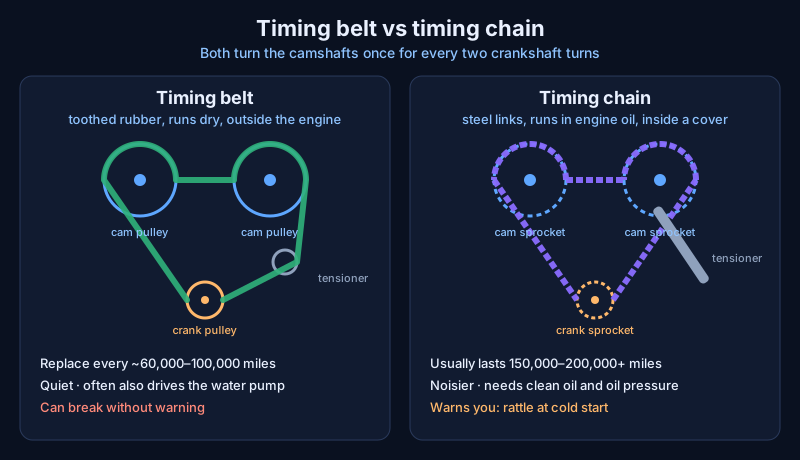
A timing belt and a timing chain do the same job: they link the crankshaft to the camshafts so every valve opens in step with its piston. A belt is quiet toothed rubber replaced on schedule; a chain runs in engine oil and usually lasts far longer. It matters most when one fails in an interference engine.
You can watch a timing chain drive both camshafts at half speed in the new Engine-X car engine 3D model, and the car engine guide walks through every part from the crankshaft to the spark plugs.
What does a timing belt or chain actually do?
It keeps the valve timing locked to the crankshaft. In a four-stroke engine each valve opens once every two crankshaft turns, so the camshafts must turn at exactly half crankshaft speed (How a Car Works). The crank sprocket therefore has half as many teeth as each cam sprocket.
- The crankshaft turns the small crank sprocket or pulley at the front of the engine.
- The belt or chain carries that motion up to the camshaft sprockets on the cylinder head.
- A tensioner presses on the slack side so the teeth never skip.
- The camshafts turn once per cycle and open the intake and exhaust valves at the right moment.
If the belt or chain slips even one tooth, the valves open at the wrong time: the engine runs badly, and if it breaks the engine stops at once (Cars.com).
Timing belt vs timing chain compared
| Timing belt | Timing chain | |
|---|---|---|
| Made of | Toothed rubber | Steel links, like a bicycle chain |
| Runs | Dry, behind a plastic cover | In engine oil, inside a metal cover |
| Typical life | Replace every 60,000 to 100,000 miles (some makers 120,000) | 150,000 to 200,000 miles or the life of the car |
| Noise | Very quiet | Noisier, rattles when worn |
| Warning before failure | Often none | Rattle at start-up, timing fault codes |
| Usual job cost | Belt kit, often with water pump | More parts and labour when it is needed |
The figures come from UTI and YourMechanic; Cars.com puts belt intervals at 60,000 to 120,000 miles, so always check the owner's manual for your engine.
Why does an interference engine make it matter?
In an interference engine the open valves reach into the space the piston uses at the top of its stroke. While the timing is right they never meet. If the belt or chain breaks, the camshafts stop with some valves open while the crankshaft keeps turning, so the pistons hit them (Cars.com).
The damage depends on speed. A belt usually breaks at start-up or shutdown, when tension is highest; at low speed the result is bent valves or broken valve guides, but at high rpm valves can snap and wreck pistons and connecting rods (YourMechanic). In a non-interference engine the engine simply stops and a new belt kit is often all it needs.
Interference engines are common, and a dealer or mechanic can tell you whether yours is one (YourMechanic). That is why skipping a belt change is such an expensive gamble.
Warning signs of a worn belt or chain
Timing belt: it often gives no warning at all. Worn teeth or a weak tensioner can make it skip a tooth, which shows up as a ticking noise, a misfire or poor running (Cars.com). That is why the interval matters more than any symptom.
Timing chain: a worn chain stretches and its guides and tensioner wear. The classic sign is a rattle at cold start that fades as oil pressure builds. A check engine light with timing-related codes and poor acceleration can follow, and a badly stretched chain can jump a tooth on the sprocket (UTI).
Chains depend on oil: the tensioner is pushed out by oil pressure, so low oil or overdue oil changes speed up wear (YourMechanic). Belt drives have their own neighbour problem: on engines where the belt also turns the water pump, a leaking pump soaks the belt, so mechanics usually replace the pump, tensioner and idlers in the same job.
Belts are not the only belts under the bonnet, either: the accessory belt that turns the alternator wears in its own way, covered in why V-belts slip, squeal and fail.
Which one is better?
Neither is better everywhere. A belt is light, quiet and cheap to make, and suits owners who follow the service schedule. A chain costs more and is noisier but usually outlives the car when the oil is changed on time. Either way, know which one your engine has and whether it is an interference engine.
With a belt, follow the replacement interval; with a chain, change the oil on time and listen for the cold-start rattle.
For the bigger picture of how belts, chains and gears compare as power drives, see belt vs chain vs gear drive. Big marine engines skip both and drive their camshafts through a train of gears, as in the marine diesel engine.
The engineering takeaway
A timing drive has one job, holding the camshafts at exactly half crank speed, and failure is rarely gentle. Belts trade a fixed replacement interval for quiet running; chains trade noise and oil dependence for long life. In an interference engine, the cheapest repair is the one done before anything breaks.