Engine‑X machine guide
How does a car engine work?
By Parth Parmar, mechanical design engineer · Updated
A car engine burns a mix of petrol and air inside its cylinders. Each burn pushes a piston down, and connecting rods turn the pistons’ up-and-down motion into rotation of the crankshaft. It works in four strokes, intake, compression, power and exhaust, while camshafts open the valves and spark plugs light the mixture.
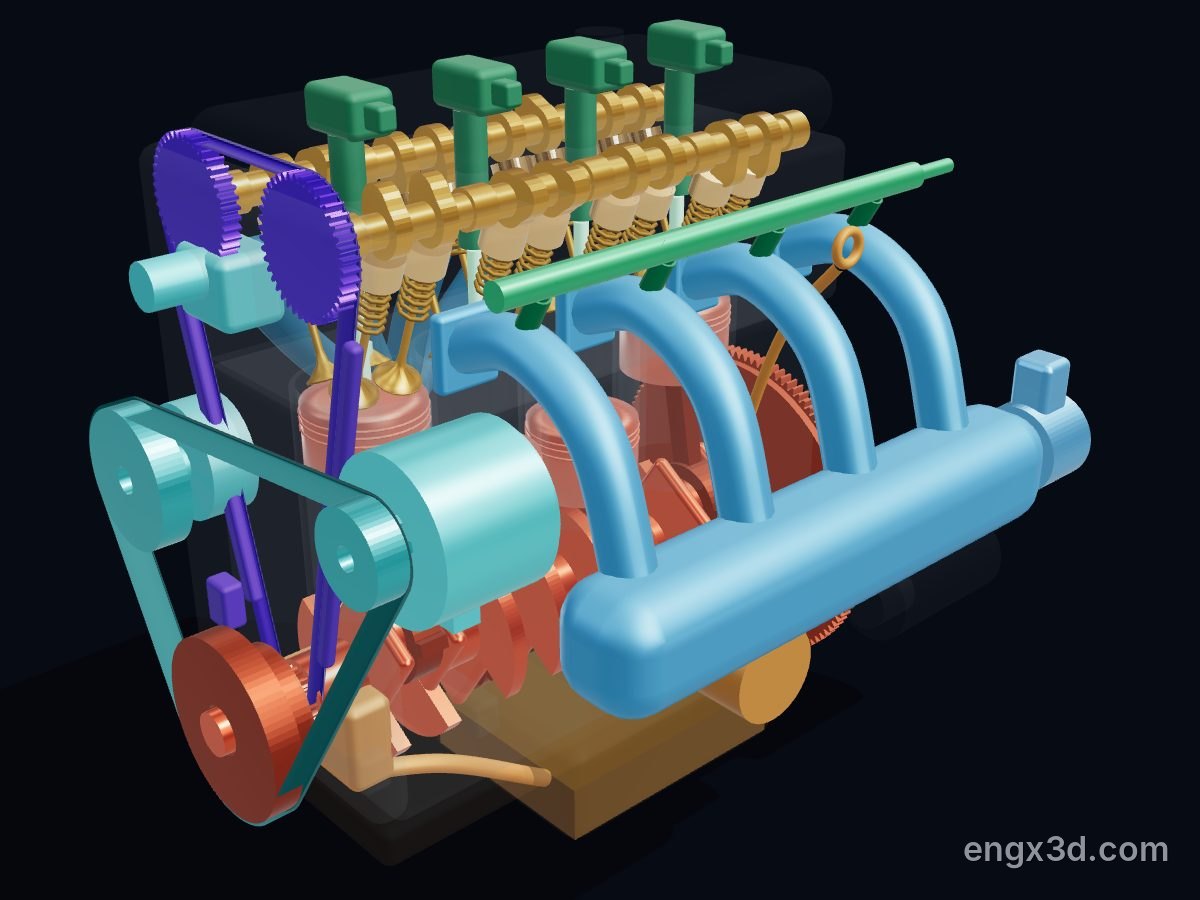
See it work: watch the four pistons, the two camshafts and all 16 valves move in step, follow the 1-3-4-2 firing strip, then explode and cut open the engine in 3D, free in your browser.
Open the 3D car engine →Or download the free 3D model (GLB, STL, AR).
Key facts
| Type in the 3D model | Inline-four (straight-4) petrol engine, 4-stroke, DOHC, 16 valves |
|---|---|
| Bore × stroke | 86 × 86 mm, a "square" engine (Honda K20A2: 86.0 × 85.9 mm) |
| Displacement | 1,998 cc: 4 cylinders × 499.6 cc, sold as a 2.0-litre |
| Compression ratio | 11.0 : 1 (petrol engines run about 8 : 1 to 12 : 1) |
| Firing order | 1-3-4-2, one cylinder fires every 180° of crank rotation |
| Crankshaft | 180° crank (throws up-down-down-up), 5 main bearings |
| Valve train | 2 overhead camshafts, chain driven at half crank speed, bucket tappets, 4 valves per cylinder |
| Fuel and ignition | Port fuel injection, one coil-on-plug per cylinder, about 14.7 : 1 air to fuel by mass |
| Example output | Honda K20A2: 149 kW (200 hp) at 7,400 rpm, redline 7,900 rpm |
How it works, step by step
- Intake: the piston moves down with the intake valves open, drawing air and the petrol sprayed by the injector into the cylinder.
- Compression: both valves close and the piston rises, squeezing the mixture to about one eleventh of its volume in this engine.
- Power: just before the top, the spark plug fires. The burning mixture expands and drives the piston down, turning the crankshaft.
- Exhaust: the exhaust valves open and the rising piston pushes the burnt gas out to the exhaust manifold and catalytic converter.
- The four strokes take two crankshaft turns (720°). The four cylinders are spaced 180° apart, so one of them is always on its power stroke: in the order 1-3-4-2.
- The crankshaft drives both camshafts through the timing chain at half speed, so each valve opens once per cycle, exactly in step with its piston.
Main parts of a car engine
- Cylinder block — the main casting that holds the four cylinders and the crankshaft.
- Crankshaft — turns the pistons’ push into rotation; its 180° throws set the firing rhythm.
- Pistons, rings and connecting rods — take the gas pressure and pass it to the crankpins.
- Cylinder head — closes the cylinders and carries the valves, camshafts and spark plugs.
- Camshafts and valves — two camshafts open 8 intake and 8 exhaust valves through bucket tappets; springs close them.
- Timing chain — keeps the camshafts in step with the crankshaft at half its speed.
- Spark plugs and ignition coils — make the spark that lights the mixture, one coil per plug.
- Fuel injectors and rail — spray metered petrol into the intake ports.
- Intake and exhaust manifolds — bring air in through the throttle body and carry exhaust out to the catalytic converter.
- Oil pump, oil pan and filter — keep every bearing on a film of clean oil.
- Water pump, alternator and belt — cool the engine and make the car’s electricity.
What is the difference between a petrol and a diesel engine?
A petrol engine mixes fuel and air, compresses it only moderately, about 8 : 1 to 12 : 1, and lights it with a spark plug. A diesel compresses air alone much harder, usually 14 : 1 or more, until it is hot enough to ignite the diesel fuel as it is injected, so it needs no spark plugs.
| Petrol (this model) | Diesel | |
|---|---|---|
| Ignition | Spark plug | Heat of compression |
| Compression ratio | About 8 : 1 to 12 : 1 | 14 : 1 or higher |
| Power control | Throttle limits the air | Amount of fuel injected |
| Typical use | Cars, motorbikes | Trucks, ships, generators, many cars |
See a big diesel work in 3D: how a marine diesel engine works.
What does the firing order 1-3-4-2 mean?
It is the order in which the four cylinders fire, counted from the front of the engine. Pistons 1 and 4 move together, as do 2 and 3, so the engine alternates between the outer and inner pairs: 1, then 3, then 4, then 2, one firing every half turn. Firing 1-2-3-4 in a row would make the engine run unevenly.
What is the difference between a timing belt and a timing chain?
Both keep the camshafts in step with the crankshaft. A timing belt is toothed rubber, runs dry and must be replaced at a set interval, usually every 60,000 to 100,000 miles. A timing chain runs in engine oil and typically lasts 150,000 to 200,000 miles or more, but a worn chain rattles at start-up and can jump a tooth.
- Why it matters: in an interference engine a broken belt or a jumped chain lets the open valves hit the pistons, which can wreck the engine.
- This model uses a chain with a hydraulic tensioner on the slack side and a fixed guide on the tight side.
Common questions
What does DOHC mean?
Double overhead camshaft: two camshafts in the cylinder head, one for the intake valves and one for the exhaust valves. It lets each cylinder have four valves and lets the engine rev higher.
What does 16-valve mean?
The engine has 16 valves in total: four per cylinder, two intake and two exhaust. Two smaller valves give more flow area than one big one and leave room for the spark plug in the middle.
Why is it called a 2.0-litre engine?
Because the four cylinders together sweep about 2,000 cubic centimetres. Each 86 mm bore times the 86 mm stroke gives 499.6 cc, and four of them make 1,998 cc.
What is an inline-four engine?
An engine with four cylinders in one straight row, all driving one crankshaft. It is the most common layout in cars because it is compact, cheap to build and needs only one cylinder head.
What does compression ratio mean?
How much the piston squeezes the mixture: the cylinder volume at the bottom of the stroke divided by the volume left at the top. At 11 : 1 the mixture is squeezed to one eleventh of its volume. Higher ratios give more efficiency but need higher-octane fuel to avoid knock.
Sources
References for the facts on this page, and further reading:
- Wikipedia — Honda K engine (K20A2: 11.0 : 1, DOHC 16-valve, 149 kW at 7,400 rpm, 7,900 rpm redline)
- 8020 Automotive — Honda K20A2 engine guide (86.0 × 85.9 mm, 1,996 cc, aluminium block and head)
- How a Car Works — The engine: how power is created (four-stroke cycle, firing order 1-3-4-2)
- MVWautotechniek — The petrol engine (four strokes, 720° cycle, firing order 1-3-4-2)
- Wikipedia — Engine balance (straight-four: 180° crank, secondary imbalance, balance shafts)
- Jalopnik — Why diesel engines have higher compression ratios than gas engines
- Universal Technical Institute — Timing belt vs timing chain
- Wikipedia — Oxygen sensor (stoichiometric 14.7 : 1 air-fuel ratio)
Related reading on the blog
Ball, roller or journal bearing? How bearing types work and how to choose
More machine guides
Compare: Belt vs chain vs gear drive: which is better?
How does a turbocharger work? · How does a centrifugal pump work? · How does a V-belt pulley drive work? · How does a gear reducer work? · Turbocharger vs supercharger: what's the difference? · Centrifugal vs positive displacement pump: what's the difference? · How does a marine diesel engine work? · How does a plate heat exchanger work? · How does a reciprocating air compressor work? · How does a planetary gearbox work? · How does a turbofan jet engine work? · How does a gate valve work? · How does a car differential work? · How does an induction motor work? · How does a manual gearbox work? · How does a butterfly valve work?
Need an interactive 3D page like this for your own machine? See Work with Engine‑X.