Engine‑X comparison
Hydraulic vs pneumatic cylinder: which should you use?
By Parth Parmar, mechanical design engineer · Updated
Both turn fluid pressure into a straight push or pull. A hydraulic cylinder uses oil at roughly 70 to 350 bar, so a small cylinder gives a very large, steady and precise force. A pneumatic cylinder uses compressed air at about 6 to 8 bar: it is faster, cleaner and cheaper, but much weaker for its size and harder to stop accurately.
Side-by-side comparison
| Hydraulic cylinder | Pneumatic cylinder | |
|---|---|---|
| Working fluid | Oil, almost incompressible | Compressed air, compressible |
| Working pressure | About 70–350 bar | About 5.5–8 bar |
| Force for the same bore | Up to about 25 times more | Lower |
| Speed | About 10–50 cm/s | Up to about 2.5 m/s |
| Positioning | Precise, can hold a load still | Less precise; air springs under load |
| Energy efficiency | Higher | Lower; compressing air wastes much of the energy |
| Leaks and cleanliness | Oil leaks are messy and a fire risk | Clean; leaks only lose air |
| Typical use | Excavators, presses, cranes, forklifts, aircraft landing gear | Packaging, assembly lines, grippers, food and pharma machines |
Which one should you choose?
- Hydraulic cylinder: heavy loads, high force in a small space, slow and precise motion, or holding a load in position.
- Pneumatic cylinder: light, fast, repetitive motion where cleanliness and low cost matter more than force.
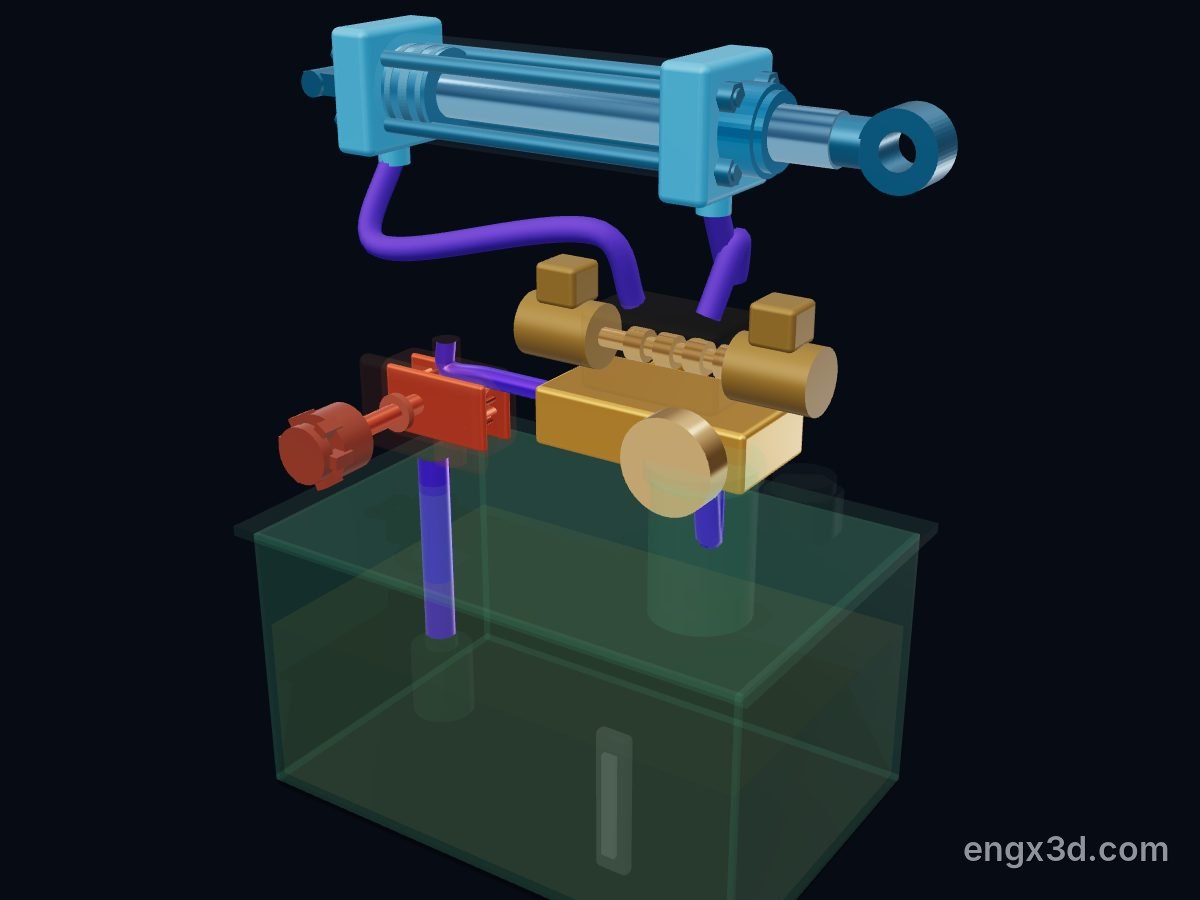
How a hydraulic cylinder works
A pump sends oil through a directional valve into one side of the cylinder. Pressure on the piston area pushes the rod out with force = pressure × area; switching the valve feeds the rod side and pulls it back, faster but with less force because the rod takes up part of the area.
Watch the Engine‑X hydraulic pump and cylinder extend and retract in 3D: 49.9 kN push from a 63 mm bore at 160 bar.
How a pneumatic cylinder works
A compressor fills a receiver with air, and a valve lets that air into one end of the cylinder. Because air is compressible it expands quickly and drives the piston fast, but it also behaves like a spring under load, so the rod is hard to stop at an exact point without extra controls. Exhaust air is simply released to the atmosphere. See where the air comes from in the reciprocating air compressor.
See how it works inside, part by part, in 3D.
Explore the 3D hydraulic cylinder →Common questions
Which is stronger, a hydraulic or a pneumatic cylinder?
A hydraulic cylinder, by far. It works at roughly 70 to 350 bar against 6 to 8 bar for air, so the same bore can give up to about 25 times the force.
Which is faster, hydraulic or pneumatic?
Pneumatic. Air is light and expands quickly, so pneumatic cylinders can move at up to about 2.5 m/s, while hydraulic cylinders usually move at about 10 to 50 cm/s.
Why are hydraulic cylinders more precise?
Oil is almost incompressible, so the rod moves exactly as much as the oil sent in and holds still when the valve closes. Air compresses like a spring, so the rod position changes with the load.
Are pneumatic cylinders cheaper?
Usually yes to buy: they are lighter and simpler. Compressed air is an expensive form of energy to make, though, so running costs can be higher than a hydraulic system doing the same work.
Where are pneumatic cylinders used instead of hydraulic?
In fast, light, clean work: packaging, assembly lines, grippers, and food and pharmaceutical machines, where an oil leak would contaminate the product.
Sources
References for the facts on this page, and further reading:
- Tameson — The difference between a hydraulic and pneumatic cylinder
- Wevolver — Pneumatic vs hydraulic power systems: principles, differences and selection
- Atos — KTC hydraulic cylinders catalogue (CK series, ISO 6020-2)
Related guides
Full guide: How does a hydraulic cylinder work? · Free hydraulic cylinder 3D model · Every machine part A–Z
More comparisons: Helical vs worm gear reducer · Two-stroke vs four-stroke diesel engine · Reciprocating vs screw air compressor · Plate vs shell and tube heat exchanger · Planetary vs helical gearbox · Turbofan vs turbojet · Gate valve vs globe valve · Open vs limited-slip differential · Petrol vs diesel engine · Induction vs synchronous motor · Manual vs automatic transmission · Butterfly valve vs gate valve · Turbocharger vs supercharger · Centrifugal vs positive displacement pump · Belt vs chain vs gear drive
Need an interactive 3D page for your own machine? See Work with Engine‑X.