Engine‑X comparison
Butterfly valve vs gate valve: which should you use?
By Parth Parmar, mechanical design engineer · Updated
A butterfly valve turns a disc a quarter turn inside the pipe, so it opens fast, is short and light, and can throttle, but the disc stays in the flow when open. A gate valve lifts a gate fully clear of the bore with many handwheel turns, giving an unobstructed bore and tight shut-off, but it is heavier, longer and slow to operate.
Side-by-side comparison
| Butterfly valve | Gate valve | |
|---|---|---|
| Operation | Quarter turn (90°) | Multi-turn handwheel |
| Open flow path | Disc stays in the flow | Full, clear bore |
| Pressure drop | Low to moderate | Very low |
| Throttling | Yes, in the middle of its travel | No |
| Length and weight | Very short (wafer or lug), light | Long face-to-face, heavy |
| Pigging | Cannot pass a pig | Full-bore designs can |
| Cost at large sizes | Low | High |
| Typical use | Water, HVAC, cooling water, ship ballast and sea-water lines | Oil and gas pipelines, steam, high-pressure isolation |
Which one should you choose?
- Butterfly valve: large water or air lines, quick operation, tight space, low weight and low cost, with some throttling.
- Gate valve: high-pressure or high-temperature isolation, full-bore flow, or lines that must be pigged.
How a butterfly valve works
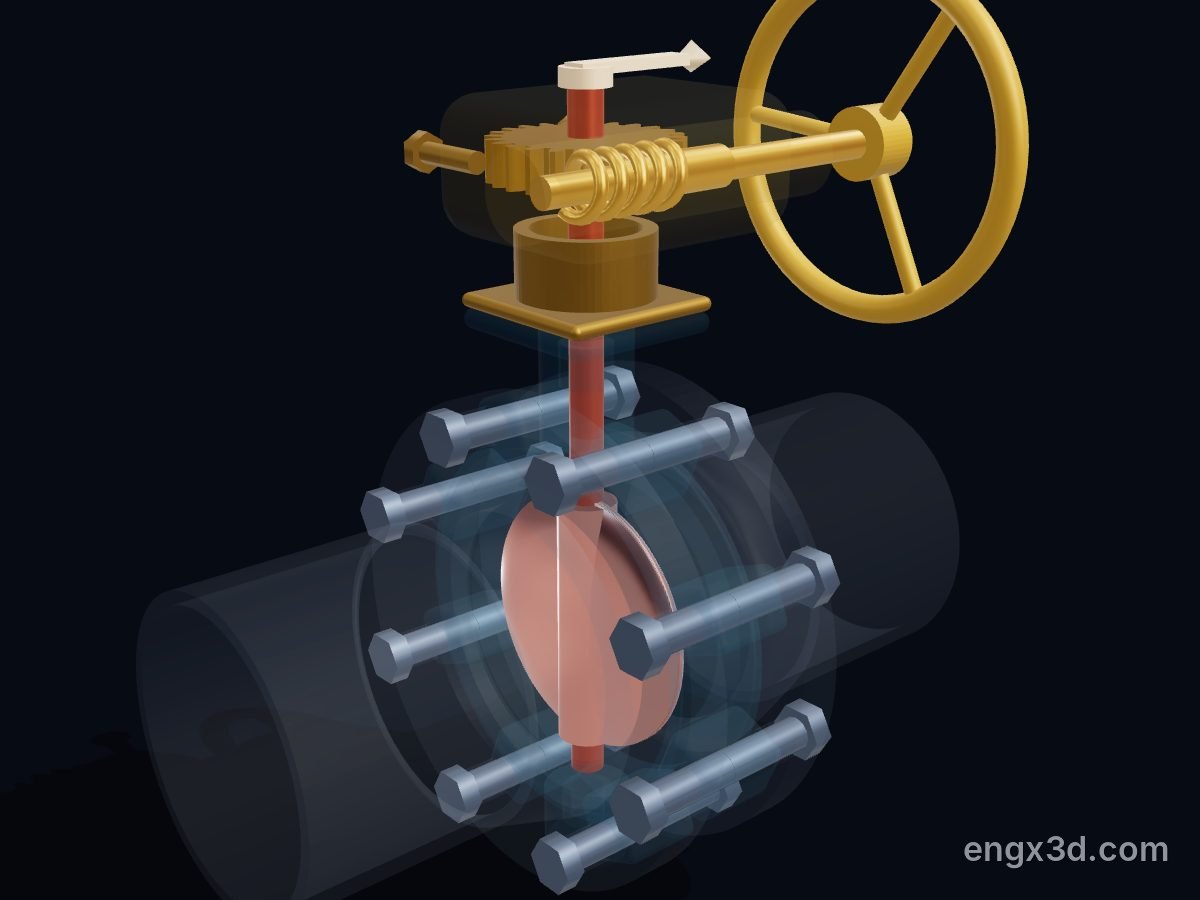
The disc is fixed to a stem across the pipe. Turning the stem 90° swings the disc from across the bore (closed), where it presses into the seat liner, to edge-on to the flow (open). A gear operator with a worm and worm wheel makes large valves easy to turn and holds the disc at any angle.
Open the Engine‑X butterfly valve in 3D and turn its handwheel.
How a gate valve works
A threaded stem lifts the wedge up into the bonnet, clear of the flow, or lowers it between two seat rings to seal. Many turns are needed for a full stroke, which makes it slow but also prevents water hammer from sudden closing. See it inside the gate valve 3D model.
See how it works inside, part by part, in 3D.
Explore the 3D butterfly valve →Common questions
Which is better for water lines, butterfly or gate valve?
For large water lines a butterfly valve is usually better: it is lighter, cheaper, shorter and opens with a quarter turn. A gate valve is chosen when a full bore or very low pressure drop is needed.
Can a butterfly valve be used for throttling?
Yes, within the middle of its travel. Near closed, the fast flow past the disc edge can wear the seat and cause noise, so a control valve is better for fine regulation.
Which valve seals better, butterfly or gate?
A resilient-seated butterfly valve seals bubble-tight on water and air. For high pressure and temperature, metal-seated gate valves or triple-offset butterfly valves are used.
Can a butterfly valve be installed in either direction?
Most concentric resilient-seated butterfly valves are bidirectional. Double and triple offset valves usually have a preferred flow direction marked on the body.
Why is a butterfly valve cheaper than a gate valve?
It uses far less metal: a thin wafer body and a disc instead of a long body, bonnet and wedge. The saving grows with pipe size.
Sources
References for the facts on this page, and further reading:
- Project Materials — Butterfly valve offset types
- Emerson Keystone — Figure 990/920 resilient seated butterfly valve data sheet
- Valve Magazine — The fundamentals of gate valves
Related guides
Full guide: How does a butterfly valve work? · Free butterfly valve 3D model · Every machine part A–Z
More comparisons: Helical vs worm gear reducer · Two-stroke vs four-stroke diesel engine · Reciprocating vs screw air compressor · Plate vs shell and tube heat exchanger · Planetary vs helical gearbox · Turbofan vs turbojet · Gate valve vs globe valve · Open vs limited-slip differential · Petrol vs diesel engine · Induction vs synchronous motor · Manual vs automatic transmission · Hydraulic vs pneumatic cylinder · Turbocharger vs supercharger · Centrifugal vs positive displacement pump · Belt vs chain vs gear drive
Need an interactive 3D page for your own machine? See Work with Engine‑X.