Engine‑X comparison
Plate vs shell and tube heat exchanger: which is better?
By Parth Parmar, mechanical design engineer · Updated
A plate heat exchanger passes heat through thin corrugated plates clamped in a frame; a shell and tube exchanger passes it through tubes inside a cylindrical shell. Plates move much more heat in a small space and can bring the two fluids very close in temperature. Shell and tube units are bigger but take higher pressures and temperatures, dirty fluids and steam.
Side-by-side comparison
| Plate heat exchanger | Shell and tube heat exchanger | |
|---|---|---|
| Construction | Corrugated plates with gaskets, clamped by tightening bolts | Tube bundle inside a pressure shell, with baffles |
| Heat transfer | Very high: thin plates and turbulent flow | Lower per square metre |
| Size for the same duty | Compact | Much bigger and heavier |
| Temperature approach | Very close; temperature cross possible | Wider |
| Pressure and temperature | Limited by gaskets and frame | High pressure and high temperature |
| Dirty fluids and steam | Narrow channels can block; gasketed units take only low-pressure steam | Handles dirt, fibres, two-phase flow and steam |
| Changing capacity | Add or remove plates | Fixed; needs a new unit |
| Typical use | HVAC, district heating, ship central coolers, food and dairy | Refineries, power plants, condensers, high-pressure process |
Which one should you choose?
- Choose a plate heat exchanger for clean liquids at moderate pressure, when space, efficiency and easy cleaning matter.
- Choose shell and tube for high pressure or temperature, steam, or fluids with solids that would block narrow plate channels.
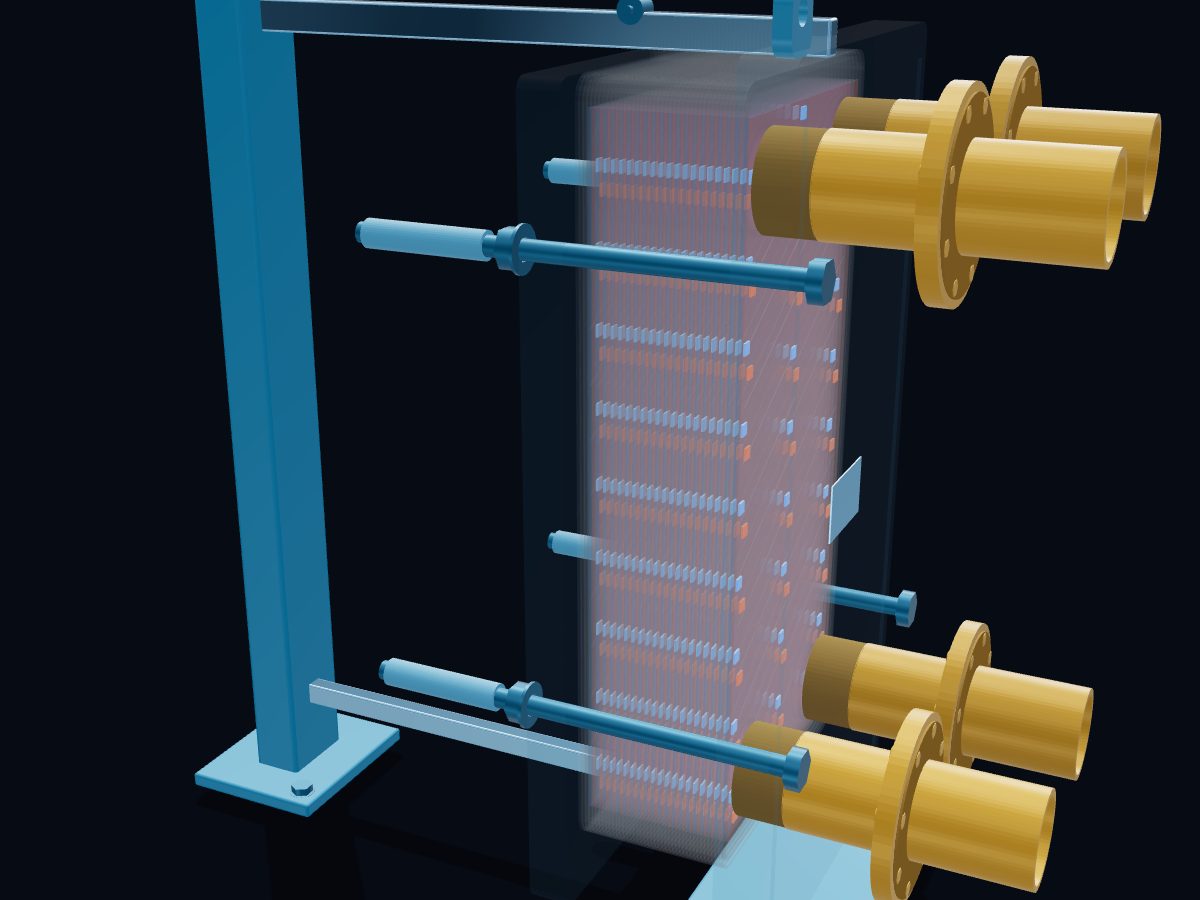
How a plate heat exchanger works
The plates are pressed with a herringbone pattern and stacked so that the hot and cold fluids flow in alternate channels, usually in opposite directions. The corrugations make the flow turbulent even at low speed, which scrubs the plates and moves heat fast. Gaskets seal each channel and steer each fluid to the right ports.
Explore every plate, gasket and bolt in the Engine‑X plate heat exchanger.
How a shell and tube heat exchanger works
One fluid flows through a bundle of tubes; the other flows around them inside the shell. Baffles force the shell-side fluid to cross the tubes several times. The thick cylindrical shell and round tubes take high pressure well, and a removable bundle can be pulled out for cleaning.
See how it works inside, part by part, in 3D.
Explore the 3D plate heat exchanger →Common questions
Which is more efficient, plate or shell and tube?
A plate heat exchanger. Its thin plates and turbulent channels transfer heat several times better per square metre, so it needs much less area and space for the same duty.
Why do ships use plate heat exchangers as central coolers?
They are compact, efficient and easy to open and clean in an engine room. Sea-water coolers usually have titanium plates to resist corrosion.
Can a plate heat exchanger be used with steam?
Gasketed plate units handle only low-pressure steam because the gaskets limit temperature. For higher-pressure steam, shell and tube or welded and brazed plate designs are used.
How do you increase the capacity of a plate heat exchanger?
Add more plates, if the frame has room, and re-tighten the pack to the specified length. A shell and tube unit cannot be enlarged this way.
Which is easier to clean?
A gasketed plate heat exchanger: loosen the tightening bolts, slide the plates apart and clean each one. Shell and tube units need the bundle pulled or the tubes rodded or chemically cleaned.
Sources
References for the facts on this page, and further reading:
- Alfa Laval — How gasketed plate heat exchangers work
- Alfa Laval — M10 gasketed plate heat exchanger: technical data
- Wikipedia — Shell and tube heat exchanger
- Wikipedia — Plate heat exchanger
Related guides
Full guide: How does a plate heat exchanger work? · Free plate heat exchanger 3D model · Every machine part A–Z
More comparisons: Helical vs worm gear reducer · Two-stroke vs four-stroke diesel engine · Reciprocating vs screw air compressor · Planetary vs helical gearbox · Turbofan vs turbojet · Gate valve vs globe valve · Open vs limited-slip differential · Petrol vs diesel engine · Induction vs synchronous motor · Manual vs automatic transmission · Butterfly valve vs gate valve · Hydraulic vs pneumatic cylinder · Turbocharger vs supercharger · Centrifugal vs positive displacement pump · Belt vs chain vs gear drive
Need an interactive 3D page for your own machine? See Work with Engine‑X.