Engine‑X comparison
Induction vs synchronous motor: what is the difference?
By Parth Parmar, mechanical design engineer · Updated
An induction motor’s rotor always turns a little slower than the rotating magnetic field, typically 2 to 5 % slip, because that slip is what induces the rotor current that makes torque. A synchronous motor’s rotor locks to the field and turns at exactly synchronous speed, 120 f / p, using magnets or a DC-fed field winding. Induction motors are simpler and tougher; synchronous motors hold exact speed and can be more efficient.
Side-by-side comparison
| Induction motor | Synchronous motor | |
|---|---|---|
| Rotor | Squirrel cage (or wound rotor), no supply to it | Permanent magnets or a DC-fed field winding |
| Speed | Slightly below synchronous (1,450 rpm for a 4-pole 50 Hz motor) | Exactly synchronous (1,500 rpm for 4-pole 50 Hz) |
| Slip | About 2–5 % at full load | None |
| Starting | Starts by itself on the mains | Needs a drive (VFD), damper winding or starting motor |
| Power factor | Lagging, worse at light load | Adjustable; can be leading when over-excited |
| Efficiency | Good (IE3 and up) | Higher, especially permanent-magnet types |
| Cost and care | Low cost, very rugged | Higher cost; magnets or exciter add parts |
| Typical use | Pumps, fans, compressors, conveyors | Large compressors and mills, servo motors, EV drives, power factor correction |
Which one should you choose?
- Induction motor: the default for pumps, fans and most industrial drives running on the mains.
- Synchronous motor: when exact speed, top efficiency, power factor correction or precise servo control is needed.
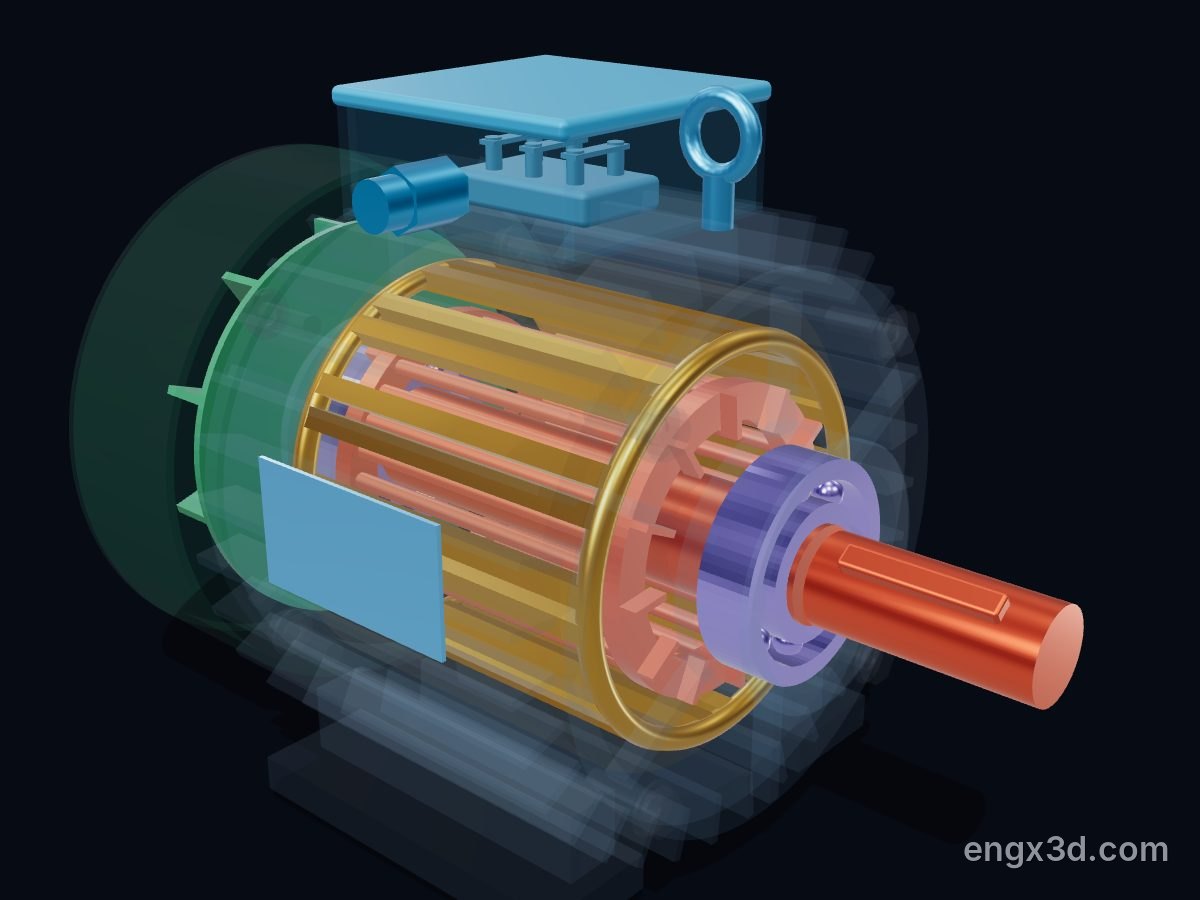
How an induction motor works
Three-phase current in the stator coils makes a magnetic field that rotates at synchronous speed. The field cuts the rotor bars and induces current in them, and that current makes the rotor follow the field. If the rotor ever reached synchronous speed, nothing would be induced and the torque would vanish, so it always slips a little behind.
The Engine‑X induction motor is a 7.5 kW, 4-pole TEFC motor running at 1,450 rpm.
How a synchronous motor works
The stator is the same kind of three-phase winding, but the rotor carries its own magnetic poles from permanent magnets or a DC field winding. Those poles lock onto the rotating field and turn in step with it, so speed depends only on supply frequency and pole count, not on load, until the motor is overloaded and pulls out of step.
See how it works inside, part by part, in 3D.
Explore the 3D induction motor →Common questions
Why is an induction motor called asynchronous?
Because its rotor never turns at the same speed as the rotating magnetic field. The small speed difference, called slip, is needed to induce current in the rotor.
Can an induction motor run at synchronous speed?
Not on its own power: at synchronous speed no current is induced and there is no torque. If something drives it faster than synchronous speed, it works as a generator.
Which is more efficient, induction or synchronous motor?
Synchronous motors, particularly permanent-magnet ones, are usually more efficient because the rotor has no induced current losses. Modern IE3 and IE4 induction motors are still very efficient.
Is a BLDC motor a synchronous motor?
Yes. Brushless DC and permanent-magnet synchronous motors both have magnet rotors that turn in step with the stator field, switched by an electronic drive.
What is the synchronous speed of a 4-pole motor?
Synchronous speed is 120 × frequency / poles: 1,500 rpm at 50 Hz and 1,800 rpm at 60 Hz. A 4-pole induction motor runs a little below that, such as 1,450 rpm.
Sources
References for the facts on this page, and further reading:
- Control Engineering — Anatomy of an AC induction motor
- Electrical Easy — Working principle and types of induction motors
- Wikipedia — Synchronous motor
Related guides
Full guide: How does an induction motor work? · Free induction motor 3D model · Every machine part A–Z
More comparisons: Helical vs worm gear reducer · Two-stroke vs four-stroke diesel engine · Reciprocating vs screw air compressor · Plate vs shell and tube heat exchanger · Planetary vs helical gearbox · Turbofan vs turbojet · Gate valve vs globe valve · Open vs limited-slip differential · Petrol vs diesel engine · Manual vs automatic transmission · Butterfly valve vs gate valve · Hydraulic vs pneumatic cylinder · Turbocharger vs supercharger · Centrifugal vs positive displacement pump · Belt vs chain vs gear drive
Need an interactive 3D page for your own machine? See Work with Engine‑X.