Engine‑X comparison
Turbofan vs turbojet: what is the difference?
By Parth Parmar, mechanical design engineer · Updated
A turbojet sends all of its air through the core, where it is compressed, burned and blasted out as a fast, narrow jet. A turbofan adds a large fan, driven by the core, that pushes most of its air around the core as bypass flow. Moving more air more slowly makes the turbofan quieter and far more fuel-efficient at airliner speeds.
Side-by-side comparison
| Turbofan | Turbojet | |
|---|---|---|
| Air path | Most air bypasses the core through the fan duct | All air passes through the core |
| Bypass ratio | About 5 : 1 on the CFM56-7B; higher on newer engines | 0 (no bypass) |
| Exhaust jet | Large mass of slower air | Small mass of very fast gas |
| Fuel use at airliner speed | Low | High |
| Noise | Much quieter | Very loud |
| Size | Large fan diameter | Slim |
| Best at | Subsonic cruise | High-speed and supersonic flight |
| Typical use | Airliners such as the Boeing 737 and Airbus A320; fighters use low-bypass turbofans | Early jets, Concorde, some missiles and drones |
Which one should you choose?
- Turbofan: almost every airliner and business jet today, because fuel cost and noise dominate.
- Turbojet: where a slim engine and very high exhaust speed matter more than fuel, such as supersonic or short-life uses.
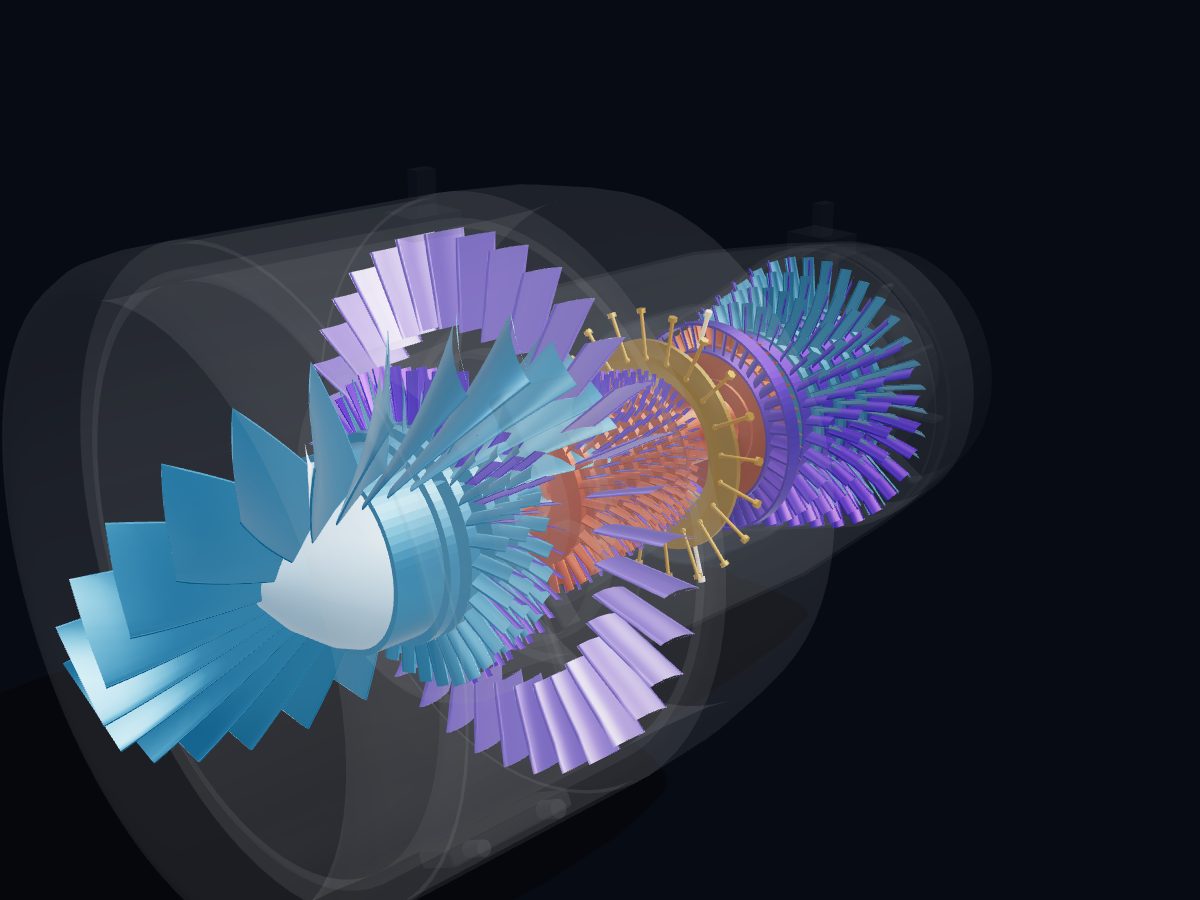
How a turbofan works
The fan at the front is driven by the low-pressure turbine through a shaft running down the middle of the engine. Part of the fan air enters the core, where the booster and high-pressure compressor squeeze it, the combustor burns fuel in it and the turbines take out the energy to drive the compressors and fan. Most of the fan air goes around the core and gives most of the thrust.
The Engine‑X turbofan is a two-spool engine in the style of the CFM56-7B.
How a turbojet works
A turbojet is just the core: compressor, combustor and turbine on one shaft, with a nozzle at the back. The turbine takes only enough energy to drive the compressor; everything else leaves as a very fast jet. Because thrust comes from accelerating a small amount of air a lot, much of the fuel energy leaves in the jet as wasted speed at subsonic flight.
See how it works inside, part by part, in 3D.
Explore the 3D turbofan jet engine →Common questions
Is a turbofan a jet engine?
Yes. A turbofan is a jet engine with a turbojet-like core plus a large fan that adds bypass air. Almost all modern airliner engines are turbofans.
Why don't airliners use turbojets?
At airliner speeds a turbojet wastes fuel and is very loud, because it throws a small amount of air out very fast. A turbofan moves much more air more slowly, which gives the same thrust with less fuel and noise.
What is bypass ratio?
Bypass ratio is the mass of air that goes around the core divided by the mass that goes through it. The CFM56-7B has a bypass ratio of about 5 : 1.
Do fighter jets use turbofans or turbojets?
Most modern fighters use low-bypass turbofans with afterburners: the small fan keeps them slim for supersonic flight while saving fuel at cruise.
Was Concorde a turbofan or a turbojet?
Concorde used Rolls-Royce/Snecma Olympus 593 turbojets with afterburners, because a turbojet's fast, narrow jet suits supersonic cruise.
Sources
References for the facts on this page, and further reading:
- NASA Glenn Research Center — Turbofan engine
- Aerospaceweb — Turbojet, turbofan and turboprop
- Purdue University — CFM56 engine data
- Wikipedia — Turbojet
Related guides
Full guide: How does a turbofan jet engine work? · Free turbofan jet engine 3D model · Every machine part A–Z
More comparisons: Helical vs worm gear reducer · Two-stroke vs four-stroke diesel engine · Reciprocating vs screw air compressor · Plate vs shell and tube heat exchanger · Planetary vs helical gearbox · Gate valve vs globe valve · Open vs limited-slip differential · Petrol vs diesel engine · Induction vs synchronous motor · Manual vs automatic transmission · Butterfly valve vs gate valve · Hydraulic vs pneumatic cylinder · Turbocharger vs supercharger · Centrifugal vs positive displacement pump · Belt vs chain vs gear drive
Need an interactive 3D page for your own machine? See Work with Engine‑X.