Engine‑X comparison
Open vs limited-slip differential: what is the difference?
By Parth Parmar, mechanical design engineer · Updated
An open differential always splits torque equally between the two wheels and lets them turn at different speeds, so if one wheel spins on ice or mud the other gets almost no drive. A limited-slip differential adds clutches, special gears or a viscous coupling that resist the speed difference and send more torque to the wheel with grip.
Side-by-side comparison
| Open differential | Limited-slip differential | |
|---|---|---|
| Torque split | Always equal to both wheels | Can send more torque to the slower wheel with grip |
| One wheel on ice | That wheel spins, the car barely moves | The wheel with grip still drives |
| Cornering | Smooth and quiet | Better traction when accelerating out of corners |
| Inside the case | Spider gears and side gears only | Plus clutch packs, helical gears (Torsen) or a viscous coupling |
| Oil | Hypoid gear oil | Clutch types often need a friction-modifier additive |
| Cost | Low | Higher |
| Typical use | Most everyday cars | Sports cars, performance and off-road vehicles, trucks |
Which one should you choose?
- Open differential: everyday driving on good roads, lowest cost and least maintenance.
- Limited-slip differential: performance driving, towing, snow, mud or anywhere one wheel often loses grip.
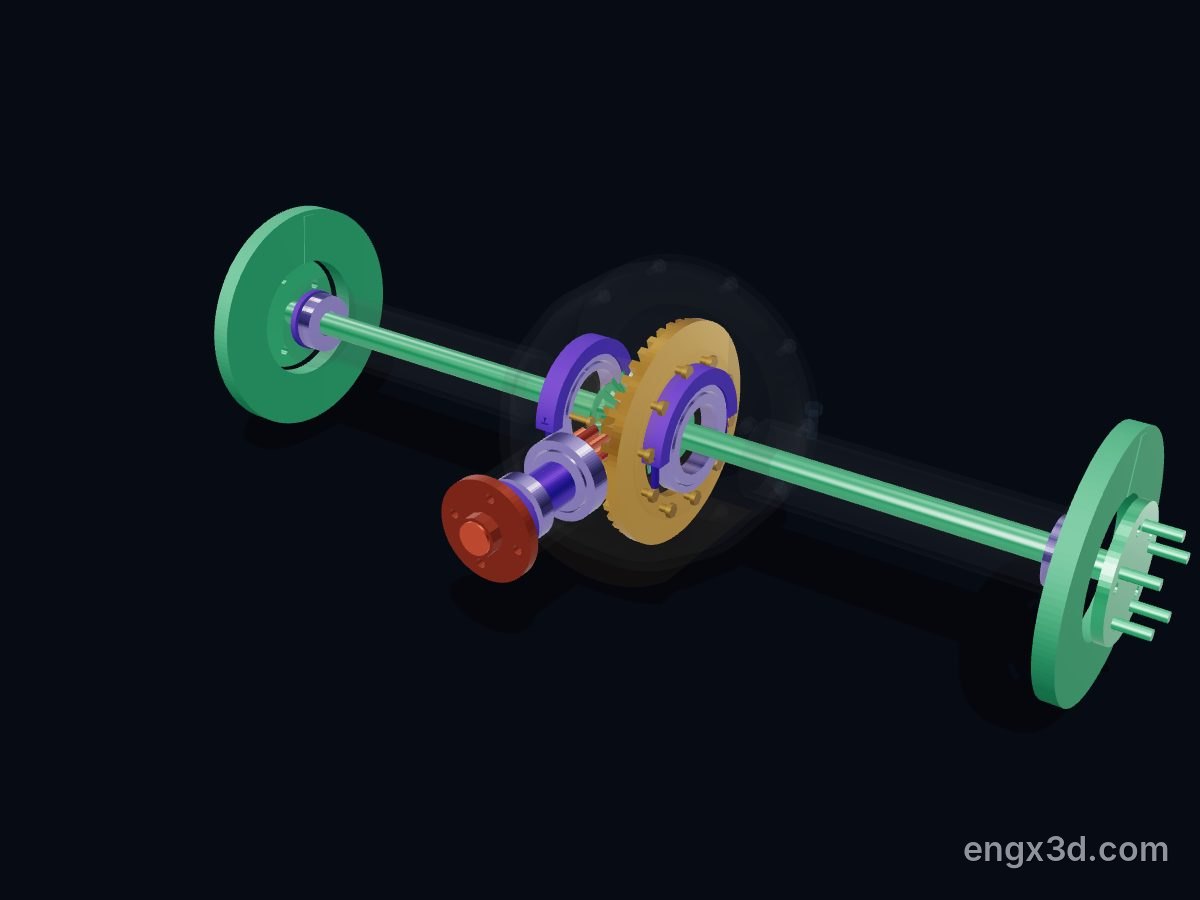
How an open differential works
The drive pinion turns the ring gear and the case bolted to it. Spider gears in the case drive the two side gears and axle shafts. Going straight, the spider gears do not spin on their shaft and both wheels turn together; in a turn they spin, letting the outer wheel go faster than the inner one.
See every gear move in the Engine‑X car differential: an 11-tooth pinion and a 41-tooth ring gear, a 3.73 : 1 final drive.
How a limited-slip differential works
A clutch-type LSD puts friction plates between the side gears and the case, preloaded by springs and squeezed harder as torque rises, so the two wheels are partly locked together. A Torsen or helical-gear LSD uses worm-type gears that resist being back-driven. A viscous LSD uses thick silicone fluid that stiffens when one side spins faster.
See how it works inside, part by part, in 3D.
Explore the 3D car differential →Common questions
Is a limited-slip differential better than an open one?
For traction, yes: it keeps driving the wheel with grip. For everyday driving an open differential is cheaper, smoother and needs less care, which is why most cars have one.
How can you tell if a car has a limited-slip differential?
With both driven wheels lifted and the gearbox in neutral, turn one wheel by hand. If the other wheel turns the opposite way, it is an open differential; if it turns the same way, it is a limited-slip.
Does a limited-slip differential need special oil?
Clutch-type units usually need gear oil with a friction modifier, or the clutches chatter in tight turns. Always use the oil and additive the vehicle maker specifies.
What is the difference between a limited-slip and a locking differential?
A limited-slip lets the wheels turn at different speeds but resists slip. A locker can join both axles solidly so both wheels turn at exactly the same speed, which is best off-road but bad on tarmac.
What type of differential is the Engine-X model?
An open differential with two spider gears, two side gears, an 11-tooth drive pinion and a 41-tooth ring gear.
Sources
References for the facts on this page, and further reading:
- EngineerFix — How does an open differential work?
- Speedway Motors — Types of differentials: limited slip vs posi vs locker
- Wikipedia — Limited-slip differential
Related guides
Full guide: How does a car differential work? · Free car differential 3D model · Every machine part A–Z
More comparisons: Helical vs worm gear reducer · Two-stroke vs four-stroke diesel engine · Reciprocating vs screw air compressor · Plate vs shell and tube heat exchanger · Planetary vs helical gearbox · Turbofan vs turbojet · Gate valve vs globe valve · Petrol vs diesel engine · Induction vs synchronous motor · Manual vs automatic transmission · Butterfly valve vs gate valve · Hydraulic vs pneumatic cylinder · Turbocharger vs supercharger · Centrifugal vs positive displacement pump · Belt vs chain vs gear drive
Need an interactive 3D page for your own machine? See Work with Engine‑X.