Engine‑X comparison
Planetary vs helical gearbox: which is better?
By Parth Parmar, mechanical design engineer · Updated
A planetary gearbox shares the load among several planet gears around a central sun gear, so it packs high torque into a small, round case with input and output on one line. A parallel-shaft helical gearbox uses gear pairs on offset shafts: it is bigger for the same torque, but simpler, cheaper and easier to inspect and repair.
Side-by-side comparison
| Planetary gearbox | Helical gearbox | |
|---|---|---|
| Shaft layout | Input and output on one line (coaxial) | Output shaft offset from the input |
| Torque for its size | High: several planets share the load | Lower: one tooth mesh per stage carries it |
| Ratio per stage | About 3 : 1 to 10 : 1 | Usually up to about 10 : 1 |
| Efficiency | About 97 % per stage | About 97–98 % per stage |
| Backlash | Can be made very low for servo drives | Moderate |
| Heat | Small case has less surface to shed heat | Bigger case runs cooler at the same power |
| Service | More parts, harder to inspect | Simple, easy to open and repair |
| Typical use | Servo drives, winches, wind turbines, slewing drives, automatic transmissions | Conveyors, mixers, pumps, general industrial drives |
Which one should you choose?
- Choose a planetary gearbox when space and weight are tight, torque is high, or the motor and output must line up.
- Choose a helical gearbox for general industrial drives where low cost, cool running and easy service matter more than size.
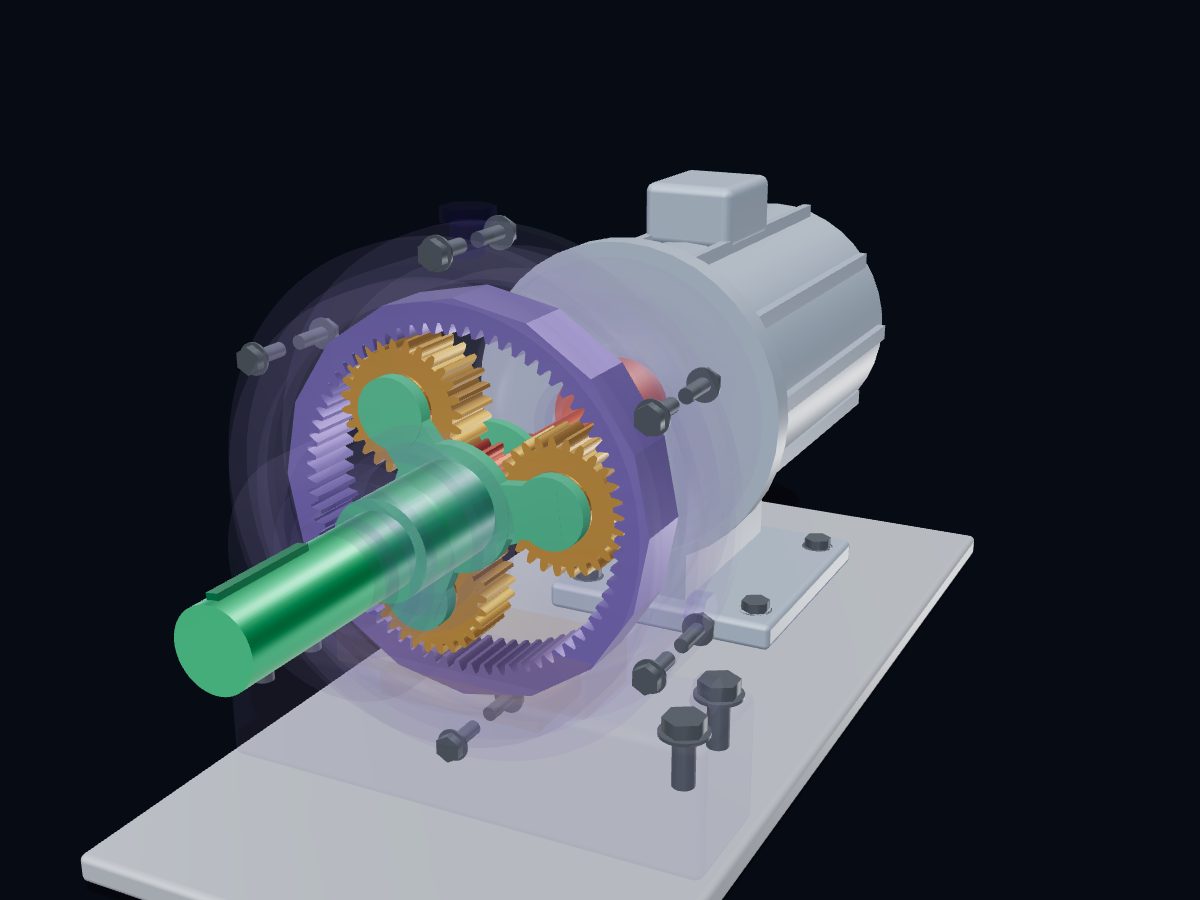
How a planetary gearbox works
The input turns the sun gear. Planet gears mesh with the sun and with an internal ring gear, and their pins sit in a carrier. With the ring held still, the carrier turns slower than the sun by the ratio 1 + ring teeth / sun teeth.
The Engine‑X planetary gearbox has an 18-tooth sun and a 72-tooth ring, so it reduces speed 5 : 1 with three planets sharing the load.
How a helical gearbox works
A pinion drives a larger gear on a parallel shaft, and further pairs can follow for more reduction. Only one pair of gears carries the load in each stage, so the gears and shafts must be bigger than in a planetary box of the same torque. See the two-stage helical gear reducer in 3D.
See how it works inside, part by part, in 3D.
Explore the 3D planetary gearbox →Common questions
Why are planetary gearboxes so compact?
The load is split among three or more planet gears, and the planets work inside the ring gear instead of beside it. Each gear carries only part of the torque, so the whole gearbox can be smaller.
What ratio can one planetary stage give?
Usually about 3 : 1 to 10 : 1 with the ring fixed. Below that the planets become too small; above it the sun gear gets too small to carry the load. Higher ratios stack two or three stages.
Which has less backlash, planetary or helical?
Precision planetary gearboxes are made with very low backlash for servo motors and robots. Standard helical gearboxes have more backlash, which is fine for conveyors and pumps.
Is a planetary gearbox more efficient than a helical gearbox?
They are close. Both are roughly 97 % efficient per stage; the choice usually comes down to size, shaft layout and cost.
Where are planetary gearboxes used?
Automatic car transmissions, wind turbine gearboxes, winches, cranes, electric screwdrivers, robot joints and servo drives all use planetary gearing.
Sources
References for the facts on this page, and further reading:
- tec-science — Planetary gears: Willis equation and ratios
- Woodgears.ca — Planetary gear ratio calculations
- Machine Design — Gear efficiency: key to lower drive cost
- Wikipedia — Epicyclic gearing
Related guides
Full guide: How does a planetary gearbox work? · Free planetary gearbox 3D model · Every machine part A–Z
More comparisons: Helical vs worm gear reducer · Two-stroke vs four-stroke diesel engine · Reciprocating vs screw air compressor · Plate vs shell and tube heat exchanger · Turbofan vs turbojet · Gate valve vs globe valve · Open vs limited-slip differential · Petrol vs diesel engine · Induction vs synchronous motor · Manual vs automatic transmission · Butterfly valve vs gate valve · Hydraulic vs pneumatic cylinder · Turbocharger vs supercharger · Centrifugal vs positive displacement pump · Belt vs chain vs gear drive
Need an interactive 3D page for your own machine? See Work with Engine‑X.