Engine‑X comparison
Reciprocating vs screw air compressor: which is better?
By Parth Parmar, mechanical design engineer · Updated
A reciprocating compressor squeezes air with pistons moving in cylinders; a rotary screw compressor squeezes it between two meshing helical rotors. Piston units cost less and suit on-off use in workshops and garages. Screw compressors give smooth, steady air, are built to run continuously, and are the usual choice for factories that need air all day.
Side-by-side comparison
| Reciprocating compressor | Rotary screw compressor | |
|---|---|---|
| How it compresses | Pistons in cylinders, with suction and delivery valves | Two meshing helical rotors |
| Air flow | Pulsing; a receiver tank smooths it | Smooth and continuous |
| Duty | Mostly on-off duty with rest time | Built to run continuously |
| High pressure in a small size | Easy with two stages and an intercooler | Usually standard plant-air pressures |
| Noise and vibration | Louder, more vibration | Quieter, often in a sound-proof cabinet |
| Wear parts | Valves, piston rings, belts | Oil, oil separator and filters; rotors last long |
| Price | Lower to buy | Higher to buy, lower cost per unit of air at high use |
| Typical use | Garages, workshops, small plants, high-pressure starting air | Factories, production lines, all-day air demand |
Which one should you choose?
- Choose a reciprocating compressor for intermittent use, small budgets, or high pressure in a small machine.
- Choose a screw compressor when air is needed most of the day and running cost, noise and steady pressure matter.
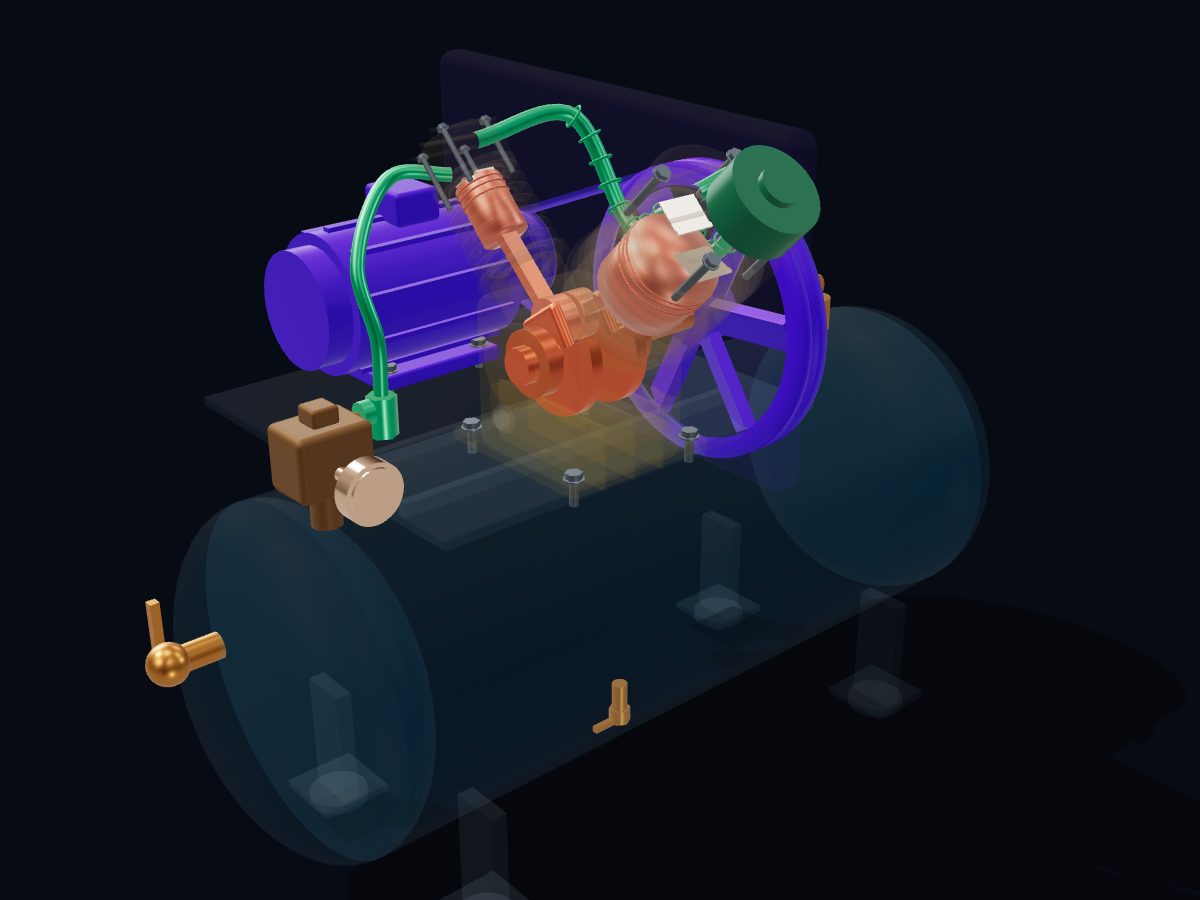
How a reciprocating compressor works
A crankshaft moves each piston up and down. On the down stroke the suction valve opens and air flows in; on the up stroke the air is squeezed until the delivery valve opens. A two-stage machine compresses the air in a large low-pressure cylinder, cools it in an intercooler, then finishes it in a small high-pressure cylinder.
The Engine‑X two-stage air compressor shows both cylinders, the reed valves, the intercooler and the receiver tank.
How a rotary screw compressor works
Two rotors with helical lobes turn against each other inside a close-fitting casing. Air trapped between the lobes is carried along and squeezed into a smaller and smaller space until it leaves at the discharge end. In oil-flooded machines oil seals the gaps and carries away heat, and a separator removes it from the air afterwards.
See how it works inside, part by part, in 3D.
Explore the 3D reciprocating air compressor →Common questions
Which lasts longer, a piston or a screw compressor?
For all-day running, a well-serviced screw compressor usually lasts longer, because its rotors do not rub like piston rings and valves. For short, occasional use a piston compressor lasts well and costs less.
Can a reciprocating compressor run continuously?
Most small piston compressors are made for on-off duty and need rest to cool. Heavy-duty industrial piston machines can run longer; check the duty rating on the data plate or manual.
Why does a piston compressor need a big tank?
Its air comes in pulses and it is meant to stop and start. The receiver tank stores air, smooths the pulses and lets the compressor rest while the pressure falls to the cut-in point.
Is a screw compressor quieter than a piston compressor?
Yes. The rotors turn smoothly instead of reciprocating, and most screw compressors come in an insulated cabinet, so they can stand near the work area.
Which compressor is better for a small workshop?
Usually a reciprocating compressor, because air is used on and off and the machine costs less. A screw compressor pays back when air is used for most of the working day.
Sources
References for the facts on this page, and further reading:
- Wikipedia — Reciprocating compressor
- Wikipedia — Rotary-screw compressor
- Ingersoll Rand — Single-stage vs two-stage reciprocating air compressors
Related guides
Full guide: How does a reciprocating air compressor work? · Free reciprocating air compressor 3D model · Every machine part A–Z
More comparisons: Helical vs worm gear reducer · Two-stroke vs four-stroke diesel engine · Plate vs shell and tube heat exchanger · Planetary vs helical gearbox · Turbofan vs turbojet · Gate valve vs globe valve · Open vs limited-slip differential · Petrol vs diesel engine · Induction vs synchronous motor · Manual vs automatic transmission · Butterfly valve vs gate valve · Hydraulic vs pneumatic cylinder · Turbocharger vs supercharger · Centrifugal vs positive displacement pump · Belt vs chain vs gear drive
Need an interactive 3D page for your own machine? See Work with Engine‑X.