Engine‑X comparison
Manual vs automatic transmission: how do they differ?
By Parth Parmar, mechanical design engineer · Updated
A manual transmission uses a clutch pedal and a gear lever: the driver picks each gear, and synchronisers match speeds so a sleeve can lock that gear to its shaft. A conventional automatic changes gear by itself, using a torque converter and planetary gear sets switched by hydraulic clutches and brakes. Manuals are simpler and cheaper; automatics are easier in traffic.
Side-by-side comparison
| Manual transmission | Automatic transmission | |
|---|---|---|
| Who changes gear | The driver, with clutch and lever | The transmission, controlled hydraulically or electronically |
| Gears | Constant-mesh gear pairs on two shafts | Planetary gear sets (or two clutches in a DCT, or a belt in a CVT) |
| Engine coupling | Dry friction clutch | Torque converter (fluid coupling with lock-up clutch) |
| How a gear engages | Synchroniser sleeve slides onto dog teeth | Clutch packs and brake bands hold parts of the planetary sets |
| Driving in traffic | Tiring | Easy |
| Cost and weight | Lower | Higher |
| Upkeep | Clutch wears; gear oil lasts long | Fluid changes matter; repairs cost more |
| Typical use | Budget cars, sports cars, many cars in India and Europe | Most US cars, premium cars, buses, many new cars worldwide |
Which one should you choose?
- Manual: lower price, simple mechanics, full control, and easy, cheap repairs.
- Automatic: city traffic, comfort, and drivers who do not want to shift; modern automatics often match manual fuel economy.
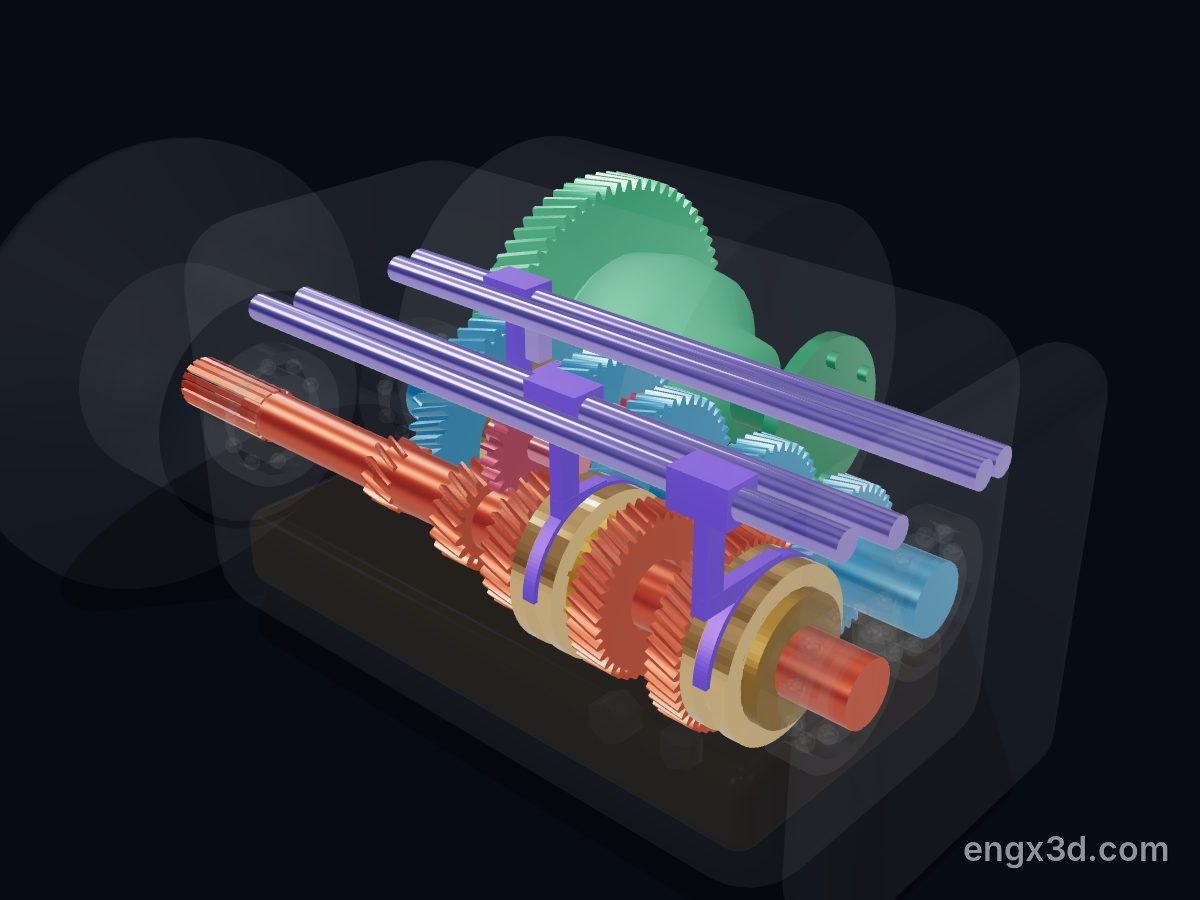
How a manual gearbox works
Every gear pair is always in mesh, but the driven gears spin freely on the output shaft. Moving the gear lever slides a synchroniser sleeve: its blocker ring first matches the speed of the gear and shaft by friction, then the sleeve slides over the gear’s dog teeth and locks it to the shaft. The clutch disconnects the engine while this happens.
Watch it shift in the Engine‑X 5-speed manual gearbox, a two-shaft design in the style of the VW 02T.
How an automatic transmission works
A torque converter lets the engine idle while the car is stopped and multiplies torque when pulling away. Behind it, planetary gear sets give each ratio by holding or driving their sun, carrier or ring with hydraulic clutches and bands, so gears change without lifting off the power. See how one set works in the planetary gearbox.
See how it works inside, part by part, in 3D.
Explore the 3D manual gearbox →Common questions
Is a manual or automatic more fuel-efficient?
Manuals used to be more efficient, but modern automatics with many gears, lock-up torque converters and dual-clutch or CVT designs now often match or beat them. Check the official figures for the exact car.
What is a synchroniser in a manual gearbox?
A synchroniser is a hub, sleeve and blocker ring that uses friction to bring a gear to the same speed as its shaft before the sleeve locks them together, so gears change without grinding.
What is a dual-clutch transmission?
A DCT is an automated manual with two clutches: one for the odd gears and one for the even gears. The next gear is pre-selected, so shifts are very fast.
Does an automatic transmission have a clutch?
A conventional automatic has no clutch pedal, but inside it uses several hydraulic clutch packs and brakes to select gears, plus a lock-up clutch in the torque converter.
Which lasts longer, manual or automatic?
Both can last the life of the car with proper care. In a manual the clutch is the main wear part; an automatic lasts longest when its fluid is changed on time and it is not overheated.
Sources
References for the facts on this page, and further reading:
- Volkswagen Self-Study Programme 237 — Manual gearbox 02T
- Edumech — The synchromesh manual transmission
- Wikipedia — Automatic transmission
Related guides
Full guide: How does a manual gearbox work? · Free manual gearbox 3D model · Every machine part A–Z
More comparisons: Helical vs worm gear reducer · Two-stroke vs four-stroke diesel engine · Reciprocating vs screw air compressor · Plate vs shell and tube heat exchanger · Planetary vs helical gearbox · Turbofan vs turbojet · Gate valve vs globe valve · Open vs limited-slip differential · Petrol vs diesel engine · Induction vs synchronous motor · Butterfly valve vs gate valve · Hydraulic vs pneumatic cylinder · Turbocharger vs supercharger · Centrifugal vs positive displacement pump · Belt vs chain vs gear drive
Need an interactive 3D page for your own machine? See Work with Engine‑X.