Engine‑X comparison
Helical vs worm gear reducer: which should you use?
By Parth Parmar, mechanical design engineer · Updated
Both slow a motor down and raise its torque. A helical gear reducer uses angled teeth on parallel shafts and loses only a few percent per stage, so it runs cool and efficient. A worm gear reducer turns the drive through 90° and gives a high ratio in one compact stage, but its sliding tooth contact wastes more power as heat.
Side-by-side comparison
| Helical gear reducer | Worm gear reducer | |
|---|---|---|
| Shaft layout | Parallel or in-line shafts | Right angle (90°) between input and output |
| Ratio per stage | Usually up to about 10 : 1, so higher ratios use 2 or 3 stages | From about 5 : 1 to 100 : 1 in a single stage |
| Efficiency | Above 95 % per stage | About 50–90 %, falling as the ratio rises |
| Tooth contact | Rolling, with gradual tooth engagement | Mostly sliding between worm and wheel |
| Heat | Low | Higher; needs good oil and cooling at high power |
| Back-driving | Easily back-driven | High-ratio worms resist back-driving, but are not a reliable brake |
| Size for a high ratio | Larger, more stages | Very compact |
| Typical use | Conveyors, mixers, crushers, continuous industrial drives | Gates, lifts, small conveyors, positioning, intermittent duty |
Which one should you choose?
- Choose a helical reducer for continuous duty and higher power, where efficiency and running cost matter.
- Choose a worm reducer for a compact right-angle drive with a high ratio on light or intermittent duty.
- Need 90° and high efficiency? A helical-bevel gearbox gives a right-angle output with gear efficiency close to a helical unit.
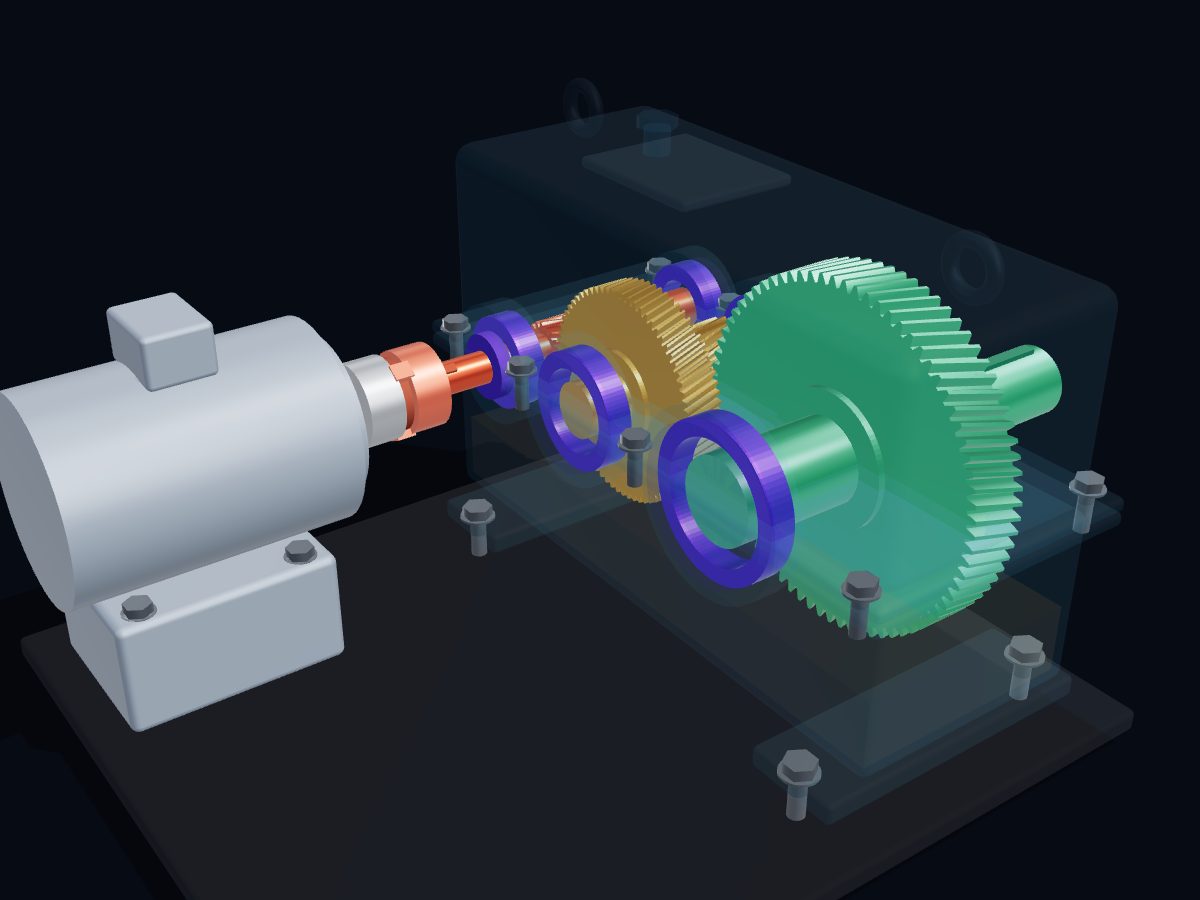
How a helical gear reducer works
A small pinion on the input shaft drives a larger gear on the next shaft. The speed falls, and the torque rises, by the ratio of their tooth counts. Because the teeth are cut at a helix angle, several teeth share the load at once, which makes helical gears quieter and stronger than straight spur gears. The angled teeth also push the shafts sideways, so the bearings must carry an axial thrust.
The Engine‑X helical gear reducer has two stages, 16 : 1 overall, taking a 1440 rpm motor down to 90 rpm.
How a worm gear reducer works
A worm, which looks like a screw, turns a worm wheel at right angles to it. One turn of a single-start worm moves the wheel by just one tooth, so a 40-tooth wheel gives 40 : 1 in a single stage. The worm slides across the wheel teeth instead of rolling, which is why worm drives are very quiet but lose more power as heat, especially at high ratios.
See how it works inside, part by part, in 3D.
Explore the 3D gear reducer →Common questions
Which is more efficient, a helical or a worm gearbox?
A helical gearbox. Each helical stage is above 95 % efficient, while a worm gearbox is about 50 to 90 % efficient, and the higher its ratio the lower its efficiency. The lost power turns into heat in the oil.
Is a worm gearbox self-locking?
High-ratio worm gearboxes often resist being turned from the output side, but this depends on the lead angle, friction, wear and vibration. Never rely on it as a brake on a lift or hoist; fit a proper brake.
Why do worm gearboxes get hot?
The worm slides across the wheel teeth, and sliding friction turns part of the input power into heat. The right oil, often a synthetic worm-gear oil, and enough cooling surface keep the temperature down.
Which gear reducer is better for a conveyor?
For a conveyor that runs all day, a helical or helical-bevel reducer usually costs less to run because it wastes less power. A worm reducer suits short, light or intermittent conveyors where low price and compact size matter more.
Can a helical gearbox replace a worm gearbox?
Yes, if the shafts are re-arranged or a helical-bevel right-angle unit is used. Check the ratio, output torque, shaft height and mounting before swapping.
Sources
References for the facts on this page, and further reading:
- Machine Design — Gear efficiency: key to lower drive cost
- Machine Design — What's the difference between spur, helical, bevel and worm gears?
- KHK Gears — Gear guide: helical gears and axial thrust
- Wikipedia — Worm drive
Related guides
Full guide: How does a gear reducer work? · Free gear reducer 3D model · Every machine part A–Z
More comparisons: Two-stroke vs four-stroke diesel engine · Reciprocating vs screw air compressor · Plate vs shell and tube heat exchanger · Planetary vs helical gearbox · Turbofan vs turbojet · Gate valve vs globe valve · Open vs limited-slip differential · Petrol vs diesel engine · Induction vs synchronous motor · Manual vs automatic transmission · Butterfly valve vs gate valve · Hydraulic vs pneumatic cylinder · Turbocharger vs supercharger · Centrifugal vs positive displacement pump · Belt vs chain vs gear drive
Need an interactive 3D page for your own machine? See Work with Engine‑X.