Engine‑X comparison
Two-stroke vs four-stroke diesel engine: what is the difference?
By Parth Parmar, mechanical design engineer · Updated
A two-stroke diesel gives a power stroke in every cylinder on every crankshaft turn; a four-stroke gives one every two turns. Large ships use slow-speed two-stroke crosshead engines coupled straight to the propeller. Four-stroke medium- and high-speed engines are smaller for their power and drive generators, ferries, tugs and boats, usually through a gearbox.
Side-by-side comparison
| Two-stroke diesel | Four-stroke diesel | |
|---|---|---|
| Power strokes | One per cylinder every revolution | One per cylinder every two revolutions |
| Gas exchange | Scavenge air enters through ports in the liner; exhaust leaves through a valve or ports | Separate intake and exhaust strokes with intake and exhaust valves |
| Speed class | Usually low speed (under about 300 rpm) | Medium speed (about 300–1,000 rpm) or high speed (above 1,000 rpm) |
| Drive to propeller | Direct, no gearbox | Through a reduction gearbox, or driving a generator |
| Construction | Crosshead, separate cylinder oil, very tall | Trunk piston, one oil system for the whole engine |
| Air supply | Needs a turbocharger plus electric auxiliary blowers at low load | Naturally aspirated or turbocharged |
| Typical use | Container ships, tankers, bulk carriers | Generators, ferries, tugs, fishing boats, yachts |
Which one should you choose?
- Two-stroke: the main engine of a large ocean-going ship, where one huge, slow engine drives the propeller directly.
- Four-stroke: smaller ships, generator sets and boats, where a compact engine and a gearbox or alternator fit better.
How a two-stroke marine diesel works
Near the bottom of the stroke the piston uncovers scavenge ports in the cylinder liner. Pressurised air from the turbocharger rushes in and pushes the burnt gas out through the exhaust valve in the cover, so the whole gas exchange happens in a fraction of one turn. The piston then compresses the fresh air, fuel is injected and burns, and the next downstroke is already a power stroke.
A crosshead keeps side forces off the liner, which is why these engines can be so tall and long-stroke. See how the turbocharger feeds them scavenge air.
How a four-stroke diesel works
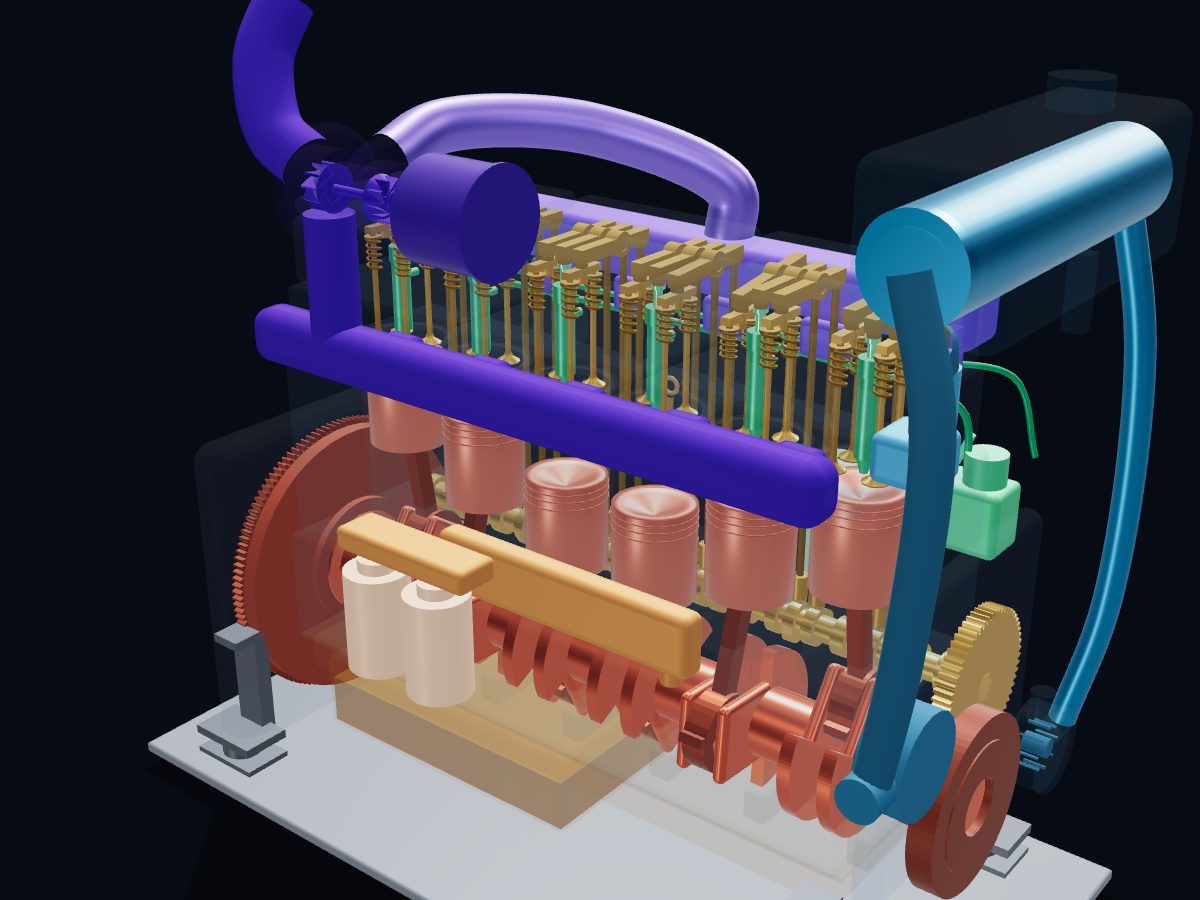
A four-stroke engine needs two crankshaft turns for one cycle: intake, compression, power and exhaust. A camshaft opens the intake and exhaust valves at the right moments. The Engine‑X marine diesel engine is a four-stroke inline-6 in the style of the Cummins NT855, a 14-litre engine used in boats and generator sets.
See how it works inside, part by part, in 3D.
Explore the 3D marine diesel engine →Common questions
Why do big ships use two-stroke engines?
A slow two-stroke can turn a large, efficient propeller directly at its best speed with no gearbox, burns heavy fuel, and gives very high power from few cylinders. Large two-stroke diesels are among the most efficient heat engines ever built.
Is the Engine-X marine diesel engine two-stroke or four-stroke?
Four-stroke. It is an inline six-cylinder engine in the style of the Cummins NT855, with a camshaft, intake and exhaust valves and a PT fuel system.
Why does a two-stroke marine engine need auxiliary blowers?
At low load there is not enough exhaust energy for the turbocharger to supply the scavenge air the engine needs, so electric auxiliary blowers start automatically until the turbocharger takes over.
Can a two-stroke ship engine run in reverse?
Yes. Most large two-stroke engines are direct-reversing: the engine is stopped and restarted with the fuel and valve timing set for the other direction, because there is no gearbox to reverse the propeller.
Which is more fuel-efficient, two-stroke or four-stroke diesel?
At ship sizes, the large slow-speed two-stroke is usually the most efficient, partly because it drives the propeller directly. Four-stroke engines win where size, weight and running at different speeds matter more.
Sources
References for the facts on this page, and further reading:
- Wikipedia — Two-stroke diesel engine
- Wikipedia — Marine propulsion
- Wikipedia — Four-stroke engine
- Cummins — NT855 engine (14 L, PT fuel system)
Related guides
Full guide: How does a marine diesel engine work? · Free marine diesel engine 3D model · Every machine part A–Z
More comparisons: Helical vs worm gear reducer · Reciprocating vs screw air compressor · Plate vs shell and tube heat exchanger · Planetary vs helical gearbox · Turbofan vs turbojet · Gate valve vs globe valve · Open vs limited-slip differential · Petrol vs diesel engine · Induction vs synchronous motor · Manual vs automatic transmission · Butterfly valve vs gate valve · Hydraulic vs pneumatic cylinder · Turbocharger vs supercharger · Centrifugal vs positive displacement pump · Belt vs chain vs gear drive
Need an interactive 3D page for your own machine? See Work with Engine‑X.