Engine‑X comparison
Gate valve vs globe valve: what is the difference?
By Parth Parmar, mechanical design engineer · Updated
A gate valve lifts a wedge-shaped gate fully out of the flow, so when open it leaves a straight, almost unrestricted bore with very low pressure drop; it is made for fully open or fully closed service. A globe valve presses a disc down onto a seat inside an S-shaped body, so it throttles flow well but has a much higher pressure drop.
Side-by-side comparison
| Gate valve | Globe valve | |
|---|---|---|
| Closing part | Wedge (gate) slides across the flow | Disc moves onto a seat, in line with the stem |
| Flow path when open | Straight through, full bore | S-shaped, changes direction |
| Pressure drop | Very low | High |
| Throttling | No: a part-open gate vibrates and erodes the seats | Yes: made for regulating flow |
| Flow direction | Usually either way | Usually one way, marked by an arrow |
| Stroke | Long: many handwheel turns | Short |
| Size and weight | Shorter face-to-face, taller | Longer face-to-face, heavier at the same size |
| Typical use | Isolation: pipelines, pump suction and discharge, tank outlets | Control: bypass lines, cooling water, fuel, steam regulation |
Which one should you choose?
- Gate valve: isolate a line, keep it fully open most of the time, and lose as little pressure as possible.
- Globe valve: regulate flow or pressure, or open and close often.
How a gate valve works
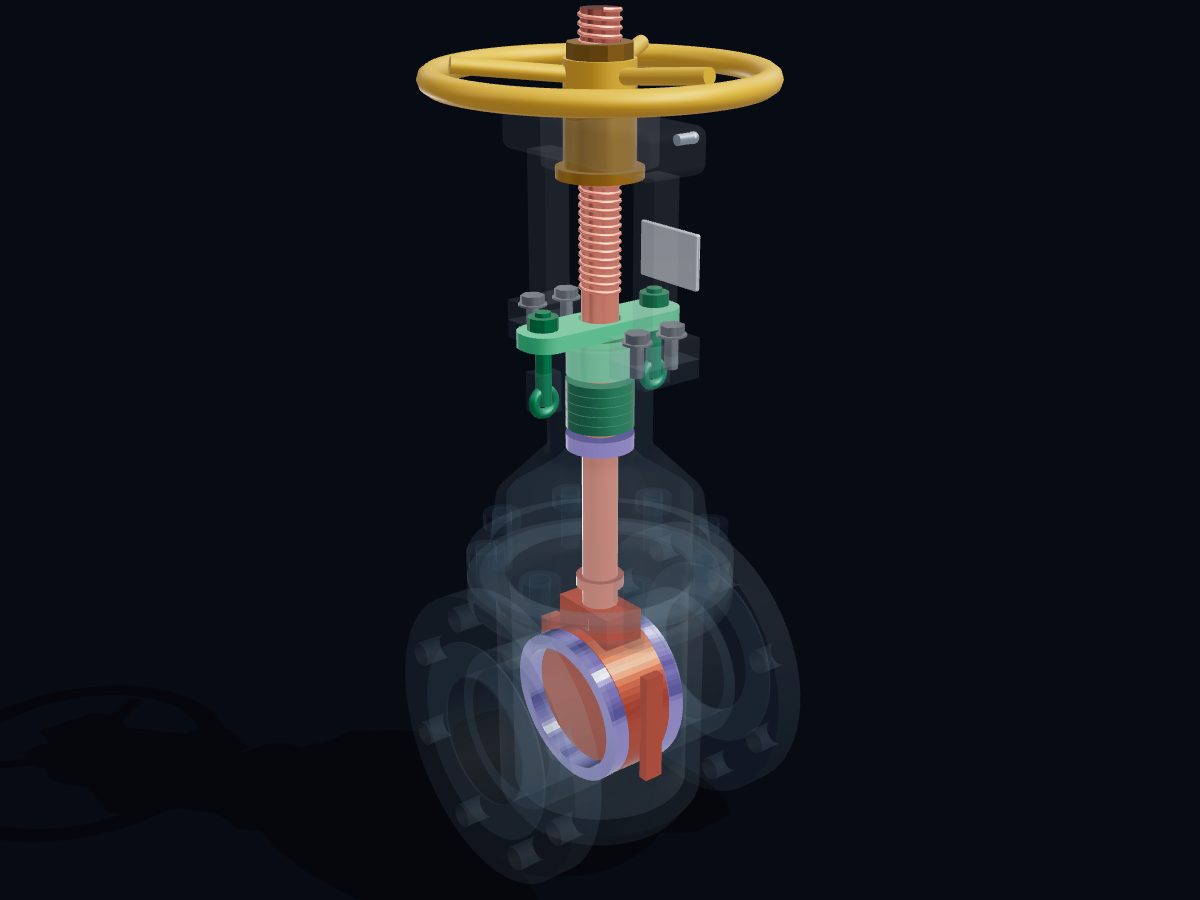
Turning the handwheel turns the yoke nut, which drives the stem up or down. The stem lifts the wedge up into the bonnet, clear of the bore, or pushes it down between the two seat rings, where its taper jams it tight to seal.
Take the Engine‑X gate valve apart in 3D: body, bonnet, wedge, seats, stem, packing and yoke.
How a globe valve works
Inside a globe valve the flow turns up through a horizontal seat and down again. The disc on the end of the stem moves straight onto or away from that seat, so a small stem movement changes the flow area smoothly. That makes it good at throttling, but the bends in the flow cost pressure.
See how it works inside, part by part, in 3D.
Explore the 3D gate valve →Common questions
Can a gate valve be used for throttling?
No. With the gate partly open the fast flow makes the gate vibrate and erodes the seats and wedge, so the valve soon stops sealing. Use a globe, butterfly or control valve to regulate flow.
Which valve has less pressure drop, gate or globe?
A gate valve. When fully open its bore is straight and nearly full size, while a globe valve forces the flow to change direction twice.
Why does a globe valve have an arrow on the body?
Most globe valves are designed for flow in one direction, usually under the disc, so the packing is not under line pressure when the valve is closed. The arrow shows the correct installation.
Which is better for steam, gate or globe valve?
Both are used on steam. Gate valves isolate steam lines, while globe valves regulate steam flow and are used where the valve is opened and closed often.
Which shuts off tighter, gate or globe valve?
A globe valve usually gives tighter shut-off, because the disc closes straight down onto its seat. A gate valve seals well too but is more easily damaged by debris or throttling.
Sources
References for the facts on this page, and further reading:
- Valve Magazine — The fundamentals of gate valves
- Project Materials — Globe vs gate valve
- Wikipedia — Globe valve
Related guides
Full guide: How does a gate valve work? · Free gate valve 3D model · Every machine part A–Z
More comparisons: Helical vs worm gear reducer · Two-stroke vs four-stroke diesel engine · Reciprocating vs screw air compressor · Plate vs shell and tube heat exchanger · Planetary vs helical gearbox · Turbofan vs turbojet · Open vs limited-slip differential · Petrol vs diesel engine · Induction vs synchronous motor · Manual vs automatic transmission · Butterfly valve vs gate valve · Hydraulic vs pneumatic cylinder · Turbocharger vs supercharger · Centrifugal vs positive displacement pump · Belt vs chain vs gear drive
Need an interactive 3D page for your own machine? See Work with Engine‑X.