Engine‑X comparison
Petrol vs diesel engine: what is the difference?
By Parth Parmar, mechanical design engineer · Updated
Both are four-stroke piston engines, but they ignite the fuel differently. A petrol engine compresses a fuel and air mixture, typically about 8 to 12 : 1, and fires it with a spark plug. A diesel compresses only air, about 15 to 22 : 1, until it is hot enough to ignite fuel injected into the cylinder. Diesels give more torque and economy; petrol engines rev higher and weigh less.
Side-by-side comparison
| Petrol engine | Diesel engine | |
|---|---|---|
| Ignition | Spark plug | Heat of compression |
| Compression ratio | About 8–12 : 1 (11.0 : 1 on the Honda K20A2) | About 15–22 : 1 |
| Power control | Throttle limits the air | Amount of fuel injected |
| Character | Revs high, less torque at low rpm | Strong low-rpm torque, lower rev limit |
| Fuel economy | Lower | Higher |
| Weight and cost | Lighter, cheaper | Heavier, stronger build, higher-pressure injection |
| Exhaust treatment | Three-way catalytic converter | Particulate filter and NOx control (often SCR with AdBlue) |
| Typical use | Cars, motorcycles, small engines | Trucks, buses, ships, generators, tractors, many SUVs |
Which one should you choose?
- Petrol: short trips, city driving, lower purchase price and a light, high-revving engine.
- Diesel: long distances, towing and heavy loads, where torque and fuel economy pay back.
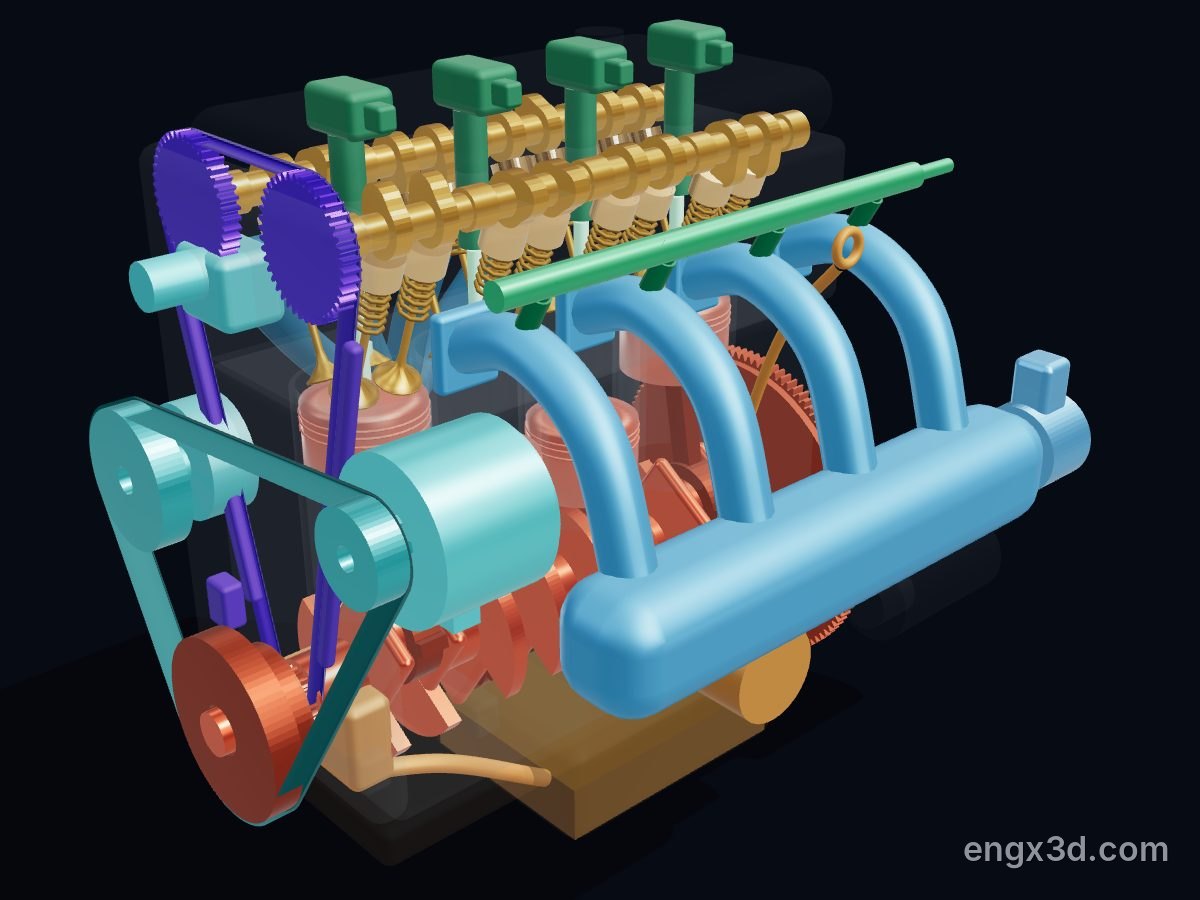
How a petrol engine works
On the intake stroke the piston draws in air while the injector adds petrol. The piston compresses the mixture and, just before the top of the stroke, the spark plug fires it. The burning gas pushes the piston down, and the exhaust stroke clears the cylinder.
The Engine‑X car engine is a 2.0-litre DOHC inline-4 in the style of the Honda K20A2, with every piston, valve and camshaft in 3D.
How a diesel engine works
A diesel draws in only air and squeezes it so hard that it becomes hotter than the fuel’s ignition point. Fuel is sprayed in at high pressure near the top of the stroke and starts burning by itself. Because there is no throttle, power is set by how much fuel is injected. See a big one in the marine diesel engine.
See how it works inside, part by part, in 3D.
Explore the 3D car engine →Common questions
Why are diesel engines more fuel-efficient?
A diesel runs a higher compression ratio, which turns more of the fuel energy into work, has no throttle losses, and diesel fuel holds more energy per litre than petrol.
Why do diesel engines have more torque?
High compression and long-stroke designs give strong pressure on the piston at low engine speed, and diesels are tuned for low rpm. Turbocharging, used on almost all modern diesels, adds more.
Does a diesel engine have spark plugs?
No. Diesel fuel ignites from the heat of the compressed air. Many diesels have glow plugs, which only warm the combustion chamber to help cold starting.
What happens if you put diesel in a petrol car?
The engine will run badly or not at all, because diesel does not ignite well from a spark, and it can damage the fuel system and catalytic converter. Do not start the engine; have the tank drained.
What is the compression ratio of a petrol engine?
Most modern petrol car engines run about 8 to 12 : 1. The Honda K20A2, the style of the Engine-X car engine, runs 11.0 : 1.
Sources
References for the facts on this page, and further reading:
- Jalopnik — Why diesel engines have higher compression ratios than gas engines
- How a Car Works — The engine: how power is created
- Wikipedia — Honda K engine
- Wikipedia — Diesel engine
Related guides
Full guide: How does a car engine work? · Free car engine 3D model · Every machine part A–Z
More comparisons: Helical vs worm gear reducer · Two-stroke vs four-stroke diesel engine · Reciprocating vs screw air compressor · Plate vs shell and tube heat exchanger · Planetary vs helical gearbox · Turbofan vs turbojet · Gate valve vs globe valve · Open vs limited-slip differential · Induction vs synchronous motor · Manual vs automatic transmission · Butterfly valve vs gate valve · Hydraulic vs pneumatic cylinder · Turbocharger vs supercharger · Centrifugal vs positive displacement pump · Belt vs chain vs gear drive
Need an interactive 3D page for your own machine? See Work with Engine‑X.