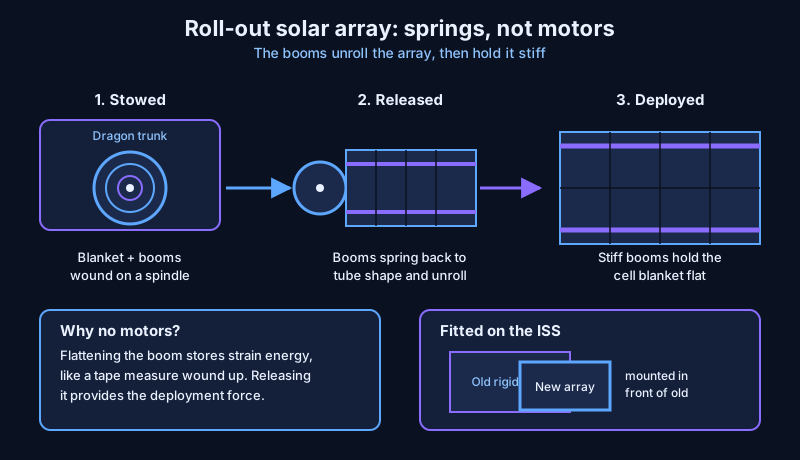
On 13 October 2026 a Falcon 9 lifted a Cargo Dragon off Cape Canaveral on NASA's 35th SpaceX resupply mission. In its unpressurised trunk sit the fourth and final pair of roll-out solar arrays for the International Space Station. Docking is planned for 15 October.
The interesting part is not the cargo run, it is how those arrays work. They fold into a compact roll and open without a single deployment motor.
Why does the ISS need new solar arrays?
The ISS's original solar wings are large rigid structures that have been in orbit for a long time, and their output has dropped with age. The new arrays are not replacements. They are fitted in front of the old wings, so the old cells keep producing wherever they are not shaded.
NASA's description of the first pair, installed in June 2021, said the station's total power then rose by more than 30% (NASA).
Spaceflight Now reports that each new wing should deliver more than 20 kW for over ten years. That is a reported figure, and earlier units were quoted by NASA at more than 28 kW when new, so treat the exact number as approximate.
How does a roll-out solar array work?
A roll-out solar array deploys itself with springy composite booms that unroll straight. Think of a metal tape measure. Flatten it and wind it up, and it wants to spring back straight. A roll-out array uses the same idea.
- Stowing: The solar blanket, a thin flexible mesh carrying strings of photovoltaic cells, is wrapped around a spindle together with the booms. Stowed, the array is a cylinder under about two feet in diameter (eoPortal).
- Storing energy: The booms are composite slit tubes. Flattening and rolling them loads the material elastically, so it stores strain energy, just like a compressed spring.
- Release: Once the array is released, the booms relax toward their natural tube shape and push the blanket out as they unroll. The energy for deployment comes from the structure itself, not from motors (NASA).
- Stiffening: As the boom opens into a closed tube shape, its bending stiffness rises sharply. The same part that deployed the array now holds it flat against vibration.
Why are fewer moving parts better in space?
Fewer moving parts means fewer things that can fail where nobody can fix them. In my work with valves and piping, the parts that fail are usually the ones that move: stems, seats, packing, actuators. A motorised deployment mechanism has gears, bearings and drive electronics that must work once, perfectly, in vacuum, with nobody nearby to fix them.
A boom that is both structure and actuator removes that whole chain of things that can jam. NASA lists fewer moving parts and reduced jamming risk as a main benefit of the design.
The trade-off is that deployment is essentially a one-shot event: the stored energy is spent once, so the design has to get the release right the first time.
How are the new arrays fitted to the old ISS?
The new arrays need custom mounting, because the ISS was not designed for this retrofit. Spaceflight Now reports that the legacy arrays lack standard interfaces for upgrades, so engineers built modification kits to mount the new wings safely. NASA has been preparing a series of spacewalks for the installation, but no dates were given in the sources I checked.
This is a very familiar situation to anyone who has modified an old ship: new equipment, old structure, and a bracket kit that has to bridge the gap. A version of the same roll-out array is also planned to power NASA's SR-1 Freedom spacecraft, due in 2028, which shows how far the idea has travelled.
The engineering takeaway
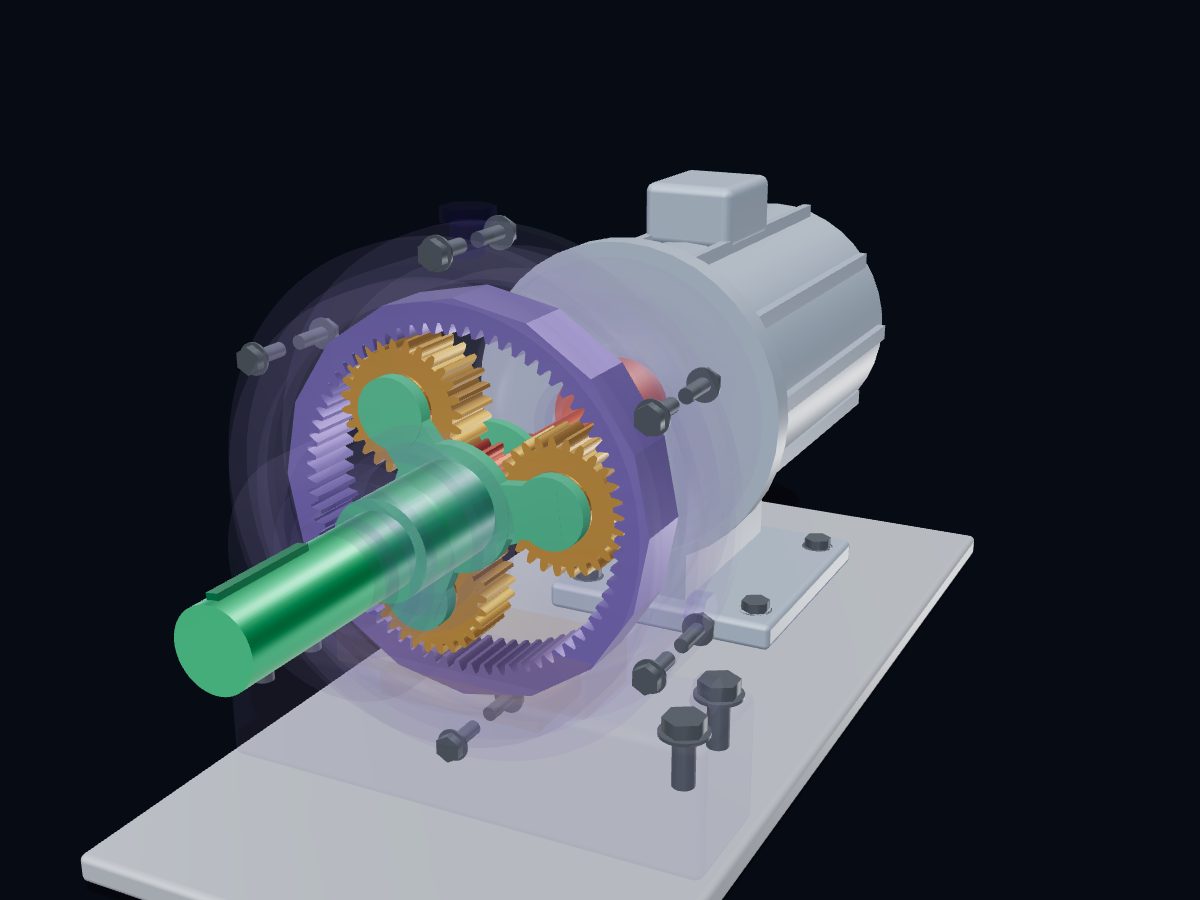
Good design often removes parts instead of adding them. By letting the booms store energy, deploy the array and then carry its load, the roll-out array replaces motors and hinges with one shaped piece of composite. The lesson for any machine, in space or in a dry dock, is that the most reliable component is the one you did not need to install. For the parts a motorised mechanism would have needed, see ball, roller and journal bearings explained and the gears inside a helical gear reducer in 3D.
 Turbocharger
 Centrifugal Pump
 V-Belt Pulley Drive
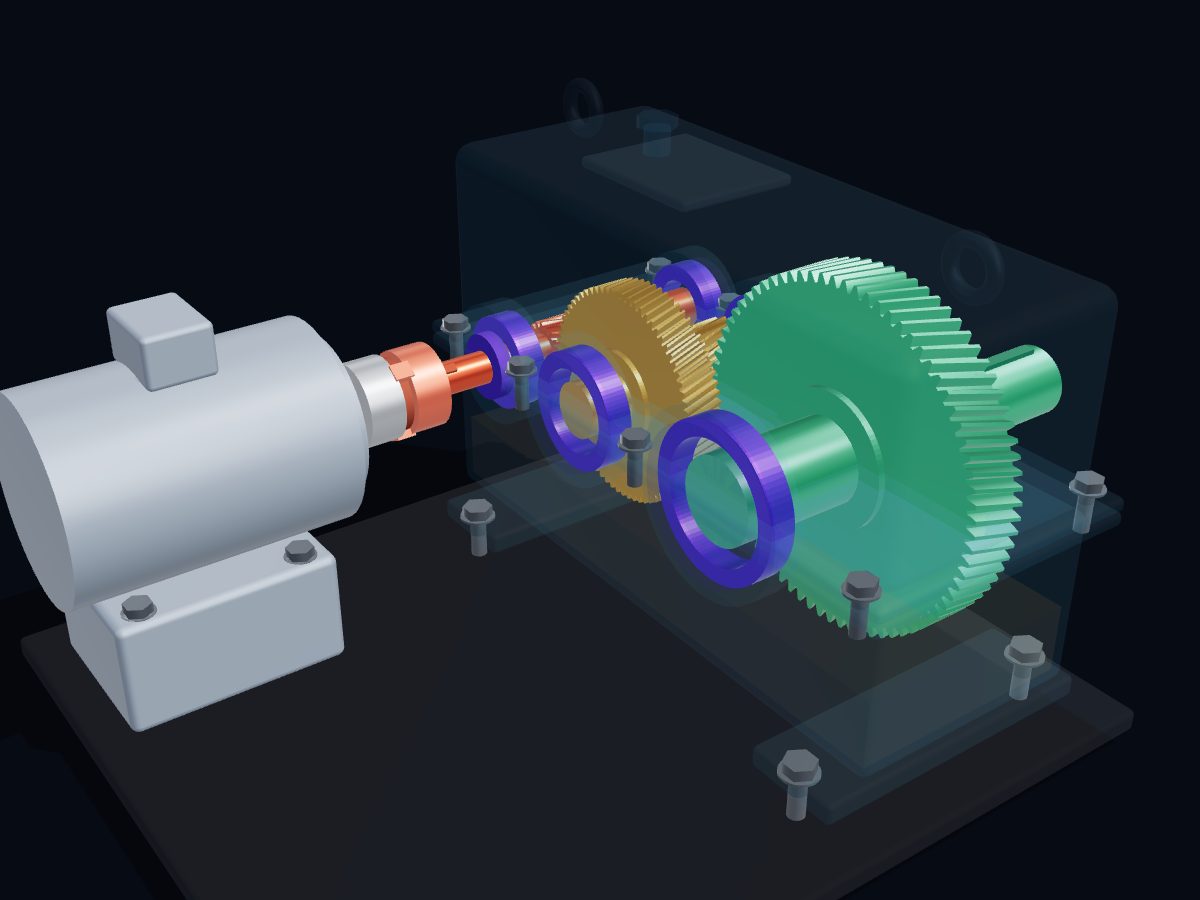 Helical Gear Reducer
 Marine Diesel Engine
 Plate Heat Exchanger
 Reciprocating Air Compressor
 Planetary Gearbox